What the digital euro pilot means for UK merchants
The ECB's digital euro merchant pilot call opened on 15 September 2026. Here's what it tests, who can join, and what it means for UK merchants and payment firms trading into the euro area.
By FinTechPulse Editorial
- Published
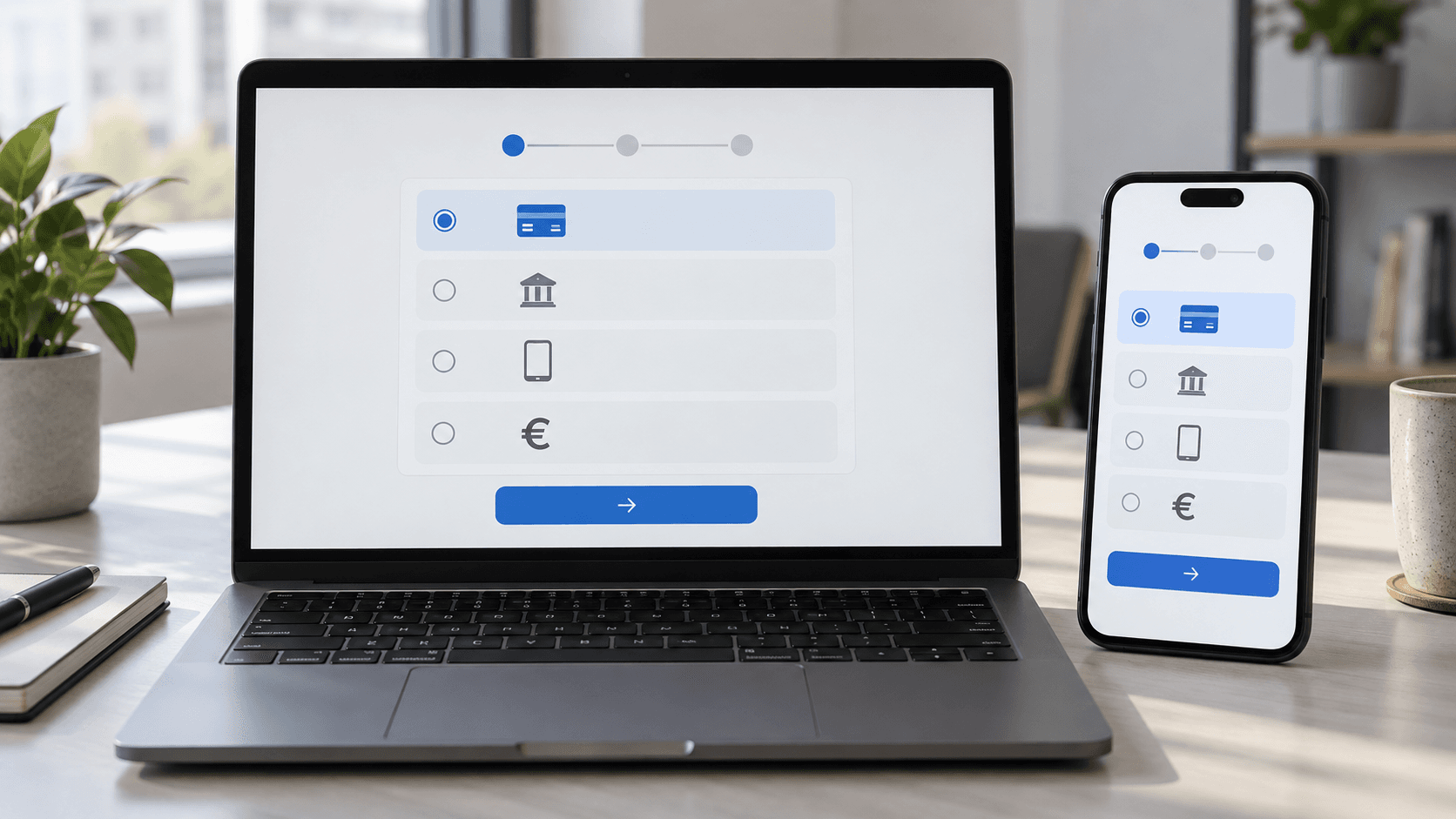
The European Central Bank (ECB) opened a call on 15 September 2026 inviting online and mobile merchants to help test a "digital euro" at checkout, with applications due by 17:00 CET on 27 October 2026. For a UK reader, the key point is what this is not: not a UK currency, not yet law, and not the final digital euro.
The call matters to two groups of UK businesses: retailers or platforms selling to euro-area customers online, and payment firms, such as acquirers, processors, wallet providers, identity or fraud vendors, and point-of-sale integrators, serving clients trading into the euro area or holding an EU-authorised arm. Neither group must act today, but the pilot is the clearest practical sign yet of how a digital euro would work at the point of sale, and where UK firms sit relative to it.
This explainer covers what the ECB is testing, who can join, how a digital euro compares with cards, deposits and cryptoassets, and what UK merchants and payment firms need to watch.
What the digital euro is, and what it isn't
The digital euro is a Eurosystem project, run by the ECB and the national central banks of the euro area. If issued, it would be retail central bank money: a direct Eurosystem liability, exchangeable one-for-one with the euro, intended to sit alongside cash and private payment methods such as cards rather than replace them.
That is the envisaged final product; it does not exist yet, and two conditions stand in the way. First, the enabling EU legislation is not yet adopted. The Commission proposed it on 28 June 2023, the Council agreed its position on 19 December 2025, and the Parliament backed its position on 9 July 2026. Trilogue talks were under way as of 21 September 2026, with the texts still differing on merchant exemptions, fee caps and access rules. Second, even once legislation passes, the ECB will decide separately whether to issue the currency, aiming for possible first issuance during 2029 if the law is adopted by the end of 2026, though readiness is not a launch decision.
The instrument being tested, which the ECB calls the "beta digital euro", falls short of that. It will not have legal-tender status. Its online form is treated as scriptural money and as funds under existing payment-services rules, not as a banknote, a coin, or an account held directly with the ECB or a national central bank. The pilot is not evidence that a digital euro has already been issued.
How the merchant pilot will work at checkout
The open call tests one use case: remote online person-to-business payments at e-commerce and mobile-commerce checkouts, distinct from the wider pilot's person-to-person and offline scenarios.
The envisaged flow at checkout: a customer selects the beta digital euro as a payment option, opens or is redirected to a payment application, verifies the merchant and payment details, authenticates and authorises the payment, and receives confirmation. Behind the screen, a distributing payment service provider handles the customer's wallet and authentication, while an acquiring payment service provider receives the payment on the merchant's side, a split of roles similar to cards today. In the pilot, the beta digital euro is treated as scriptural money and as funds under existing payment-services rules, not as central bank money. Only if a digital euro is eventually issued, following adopted legislation and a separate ECB decision, would the money itself be a Eurosystem liability rather than a commercial bank's.
Selected merchants must contract with the ECB or a national central bank and with a pilot acquiring provider, and must build a dedicated or adapted checkout showing the beta option only to pilot participants. Merchants will not be paid or reimbursed for taking part, and must bear their own integration costs; they will not, however, pay their pilot provider for the pilot payment services themselves.
The controlled pilot is planned to run for 12 months from the second half of 2027, involving the ECB, 19 national central banks, the 36 payment service providers selected on 14 July 2026 from more than 50 applicants, selected merchants, and Eurosystem staff acting as end users.
Who can join the pilot
This is where the UK boundary is sharpest: an applicant may operate outside the euro area, but the ECB's criteria require it to be legally established in the EU and to reach at least two pilot locations. A UK-only company cannot qualify directly, though a UK-headed group with a qualifying EU-established subsidiary or branch may apply through that entity.
The same logic applies to payment service providers: the proposed legislation on non-euro EU payment providers covers firms incorporated in EU member states, not the UK, so a UK payment firm cannot act as a distributing or acquiring provider in the pilot directly. It can supply software, integration or infrastructure to a participating EU-authorised provider as a technical service provider, though that provider holds the Eurosystem contract and remains responsible.
Digital euro versus cards, deposits and cryptoassets
| Instrument | Who is liable / who issues it | How value moves | Interest | Underlying technology |
|---|---|---|---|---|
| Card payment | Not applicable; a card is a payment instrument, not money in itself | Moves commercial-bank money via card networks | N/A (instrument, not a store of value) | Card scheme rails |
| Bank deposit | Commercial bank (a claim on that bank) | Bank ledger transfers | Bank-set, varies | Bank core systems |
| Digital euro (envisaged) | Eurosystem (central bank liability) | Centralised Eurosystem platform, distributed via banks and payment providers | None proposed | Centralised platform, not a public blockchain |
| Stablecoin | Private issuer, backed by its own reserves | Issuer's ledger/blockchain | Issuer-dependent | Typically distributed-ledger |
| Unbacked cryptoasset (e.g. Bitcoin, Ether) | No issuer | Public blockchain | None | Distributed ledger |
A card is a payment instrument that moves commercial-bank money; the digital euro, if issued, would be the money itself, with payment providers still supplying the wallet, authentication and acquiring. Unlike a bank deposit, it would be a claim on the Eurosystem, pay no interest, and carry a holding limit the ECB has not yet fixed (it has stress-tested hypothetical limits up to €3,000 per person, not an adopted cap), with a "waterfall" sweeping balances above the limit into a linked bank account and a "reverse waterfall" drawing from it when needed. Corporates would face a zero holding limit, so a merchant's receipts would be swept into commercial-bank money rather than accumulated.
Unlike a stablecoin, it would not depend on a private issuer's reserves; unlike Bitcoin or Ether, it would have an official issuer and a fixed one-for-one euro value, avoiding cryptoasset-style price volatility for an accepting merchant. Its architecture is centralised, not a public blockchain.
What UK merchants and payment firms may need to do
A UK-only merchant selling remotely into the euro area is neither entitled to join the pilot nor currently required to accept a digital euro; the Commission's proposal ties the prospective acceptance duty to payees established in the euro area, not remote UK sellers. That changes only where a UK group has an EU-established entity, such as a subsidiary, branch or marketplace arrangement, acting as the payee, in which case that entity's acceptance duty and any merchant-fee arrangements would depend on the final legislation and contract structure. Commercially, a UK merchant with EU sales exposure may want to understand how a digital euro could sit alongside existing card and account-to-account methods, though nothing is required now and the pilot offers no reimbursement for integration costs.
A UK-incorporated payment firm cannot hold a direct Eurosystem pilot contract as a distributing or acquiring provider; that role sits with the 36 euro-area-licensed payment service providers the ECB has already selected. A UK group can participate directly only if its EU-established entity is among those selected providers; other UK firms may instead supply the pilot as a technical service provider to a participating provider, which retains the Eurosystem contract and regulatory responsibility. For EU-facing UK acquirers, processors and point-of-sale vendors, the checkout flow signals the integration work a digital euro would eventually require: a new payment method at checkout, a redirect or in-app authentication step, and a settlement leg distinct from existing rails.
None of this is current law: as of 21 September 2026, the Commission, Council and Parliament positions still differ on merchant exemptions and fee caps, with negotiations ongoing. If enacted, an issued digital euro would carry legal-tender status in the euro area, and most euro-area merchants already accepting comparable digital payments would have to accept it too, subject to exemptions under discussion for small or micro enterprises. The Council's position also proposes merchant and interchange fee caps for a transitional period of at least five years; the ECB's own project cost estimates, around €1.3bn in development costs and €320m a year in running costs from 2029, are Eurosystem figures, not merchant fees. Access for UK-established people and businesses is not automatic: it would need specific conditions and either an EU-third-country agreement or an ECB-Bank of England arrangement, neither of which yet exists.
Not a UK currency: the digital pound is separate
The digital euro is a euro-area project with no automatic bearing on sterling or the UK payments market beyond the cross-border points above. The UK has a separate project, the digital pound. As of 4 March 2026, the Bank of England and HM Treasury said they had made no decision to introduce a digital pound and expected to publish their assessment and a decision on next steps later in 2026.
Risks and open questions
Several points that matter to a UK merchant or payment firm remain unsettled. The regulation has not been adopted, so final duties, exemptions, fee caps and deadlines could still change, and the ECB has not decided whether to issue the currency. The personal holding limit is unfixed, and refund, fraud-liability and redress rules for a final digital euro are not settled; the pilot's refund functionality sits under existing payment-services rules, not confirmation of the eventual regime. No route has yet been confirmed for UK residents or businesses to hold a digital euro directly, and the eventual cost of acceptance is not yet knowable.
What to watch next
The near-term date is 27 October 2026, 17:00 CET, when the ECB's merchant application window closes; an information session for merchants runs on 6 October 2026. Beyond that, watch the EU trilogue outcome, any agreed text on acceptance and fees, the pilot's planned start in the second half of 2027, and the ECB's progress toward a possible, unconfirmed, first issuance during 2029. UK firms with euro-area exposure should also watch the Bank of England and HM Treasury's digital-pound decision, expected later in 2026. Official detail sits with the ECB, the Commission, the Council, the Parliament and the Bank of England.
Sources
- Call for online and mobile merchants to participate in digital euro pilot now open (opens in a new tab)
European Central Bank · · Accessed
- FAQs on the digital euro pilot (opens in a new tab)
European Central Bank · · Accessed
- Digital euro pilot (opens in a new tab)
European Central Bank · Accessed
- ECB selects 36 payment service providers to join digital euro pilot (opens in a new tab)
European Central Bank · · Accessed
- FAQs on the digital euro (opens in a new tab)
European Central Bank · Accessed
- Fireside chat (opens in a new tab)
European Central Bank · · Accessed
- Frequently asked questions on the digital euro and the legal tender of cash (opens in a new tab)
European Commission · Accessed
- Proposal for a Regulation on the establishment of the digital euro (opens in a new tab)
European Commission via EUR-Lex · · Accessed
- Proposal on the provision of digital euro services by payment services providers incorporated in Member States whose currency is not the euro (opens in a new tab)
European Commission via EUR-Lex · · Accessed
- Single currency: Council agrees position on the digital euro and on strengthening the role of cash (opens in a new tab)
Council of the European Union · · Accessed
- Digital euro: MEPs ready to start negotiations (opens in a new tab)
European Parliament · · Accessed
- Progress update: Digital Pound Design Phase (opens in a new tab)
Bank of England · · Accessed