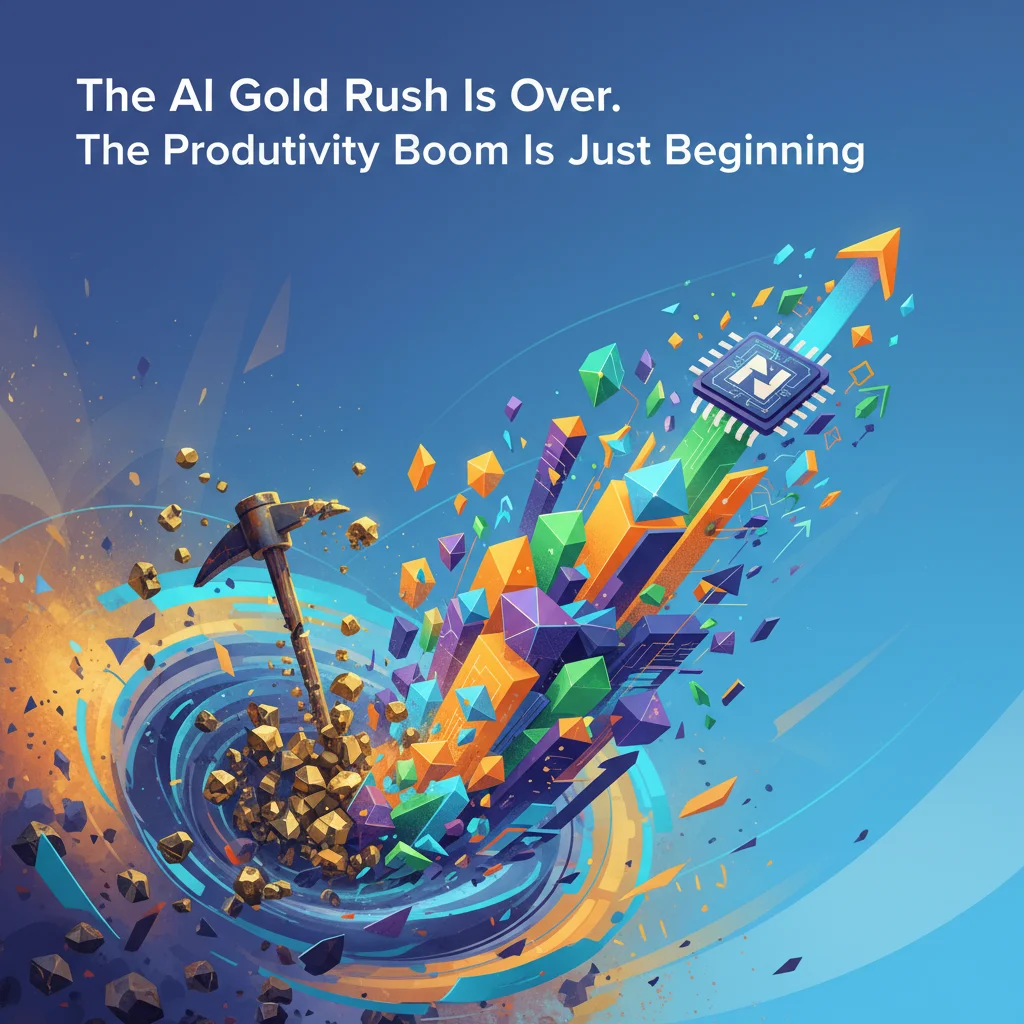
The AI Gold Rush Is Over. The Productivity Boom Is Just Beginning.
For the past few years, the story of artificial intelligence in the stock market has been a simple one. It’s been a story about picks and shovels. Companies like Nvidia, designing the GPUs that power the revolution, have seen their valuations soar into the trillions. Cloud giants like Amazon, Microsoft, and Google, who provide the massive server farms to run AI models, have become the undisputed landlords of the new digital frontier.
This was the first wave. It was tangible, understandable, and immensely profitable for early investors. It was the AI gold rush, and everyone was buying the hardware. But as the dust from this initial frenzy begins to settle, a more nuanced and potentially even more significant chapter is starting. The focus is shifting from the engine to what the engine can do.
We are entering the era of AI-driven productivity. The next generation of market leaders won’t just be the ones building the infrastructure; they will be the software companies that masterfully weave AI into their products to deliver staggering, measurable gains in efficiency and innovation. This is where AI stops being a fascinating science experiment and starts becoming a company’s most valuable employee. And for investors, developers, and entrepreneurs, understanding this shift is the key to catching the next wave.
The First Wave: Building the Digital Power Plants
Think of the early days of electricity. The first big investments weren’t in toasters and televisions; they were in building the massive power plants and the sprawling grid to carry the current. The same pattern has played out with artificial intelligence. The initial phase has been all about building the foundational infrastructure.
This “infrastructure phase” included:
- The Chips: Specialized processors (GPUs) from companies like Nvidia became the essential building blocks for training and running large language models (LLMs).
- The Cloud: Hyperscalers like AWS, Azure, and Google Cloud invested billions in data centers, making immense computational power accessible to startups and enterprises alike via their cloud platforms.
- The Foundational Models: Companies like OpenAI, Anthropic, and Google developed the core LLMs that serve as the “brains” for a vast array of applications.
This was a necessary, capital-intensive period. It laid the groundwork. But owning a power plant is only valuable if people have things to plug into it. The long-term value of electricity wasn’t just in its generation, but in the countless appliances and industries it enabled. Similarly, the long-term value of AI isn’t just in the models, but in the specific, problem-solving applications it powers.
The Code Behind the Stream: Why Big Money and AI Will Own the Future of Media
The Second Wave: From Raw Power to Tangible ROI
We’re now moving into the application layer, where the abstract power of AI is being transformed into concrete business value. The new winners will be the software companies—both established giants and nimble startups—that can answer a simple question from their customers: “How will your AI make my business run better, faster, and smarter?”
The focus is shifting from “what AI can do” to “what AI can do for me.” This is the world of AI-native Software-as-a-Service (SaaS), intelligent automation, and hyper-personalized digital experiences. It’s less about the novelty of a chatbot and more about a system that automates 70% of customer service inquiries, freeing up human agents to handle the most complex issues.
Consider a few real-world examples of this shift in action:
- Enterprise Automation: A company like ServiceNow is a prime example. They are using AI to automate IT help desks, with the goal of resolving common employee tech issues instantly without human intervention. The value proposition is crystal clear: reduced support costs, less downtime for employees, and a more efficient IT department.
- Programming & Software Development: Microsoft’s GitHub Copilot is fundamentally changing how developers work. It’s not just an autocomplete tool; it’s an AI pair programmer that suggests entire blocks of code, helps debug, and accelerates the development lifecycle. The productivity gain here is directly measurable in project timelines and developer output.
- Cybersecurity: In a world of ever-more-sophisticated threats, human analysts can’t keep up. AI-powered cybersecurity platforms can analyze billions of data points in real-time to detect anomalies and neutralize threats before they cause damage. According to the original Financial Times analysis, this is a key area where AI’s defensive capabilities provide an obvious and compelling return on investment.
The common thread here is a move from possibility to profitability. The question is no longer “Can an AI do this?” but “What is the dollar value of an AI doing this?”
The Challenge: Making Productivity Visible
One of the biggest hurdles in this new phase is measurement. While the cost of AI infrastructure is easy to see on a cloud bill, the productivity gains can be more elusive. How do you quantify the value of a marketing email that’s 10% more persuasive, or a developer who can now build a feature in three days instead of five?
This is where the most innovative companies will distinguish themselves. They will build dashboards and analytics that translate AI’s impact into the language of business: dollars saved, hours reclaimed, and revenue generated. The focus is shifting from old-world metrics to new, AI-centric key performance indicators (KPIs).
Here’s a look at how performance metrics are evolving in the age of AI:
| Traditional Business Area | Old-World Metric | New AI-Driven Metric |
|---|---|---|
| IT Support | Average Handle Time (AHT) | Automated Resolution Rate (%) |
| Software Development | Lines of Code Written | Mean Time to Deploy (MTTD) |
| Customer Service | Number of Tickets Closed | First-Contact Resolution (FCR) via AI |
| Sales & Marketing | Lead Conversion Rate | AI-Qualified Lead (AQL) to Close Ratio |
| Cybersecurity | Number of Alerts Investigated | Mean Time to Detect & Respond (MTTD/R) |
The companies that can successfully define, track, and report on these new metrics will be the ones that earn the trust of the market. They will be able to prove, not just promise, their value.
Where to Find the Next AI Winners
So, if the future isn’t just about the chipmakers, where should we be looking? The innovation is happening across the software stack, particularly in areas where complex workflows and large datasets create opportunities for automation and intelligence.
The article points to the “AI 100” list from CB Insights, a curated group of the most promising private AI startups, as a good indicator of where venture capital is placing its bets. Many of these companies aren’t building foundational models; they’re building highly specialized, vertical-specific solutions.
Here are the key domains poised for an AI-driven productivity boom:
| Sector | How AI is Creating Value | Example Concepts |
|---|---|---|
| Vertical SaaS | Building industry-specific AI tools for law, healthcare, finance, and manufacturing that understand unique jargon, workflows, and regulations. | AI for legal contract review, AI-powered diagnostic imaging analysis, algorithmic trading platforms. |
| Enterprise Software (Horizontal) | Embedding generative AI assistants and automation into existing CRM, ERP, and HR platforms that are already central to business operations. | Salesforce Einstein, Microsoft 365 Copilot, ServiceNow’s generative AI features. |
| Cybersecurity | Using machine learning to predict, detect, and respond to cyber threats in real-time, moving from a reactive to a predictive security posture. | AI-driven network monitoring, automated threat hunting, behavioral analysis to spot insider threats. |
| Developer Tools | Accelerating every stage of the software development lifecycle, from coding and debugging to testing and deployment. | GitHub Copilot, AI-powered code review tools, automated test case generation. |
The big takeaway is the shift from general-purpose AI to job-specific AI. The value lies in applying the immense power of machine learning to solve a very particular, and often very expensive, business problem.
Your Playbook for the Productivity Era
This shift has profound implications for everyone in the tech ecosystem. Here’s how you can adapt:
For Entrepreneurs & Startups: Stop selling “AI.” Start selling “automated compliance,” “accelerated drug discovery,” or “a 50% reduction in customer churn.” Your pitch must be laser-focused on the productivity gain and the business outcome. Be prepared to back it up with data. The most successful new startups will be those that can demonstrate a clear, quantifiable ROI from day one.
For Developers & Tech Professionals: Your value is no longer just in your programming skills, but in your ability to be an “AI translator.” Can you take a powerful tool like the GPT-4 API and apply it to solve a specific business workflow? Skills in prompt engineering, AI ethics, and integrating AI services into existing software stacks are becoming more valuable than ever.
For Investors: Look past the headlines about new model releases. Dig into the financials of software companies and ask critical questions. Is their AI integration driving user growth? Is it allowing them to charge a premium? Can they demonstrate lower customer churn because their product is now indispensable? The winners will be the companies where AI is not just a feature but a core driver of their business model.
Beyond the Magnificent Seven: Why the AI Revolution is Spreading to the Rest of the Economy
Conclusion: The Real Work Begins Now
The initial AI hype cycle, fueled by the spectacle of generative AI and the rocketing stocks of infrastructure players, was exhilarating. But it was just the prelude. We are now entering a more mature, more meaningful, and ultimately more valuable phase of the AI revolution.
The coming years will be defined by the quiet, relentless integration of artificial intelligence into the software that powers our global economy. The biggest winners won’t be the companies that talk about AI the loudest, but those that use it to create undeniable, measurable productivity gains for their customers. The gold rush is over. The era of building enduring, AI-powered enterprises has just begun.

Related Posts
The AI Bubble Warning: Why Google DeepMind’s Chief Thinks We’re Flying Too Close to the Sun

The Cloud Wars Get a New Titan: Is ByteDance’s AI Gamble a Threat to Alibaba?
