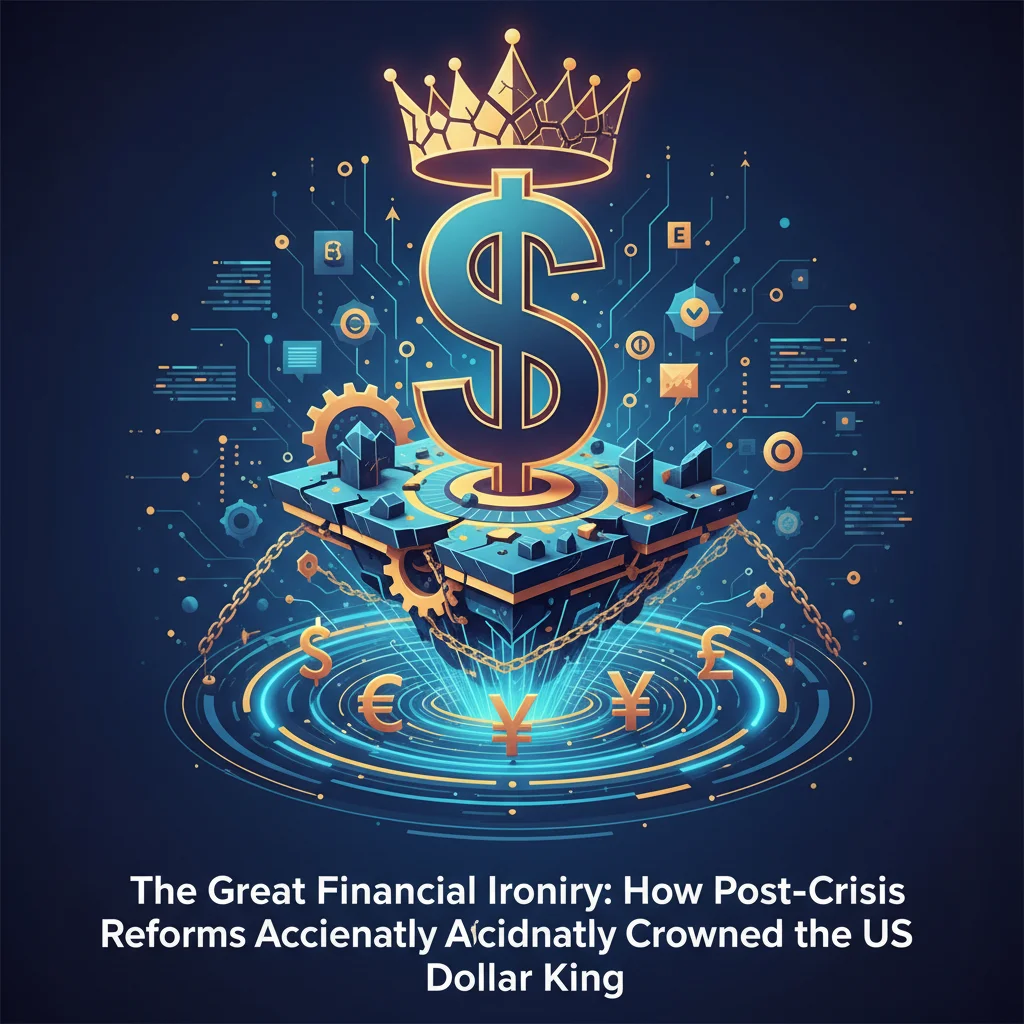
The Great Financial Irony: How Post-Crisis Reforms Accidentally Crowned the US Dollar King
The Paradox of Global Financial Regulation
In the world of international finance, words from figures like Mark Carney—former Governor of the Bank of England and the Bank of Canada—carry immense weight. So when he refers to the US dollar’s overwhelming dominance in the global economy as that of a “hegemon,” the market listens. It’s a critique that resonates with many nations wary of America’s financial influence. But what if the very architecture designed to prevent another global meltdown, an architecture Mr. Carney himself helped build, is the primary reason for the dollar’s unshakeable reign?
This is the compelling irony highlighted by J. Christopher Giancarlo, the former Chairman of the US Commodity Futures Trading Commission (CFTC). In a sharp analysis, Giancarlo points to a classic case of unintended consequences. The global quest for financial stability after the 2008 crisis, led by the G20, set in motion a series of reforms that, instead of diversifying power, concentrated it, cementing the US dollar’s position at the heart of the system. This isn’t just a story about currency; it’s a deep dive into the plumbing of global finance, where the rules of the game have shaped a reality far different from what was intended.
Rewinding to 2008: The Vow to Tame the Derivatives Market
To understand this irony, we must return to the ashes of the 2008 financial crisis. A key villain in that story was the vast, opaque, and unregulated market for over-the-counter (OTC) derivatives. These complex financial instruments, such as credit default swaps, were traded privately between large institutions, creating a tangled web of counterparty risk. When one institution, like Lehman Brothers, failed, the domino effect threatened to bring down the entire global banking system because no one was sure who owed what to whom.
In response, leaders of the G20 nations gathered in Pittsburgh in 2009 and made a solemn promise: this would never happen again. They agreed on a sweeping reform agenda, with a central mandate that standardized OTC derivatives must be cleared through central counterparties (CCPs), also known as clearing houses. The goal, as stated in their official communiqué, was to “improve transparency in the derivatives markets, mitigate systemic risk, and protect against market abuse.”
In theory, the logic was sound. A CCP acts as a middleman for trades, becoming the buyer to every seller and the seller to every buyer. This process, known as central clearing, prevents the failure of a single firm from cascading through the market. By forcing trades into the open and through these robust intermediaries, regulators hoped to de-risk the global financial system. The intention was to create a safer, more resilient network. The outcome, however, had a powerful side effect.
Decoding the Market: Financial Lessons Hidden in the FT Crossword
The Unintended Consequence: A Funnel into the US Financial System
The G20 mandate triggered a massive migration of the multi-trillion dollar derivatives trading market. Trillions of dollars in trades that were once bilateral were now forced through a handful of major clearing houses. This led to an immense consolidation of activity and risk into a few entities deemed “systemically important.”
Herein lies the core of Giancarlo’s argument. The largest and most significant of these clearing houses are predominantly located in the United States and denominate their trades and collateral in US dollars. Giants like the CME Group in Chicago and ICE Clear in the US became the indispensable plumbing for a vast portion of global derivatives trading, particularly for crucial instruments like interest rate swaps.
The sheer scale of this concentration is staggering. The global OTC derivatives market is enormous, with the Bank for International Settlements (BIS) reporting the total notional amount outstanding at $715 trillion as of mid-2023. A huge portion of this market is now centrally cleared, and US-based CCPs are the dominant players.
To illustrate this dominance, consider the concentration in interest rate derivatives, one of the largest segments of the market:
| Clearing House (CCP) | Primary Location | Primary Currency of Cleared Products | Significance in Global Markets |
|---|---|---|---|
| LCH (part of London Stock Exchange Group) | United Kingdom | Multiple (incl. EUR, GBP, USD) | The largest clearer of interest rate swaps, but with significant USD volume. |
| CME Group | United States | US Dollar (USD) | Dominant clearer for a wide range of futures and a major player in USD interest rate swaps. |
| ICE Clear | United States | US Dollar (USD) | Key clearer for credit default swaps (CDS) and energy derivatives, largely USD-based. |
| Eurex Clearing | Germany | Euro (EUR) | The primary CCP for Euro-denominated derivatives, but smaller in scale compared to USD markets. |
While London’s LCH remains a critical hub, the post-crisis regulatory push created an ecosystem where global banks, corporations, and investors—regardless of their home country—had to connect to US financial infrastructure and transact in US dollars to participate in essential markets. This wasn’t a hostile takeover; it was the quiet, structural outcome of a global safety initiative.
How Central Clearing Supercharged Dollar Dominance
The practical implications of this shift are profound. To trade in these critical markets, international firms need access to US dollars—not just for the trades themselves, but also for posting collateral. Clearing houses require high-quality liquid assets as margin to backstop their positions, and the asset of choice is overwhelmingly US Treasury bonds.
This creates a powerful, self-reinforcing loop for the dollar’s hegemony:
- Global players must trade derivatives (like interest rate swaps) to hedge their financial risk.
- Post-2008 regulations push this trading onto US-domiciled, dollar-based clearing houses.
- To participate, these players must hold US dollars and post US Treasury bonds as collateral.
- This creates constant, structural demand for US dollars and US government debt, keeping US borrowing costs low and reinforcing the dollar’s status as the world’s primary reserve currency.
This dynamic grants the United States immense economic and geopolitical leverage. It enhances the global reach of the Federal Reserve’s monetary policy and the US Treasury’s regulatory power. When Mark Carney laments the dollar “hegemon,” he is decrying a system that the global regulatory community, with the best of intentions, helped to fortify.
The Brussels Gambit: Has the EU Folded Its Winning Hand in Global Finance?
The Future of Global Finance: Is There an Alternative?
The recognition of this unintended outcome has fueled a search for alternatives. Mr. Carney himself has proposed the idea of a “synthetic hegemonic currency,” a digital currency backed by a basket of G20 currencies, to reduce reliance on the dollar. Others see the rise of Central Bank Digital Currencies (CBDCs) as a potential pathway for other economic blocs, like China or the Eurozone, to build their own parallel financial ecosystems.
The world of fintech offers another potential route. The principles of decentralization, powered by blockchain technology, aim to create financial systems that don’t rely on powerful central intermediaries. While still a nascent and volatile field, the underlying goal is to distribute risk and access, breaking free from the concentrated power structures that define today’s financial landscape.
However, challenging the dollar’s incumbency is a monumental task. The network effects, liquidity, and trust built into the dollar-based system are deeply entrenched. Any alternative would need to offer superior efficiency, security, and stability on a global scale—a challenge that, for now, remains unmet.
Conclusion: An Enduring Irony at the Heart of the Economy
The story of post-crisis reform is a powerful lesson in the law of unintended consequences. In the effort to build a safer global financial system, regulators from around the world inadvertently handed the keys to the kingdom to US-based, dollar-denominated infrastructure. As J. Christopher Giancarlo points out, the irony is that an international effort to disperse risk ended up concentrating power.
Today, as business leaders, investors, and policymakers navigate the complexities of the global stock market and broader economy, they are operating within a framework shaped by this paradox. The debate over the dollar’s future is not merely an academic exercise in economics; it is a fundamental question about the architecture of global power and the future of international commerce. The regulations born from the last crisis have defined the present, and the next wave of financial technology and geopolitical shifts will determine what comes next.
Greenland's Ice Is Melting, Revealing a Trillion-Dollar Geopolitical Prize

Related Posts
Beyond the Headlines: 3 Financial Crises Shaping the Future of Business
Global Crosscurrents: Navigating Political Risk, Market Volatility, and the Long Arm of Finance