Trump’s 100% Tariff Threat on Canada: A Geopolitical Gambit with Deep Economic Consequences
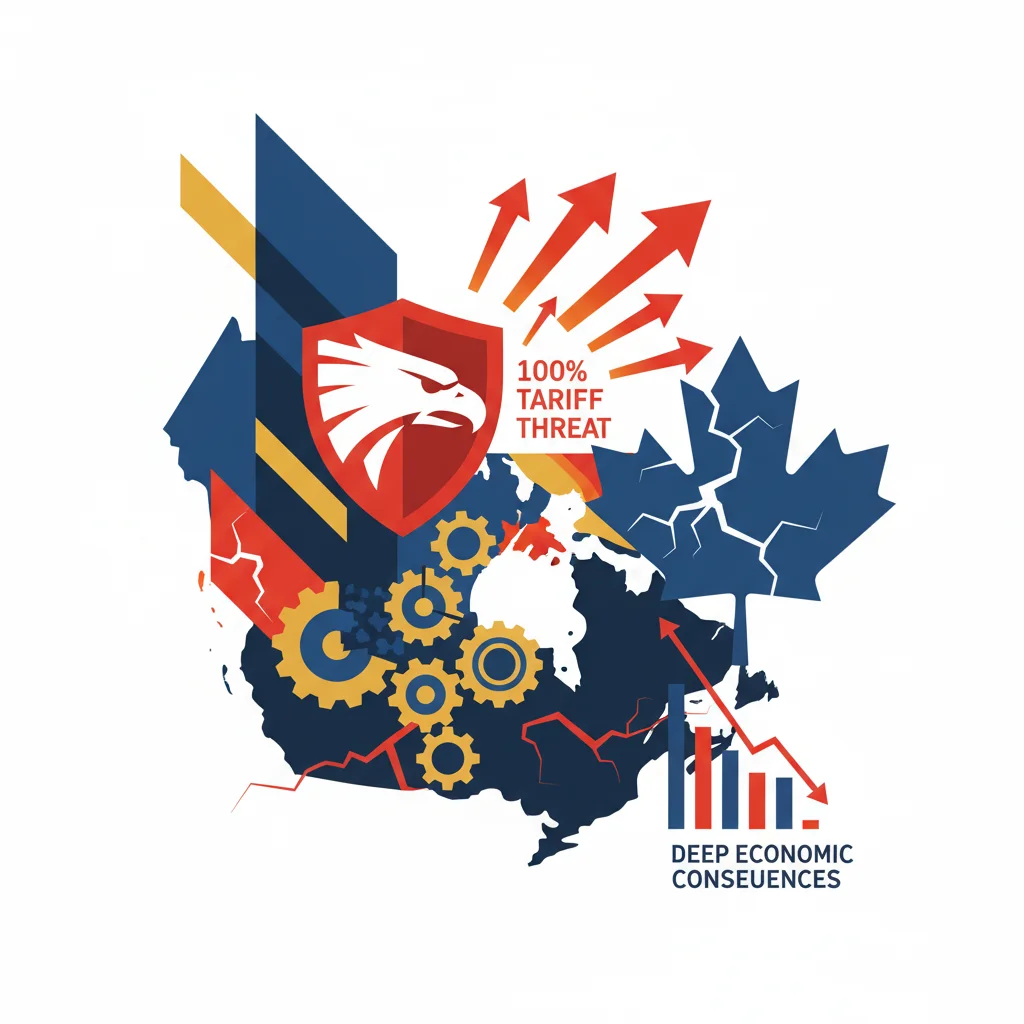
In a move that sent ripples through the worlds of international finance and politics, former U.S. President Donald Trump recently issued a stark warning to one of America’s closest allies. He threatened to impose a staggering 100% tariff on Canadian goods if the nation deepens its economic ties with China. This declaration, reported by the BBC, signals a potential return to the turbulent trade policies of his first term and raises critical questions for investors, business leaders, and the future of the North American economy.
While the initial report mentioned escalating tensions with “Canadian Prime Minister Mark Carney,” the current head of government is, of course, Justin Trudeau. This detail, however, does little to soften the blow of the statement itself. The threat is not merely a negotiating tactic; it’s a potential economic bombshell aimed at the heart of a deeply integrated trade relationship. This blog post will unpack the layers of this threat, exploring its historical context, the severe economic implications, its impact on the stock market and investing strategies, and the complex geopolitical chess match being played out between the U.S., Canada, and China.
Deconstructing the Threat: What a 100% Tariff Actually Means
To understand the gravity of this situation, it’s crucial to grasp what a tariff is and why a 100% rate is so significant. A tariff is a tax imposed by one country on the goods and services imported from another country. While smaller tariffs (e.g., 5-25%) are often used to protect domestic industries or as leverage in trade negotiations, a 100% tariff is a tool of economic warfare. It effectively doubles the price of an imported product overnight, making it completely uncompetitive in the destination market.
The U.S. and Canada share one of the world’s largest and most comprehensive trading relationships. In 2023, the total two-way trade in goods and services was nearly $900 billion. This isn’t just about finished products on shelves; it’s about deeply intertwined supply chains. Parts for a single car, for instance, might cross the U.S.-Canada border multiple times during the manufacturing process. A 100% tariff would shatter these supply chains, leading to production halts, factory closures, and significant job losses on both sides of theborder.
The impact would be felt across numerous sectors of the economy, disrupting everything from agriculture and energy to advanced manufacturing. The intricate dance of modern trading and economics would grind to a halt, forcing a painful and costly restructuring of the entire North American industrial base.
The Price of a Turnaround: Inside Rolls-Royce's Multimillion-Pound CEO Pay Plan
A Flashback to Previous Trade Wars and the USMCA
This aggressive rhetoric is not without precedent. During his presidency, Trump initiated a series of trade disputes, most notably imposing tariffs on steel and aluminum, which also targeted Canada. Those actions were justified on national security grounds but were widely seen as a protectionist measure. The result was a period of intense negotiation and retaliatory tariffs from Canada, which ultimately led to the replacement of the North American Free Trade Agreement (NAFTA) with the United States-Mexico-Canada Agreement (USMCA).
The USMCA, which went into effect in 2020, was designed to modernize the trade relationship. However, analysis from institutions like the Peterson Institute for International Economics suggests that Trump’s previous tariff policies often led to higher costs for American consumers and businesses without necessarily achieving their stated goals of reshoring jobs. This history provides a crucial lesson: trade wars are costly, unpredictable, and their consequences often ripple through the economy in unintended ways, affecting everything from consumer prices to the stability of the banking sector.
To illustrate the scale of the trade relationship at stake, consider the top categories of goods exchanged between the two nations.
| Category | U.S. Exports to Canada | U.S. Imports from Canada |
|---|---|---|
| Vehicles | $63.6 billion | $76.1 billion |
| Mineral Fuels (Oil, Gas) | $40.9 billion | $117.0 billion |
| Machinery | $50.0 billion | $31.0 billion |
| Plastics | $17.8 billion | $13.9 billion |
| Agricultural Products | $27.9 billion | $33.3 billion |
| Data Source: U.S. Census Bureau | ||
The Geopolitical Chessboard: Forcing a Choice Between the U.S. and China
At its core, Trump’s threat is a move in the great power competition between the United States and China. He is effectively telling Canada that it cannot maintain a neutral economic stance. By threatening to sever Canada’s primary trade artery, he is attempting to force Ottawa into the U.S. camp in the ongoing economic decoupling from Beijing. This puts Canada in an incredibly difficult position. While the U.S. is its indispensable partner, China is the world’s second-largest economy and a critical market for many Canadian resources.
This ultimatum reflects a broader shift in American foreign policy, prioritizing geopolitical alignment over pure free-market economics. The strategy, sometimes called “friend-shoring,” aims to build resilient supply chains among allied nations while isolating strategic rivals. For investors, this means that a company’s geopolitical risk profile is becoming just as important as its balance sheet. Understanding a firm’s exposure to specific countries—not just as markets, but as integral parts of their supply chain—is now a fundamental aspect of modern investing analysis.
The Price of Protection: How Trump's Transactional Foreign Policy is Reshaping the Global Economy
Navigating the Volatility: Investment and Stock Market Implications
The mere suggestion of such a radical policy is enough to inject significant volatility into the stock market. Should the threat gain credibility, the impact would be swift and severe.
- Sector-Specific Carnage: The automotive sector (e.g., Ford, GM, Magna International), the energy sector (Canadian oil sands producers), and agriculture would be hit hardest. Any company with a highly integrated North American supply chain would see its stock price plummet as investors priced in massive operational disruptions.
- Inflationary Shock: Tariffs are a direct tax on consumers and businesses. A 100% tariff would cause a massive inflationary shock, as the cost of a wide range of goods would skyrocket. This would complicate the work of central banks like the Federal Reserve and the Bank of Canada, potentially forcing them to maintain higher interest rates, which would further dampen the economy.
- Flight to Safety: In such a scenario, capital would likely flow out of equities and into safe-haven assets like U.S. Treasury bonds and the U.S. dollar, despite the U.S. being the source of the instability. This is a common pattern in global finance during periods of high uncertainty.
For those involved in trading and investing, the key is not to panic but to prepare. This involves stress-testing portfolios for geopolitical shocks, diversifying across asset classes and geographies, and potentially using options or other derivatives to hedge against downside risk. Understanding the macroeconomic landscape and the principles of international economics is no longer optional for serious investors.
The Greenland Gambit: Trump's Tariff Threat Ignites a New Era of Geopolitical Economics
Conclusion: Preparing for an Unpredictable Future
Donald Trump’s threat to impose 100% tariffs on Canada is more than just campaign rhetoric; it is a clear signal of a potential future where trade policy is wielded as a geopolitical weapon. While the execution of such a policy would be catastrophic for the North American economy, the threat alone creates a cloud of uncertainty that can chill investment and disrupt business planning.
For professionals in finance, leaders in business, and individual investors, the message is clear: the intersection of politics and economics is now a dominant force in the market. Building resilient businesses, diversifying investment portfolios, and staying informed on geopolitical developments are the essential strategies for navigating an increasingly turbulent and unpredictable global landscape. The stability of the post-war trading order can no longer be taken for granted, and the ability to adapt to this new reality will separate the winners from the losers in the years to come.