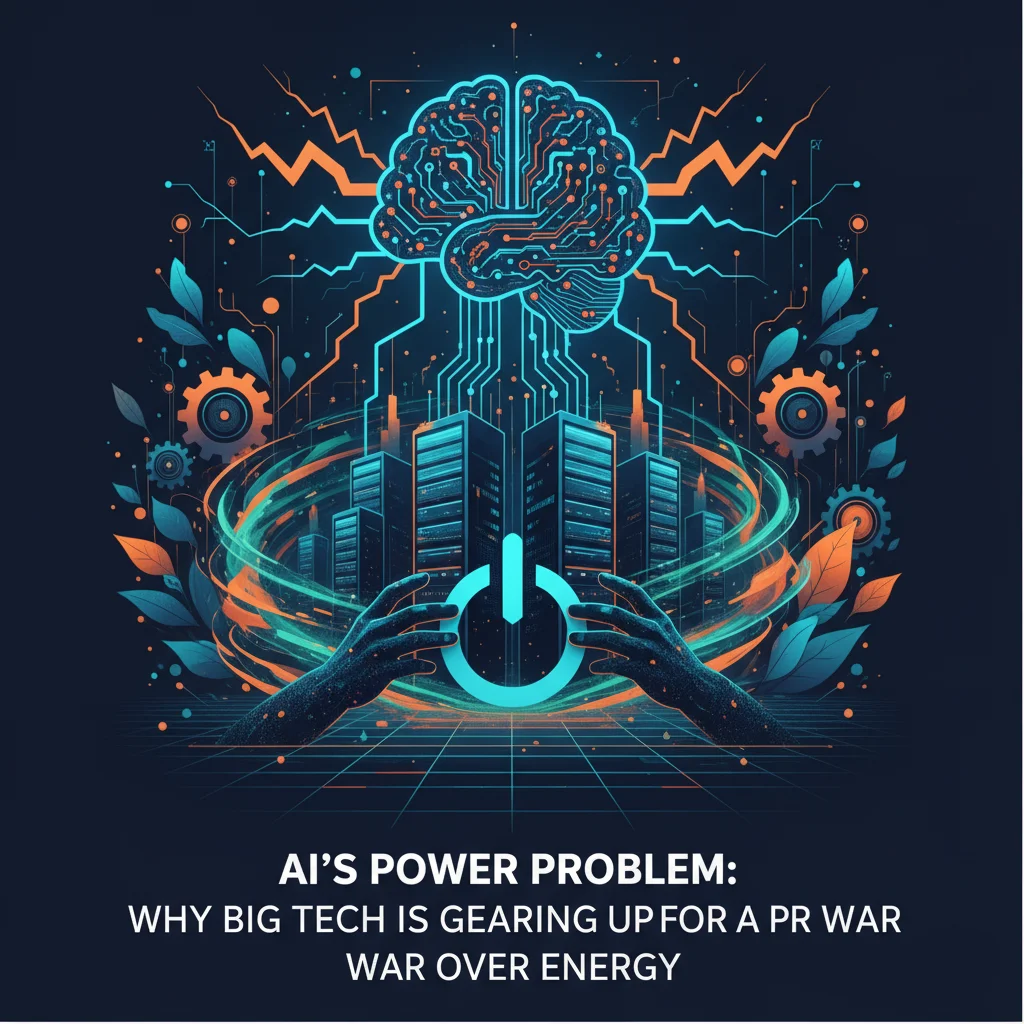
AI’s Power Problem: Why Big Tech is Gearing Up for a PR War Over Energy
We’re living in the golden age of artificial intelligence. With a few keystrokes, we can generate stunning art, write complex code, and get answers to questions we haven’t even fully formed. This explosion in AI capability, powering everything from a new wave of SaaS products to groundbreaking scientific research, feels like magic. But behind the curtain, the wizards of Silicon Valley are getting nervous. The magic has a massive, hidden cost: an insatiable appetite for energy.
The sleek, digital world of AI and machine learning lives in a very physical, very power-hungry place: the data center. These sprawling, windowless buildings are the engines of the modern internet, and the AI revolution is pushing them—and our power grids—to the breaking point. Now, as public awareness and opposition grow, the data center industry is preparing for a fight. Not a fight with code or algorithms, but a battle for hearts and minds, backed by a massive lobbying and advertising blitz designed to counter a growing energy backlash (source).
This isn’t just a corporate squabble. It’s a fundamental conflict that will define the next decade of tech innovation. Can we fuel the future without draining the present? Let’s break down the power struggle brewing behind your favorite AI tools.
The Unseen Engine: Why AI Drinks Energy Like Water
First, what exactly is a data center? Think of it as the physical brain of the cloud. It’s a secure facility packed with tens of thousands of computer servers, storage systems, and networking gear. Every time you use a cloud-based app, stream a movie, or run a query on an AI model, you’re sending a request to one of these buildings somewhere in the world.
For decades, data centers have been the quiet workhorses of the digital age. But the rise of generative AI has changed the game entirely. Here’s why:
- Computational Intensity: Traditional computing tasks, like hosting a website, are relatively straightforward. But training a large language model (LLM) like GPT-4 involves processing trillions of data points simultaneously. This requires specialized, high-powered processors (GPUs) that run in parallel, consuming exponentially more electricity than the standard CPUs that power most traditional servers.
- Constant Operation: AI models aren’t just trained once; they are constantly being fine-tuned and are “in-service” 24/7 to answer user queries (a process called inference). This creates a constant, high-energy demand that never lets up.
- The Cooling Problem: All those processors generate an immense amount of heat. To prevent them from melting, data centers require colossal cooling systems—essentially industrial-scale air conditioners and water-chilling plants. In some cases, cooling can account for up to 40% of a data center’s total energy consumption.
The scale is staggering. A single large-scale AI data center can consume as much electricity as 800,000 U.S. homes according to some estimates. As the AI arms race heats up, the demand for these “AI factories” is exploding, and local communities are starting to notice.
My AI Coach Made Me Run in Circles: What a Marathon Taught Me About Trusting Algorithms
The Backlash Is Real, and It’s in Your Backyard
For years, attracting a data center was a major win for a local community, promising jobs and tax revenue. But the sheer scale of AI-focused facilities has flipped the script. Residents and local governments are now pushing back, worried about the immense strain these projects place on public resources.
In places like “Data Center Alley” in Northern Virginia, the world’s largest concentration of data centers, utilities are struggling to keep up with power demands. In Arizona, communities are raising alarms about the vast quantities of water needed for cooling in an already drought-stricken state. The opposition isn’t just about environmental concerns; it’s about basic infrastructure. When a handful of new buildings threaten to destabilize a regional power grid or deplete water reserves, people start asking hard questions.
This local resistance is creating a major headache for the tech industry. It delays projects, drives up costs, and, most importantly, creates a negative public narrative. And that’s why the industry is shifting from building servers to building a new public image.
The Industry’s PR Playbook: Winning Hearts, Minds, and Power Grids
Faced with this growing opposition, industry groups like the Data Center Coalition are launching a coordinated effort to reshape the conversation. According to the Financial Times, companies are set to “increase advertising spending this year” to defuse public opposition in a major lobbying push. Their goal is to frame data centers not as energy hogs, but as essential public infrastructure—as vital as roads, hospitals, and the internet itself.
Here’s a breakdown of the likely arguments we’ll see and the context behind them:
| The Industry’s Argument | The Underlying Reality | What This Means for Tech Professionals |
|---|---|---|
| “We Power Progress and Innovation” The message: AI is curing diseases, fighting climate change, and creating economic opportunity. Data centers are the engine of that progress. |
While true, the vast majority of current AI computation is used for commercial applications like ad targeting, content recommendation, and enterprise automation. | Be prepared to connect your work, whether in SaaS or enterprise software, to a larger, positive societal narrative. Your company’s ESG (Environmental, Social, and Governance) report is about to become a lot more important. |
| “We Are Committed to Sustainability” The message: We are investing heavily in renewable energy and building more efficient facilities. |
Many tech giants have made impressive strides with Power Purchase Agreements (PPAs) for renewables. However, the 24/7 nature of data centers means they still rely on the grid (often fossil-fuel-powered) when the sun isn’t shining or the wind isn’t blowing. | Skills in energy-efficient programming and green computing are becoming highly valuable. Optimizing code to reduce CPU cycles is no longer just about performance; it’s about sustainability. |
| “We Are Economic Engines” The message: We bring high-tech jobs and significant tax revenue to local communities. |
Data centers are highly automated and create relatively few long-term jobs compared to their massive physical and energy footprint. The primary economic benefit is often the tax revenue. | For startups and entrepreneurs, this creates an opportunity. The industry needs solutions for local community engagement, energy efficiency, and demonstrating value beyond tax dollars. |
This PR campaign is a defensive maneuver, but it’s also a necessary one for an industry that needs to keep expanding to meet the voracious demand for AI services. The success of countless startups and the future of cloud computing depend on their ability to secure the physical space and power to operate.
The EU's Digital Wall: Why Brussels Is Moving to Ban Huawei and ZTE from Critical Infrastructure
Beyond the Spin: The Search for a Truly Sustainable AI
While the lobbying and advertising campaigns play out, a more important battle is being fought in research labs and engineering departments. The long-term solution to AI’s energy problem won’t be a better slogan; it will be better technology. This is where real, lasting innovation will happen.
Several key areas are emerging:
- Hardware and Chip Efficiency: Companies like NVIDIA, Intel, and a host of startups are in a race to design more energy-efficient processors (GPUs, TPUs, and neuromorphic chips) that can perform more calculations per watt of energy.
- Advanced Cooling Solutions: The days of simply blasting cold air are numbered. Liquid cooling, where servers are directly immersed in or cooled by non-conductive fluids, is far more efficient and is becoming the new standard for high-density AI racks.
- Smarter Software and Algorithms: This is a critical area where developers and programmers can make a huge impact. Techniques like model quantization (shrinking AI models), algorithmic optimization, and more efficient programming can drastically reduce the computational load required for a given task, directly saving energy.
- Intelligent Location Strategy: Instead of building in power-constrained areas, companies are exploring locations with abundant renewable energy (like Iceland’s geothermal or Scandinavia’s hydropower) and cooler climates that reduce cooling costs. This also involves better integration with local power grids to help balance load.
- Next-Generation Power: Some are even looking at co-locating data centers with small modular nuclear reactors (SMRs) to provide a constant, carbon-free source of baseload power, a move that would completely change the energy equation.
These solutions require a multi-disciplinary approach, combining hardware engineering, software development, energy policy, and even urban planning. It represents a massive opportunity for tech professionals, entrepreneurs, and investors to build the foundational technologies for a more sustainable digital future.
OpenAI's Big Gamble: Why Ads in ChatGPT Signal a New Era for AI
The Future is Powerful, But It Needs a Conscience
The conflict between AI’s boundless potential and its very finite resource constraints is here to stay. The industry’s lobbying effort is a clear sign that the era of building massive data centers without public scrutiny is over.
For developers, entrepreneurs, and tech leaders, this isn’t just background noise. It’s a direct challenge. The most valuable innovations of the coming decade might not be the next viral AI application, but the breakthroughs in hardware, software, and energy systems that allow AI to scale responsibly. The race is on, not just to build the most intelligent machine, but to build one that doesn’t cost the Earth.