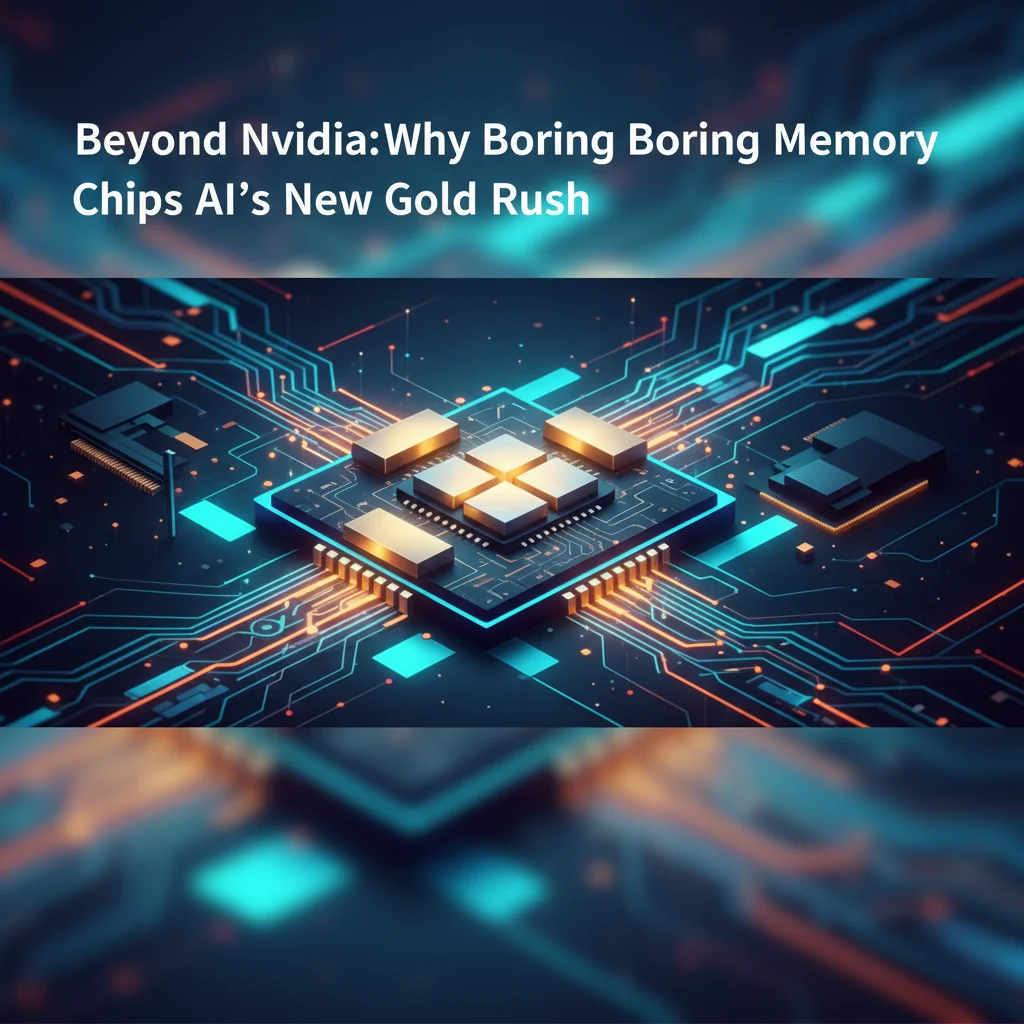
Beyond Nvidia: Why Boring Memory Chips Are AI’s New Gold Rush
For the past two years, the story of artificial intelligence hardware has been a one-act play starring Nvidia. Its powerful GPUs became the undisputed picks and shovels of the generative AI gold rush, and its stock price soared into the stratosphere. Investors, developers, and entire nations have been mesmerized by the company’s dominance. But as the AI revolution matures, the spotlight is starting to pan across the stage to reveal the unsung heroes working tirelessly in the background: memory chips.
What was once considered a sleepy, cyclical, and frankly “unglamorous” corner of the tech world is now white-hot. Companies that produce specialized memory are seeing their stocks surge as the industry awakens to a critical truth: a super-fast brain is useless without an equally fast memory to feed it. The “insatiable” demand for AI processing power is creating a massive supply bottleneck, and the humble memory chip is standing right in the middle of it. This isn’t just a side-story to the AI boom; it’s the next chapter.
The AI Engine’s Insatiable Thirst for Data
To understand why memory is suddenly so critical, we need to look under the hood of large language models (LLMs) and other complex artificial intelligence systems. Think of an AI model like a brilliant expert in a vast library. The GPU is the expert’s brain, capable of processing information at incredible speeds. But to answer a question, that expert needs to pull countless books off the shelves, read them, and synthesize the information. If the library is poorly organized or the path to the books is a narrow, winding hallway, the expert’s genius is wasted. They spend more time fetching information than thinking.
This is the problem traditional memory poses for modern AI. Standard DRAM, while fast for everyday computing, creates a traffic jam when feeding the voracious appetite of a high-end GPU. The solution? A new class of memory that acts less like a hallway and more like a multi-lane superhighway built directly into the processor: High Bandwidth Memory (HBM).
HBM is an architectural marvel. Instead of placing memory chips next to the processor, HBM involves stacking multiple memory dies vertically and connecting them through microscopic wires. This stack is then placed on the same package as the GPU, drastically shortening the distance data has to travel. The result is a massive increase in bandwidth—the amount of data that can be moved per second. This innovation is fundamental to the performance of the advanced GPUs that power today’s machine learning models.
The New Titans of Tech: Meet the HBM Players
For decades, the memory market was a brutal, low-margin business defined by boom-and-bust cycles. But HBM is a different beast. It’s incredibly difficult and expensive to manufacture, meaning only a few companies have the technical prowess to compete. This has created a new hierarchy in the semiconductor world, with three key players at the forefront: SK Hynix, Micron, and Samsung.
Their recent performance on the stock market tells a compelling story of this shift, as investors hunt for the next big winners in the AI supply chain. According to a recent Financial Times report, the rally has been staggering.
Here’s a snapshot of the key contenders and their recent ascent:
| Company | Stock Performance (Over Past Year) | Market Position & Key Partnerships |
|---|---|---|
| SK Hynix (South Korea) | Up 122% (source) | Current market leader and the exclusive supplier of HBM for Nvidia’s powerhouse H100 GPUs. Their early bet on HBM technology has paid off spectacularly. |
| Micron (USA) | Up 63% (source) | A strong competitor, Micron has secured a major win by becoming a supplier for Nvidia’s next-generation H200 chips, which require even more advanced HBM. |
| Samsung (South Korea) | Up 31% (source) | The world’s largest memory maker, currently playing catch-up in the HBM race but investing heavily to close the gap with its rivals. |
SK Hynix’s foresight has given it a significant head start, but the race is far from over. With the HBM market projected to more than double from $2.3 billion to $5.6 billion in 2024 alone, the stakes are astronomically high. This fierce competition is a clear sign that the industry sees HBM not as a niche product, but as a foundational pillar of future computing.
Beyond the Magnificent Seven: Why the AI Revolution is Spreading to the Rest of the Economy
From Commodity to Crown Jewel: The Economics of Scarcity
The transformation of memory from a commoditized part to a crown jewel is rooted in simple economics: overwhelming demand meeting constrained supply. Every major tech company, from cloud giants like Amazon and Microsoft to innovative startups building the next generation of SaaS platforms, is scrambling to get their hands on more AI processing power. This has created what one analyst described as a “genuine supply-demand imbalance” that is far from being resolved.
The manufacturing process for HBM is a key part of this bottleneck. Stacking memory dies requires precision engineering at an atomic level. Yields—the percentage of usable chips from a silicon wafer—are lower than for traditional memory, and ramping up production takes billions of dollars and years of effort. You can’t just flip a switch and make more HBM.
This scarcity gives memory makers immense pricing power, transforming their financial outlook. They are no longer just competing on price for a standard product; they are selling a key that unlocks performance in a multi-trillion-dollar AI ecosystem. This dynamic is a core driver of the innovation and investment we’re seeing across the board, from hardware design to software optimization and even cybersecurity protocols needed to protect the valuable data flowing through these high-speed channels.
OpenAI's Big Gamble: Why Ads in ChatGPT Signal a New Era for AI
The Ripple Effect: What This Means for the Entire Tech Ecosystem
This memory crunch isn’t just a problem for chip designers and investors. It has profound implications for everyone in the technology world, from individual developers to enterprise CTOs.
- For Developers and Programmers: For years, the focus in programming for AI has been on algorithmic efficiency. Now, hardware awareness is becoming paramount. Understanding memory bandwidth limitations and writing code that uses data efficiently can be the difference between a high-performing model and a sluggish one. The physical constraints of hardware are once again shaping the future of software.
- For Entrepreneurs and Startups: The high cost and limited availability of cutting-edge AI hardware will further concentrate power in the hands of major cloud providers. For startups, this presents both a challenge and an opportunity. Competing on raw model size is a losing game. The real innovation will come from developing more efficient models, clever software-level optimizations, and finding novel applications that don’t require planet-sized clusters of GPUs.
- For Tech Professionals and Businesses: The push for greater efficiency is driving a wave of automation in model development and deployment (MLOps). Businesses need to think critically about their AI strategy. Is it better to pay a premium for the absolute best hardware, or invest in software and talent to get more out of existing systems? The answer will define the winners and losers in the corporate adoption of AI.
Looking Ahead: Navigating the Memory Maze
The road ahead is complex and filled with both opportunity and risk. The incredible demand for HBM is spurring a massive R&D effort to create the next generation—HBM4 and beyond—which promises even greater performance. However, several challenges loom.
First, the technological race is relentless. A breakthrough in another memory technology or a new computing architecture could potentially disrupt the dominance of the current HBM-GPU paradigm. Second, the geopolitical landscape adds another layer of complexity. With South Korea currently dominating the HBM market, supply chain resilience is a major concern for governments and companies worldwide, especially in the US.
Finally, the risk of over-investment remains. If the current pace of AI adoption slows, or if more efficient models reduce hardware demand, today’s heroes could find themselves in a market flooded with excess capacity. Navigating this landscape requires a deep understanding not just of the technology, but of the economic and geopolitical forces shaping it.
The .1 Billion Voice: How ElevenLabs is Redefining AI and Becoming a Tech Unicorn
The story of AI is no longer just about the brilliance of the algorithm or the power of the GPU. It’s about the entire symphony of hardware working in perfect harmony. The memory chip has finally taken its rightful place at the center of the orchestra, and its performance will dictate the tempo of technological progress for years to come. The “boring” part of the computer just became the most exciting story in tech.