The Aga Oven Economy: What a Self-Service Irish Breakfast Teaches Us About the Future of Finance
In the pages of the Financial Times, amidst complex analyses of global markets and corporate strategy, a simple letter to the editor from a reader named Liz Woods offered a profound, if unintentional, lesson on the future of our economy. Recounting a stay at a B&B near the iconic Cliffs of Moher in Ireland, she described arriving for breakfast to find an empty room and a note from the hosts: “Gone to milk the cows. Your breakfast is in the lower oven of the Aga.”
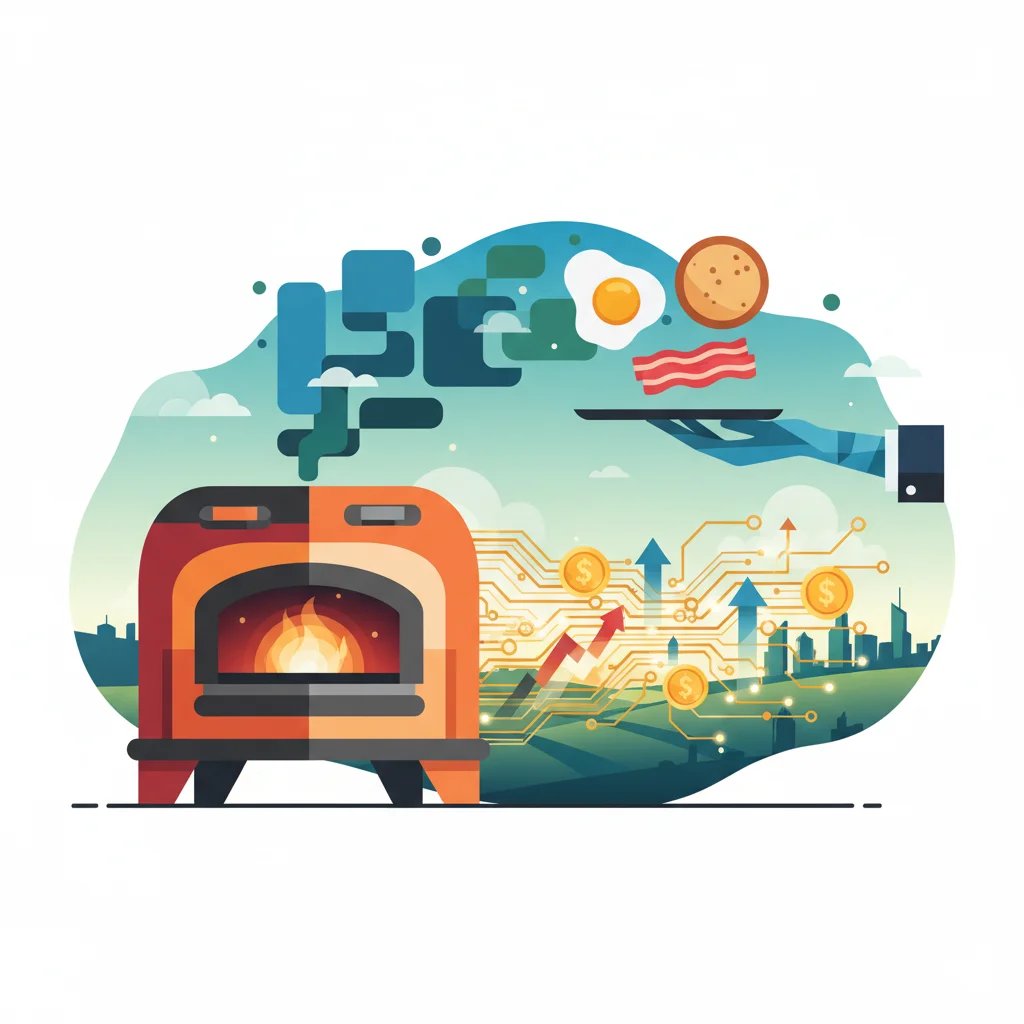
Inside the classic cast-iron cooker was a “delicious, hot, full Irish breakfast,” delivered perfectly without any direct human interaction at the point of service. This charming anecdote, a testament to Irish hospitality, is also a perfect metaphor for the seismic shifts occurring in finance, investing, and banking. It’s a story about trust, automation, and a new paradigm of value delivery. It’s the story of the Aga Oven Economy, where the most effective systems are the ones that work seamlessly in the background, allowing us to focus on what truly matters—whether that’s milking the cows or building a multi-generational investment portfolio.
The Note on the Table: Smart Contracts and the Trust Economy
At the heart of the B&B experience was a simple note. This note was more than just a piece of paper; it was a contract built on mutual trust. The hosts trusted their guests to serve themselves, and the guests trusted the note’s instructions to find their promised meal. This simple, automated agreement is a rustic precursor to one of the most transformative concepts in modern financial technology: the smart contract.
A smart contract, a cornerstone of blockchain technology, is essentially a self-executing contract with the terms of the agreement directly written into lines of code. It automatically executes transactions and enforces rules when predetermined conditions are met, eliminating the need for a central authority or intermediary. The note on the table was a low-tech smart contract:
- Condition: If it is breakfast time.
- Action: Then your meal is in the Aga oven.
- Execution: The process completed without the hosts (the intermediaries) needing to be physically present.
This principle is the driving force behind Decentralized Finance (DeFi), an emerging financial ecosystem built on blockchain technology. DeFi aims to create an open and transparent financial system that operates without traditional intermediaries like banks or brokerages. According to a 2023 report from Deloitte, the total value locked in DeFi protocols has surged, demonstrating growing confidence in systems that replace interpersonal trust with cryptographic certainty. Just as the guests trusted the B&B’s system, users in the DeFi space trust the code to execute transactions fairly and transparently, from lending and borrowing to complex trading derivatives.
The implication for the traditional banking sector is monumental. Activities that once required teams of people and extensive paperwork can now be automated with greater efficiency and lower cost. This shift challenges us to reconsider where we place our trust: in long-standing institutions or in the immutable logic of code. The 12-Year-Old Test: The Most Powerful, Overlooked Secret in Finance and Investing
“Gone to Milk the Cows”: Automation and Core Business Focus
The note’s explanation—“Gone to milk the cows”—is perhaps the most critical economic lesson in the entire story. The hosts were not absent due to negligence; they were engaged in their primary production activity. By automating the breakfast service using the Aga’s slow-heat capabilities, they optimized their labor, allocating their time to the most crucial part of their farm-based business. They didn’t need to choose between milking the cows and serving the guests; technology allowed them to do both.
This is a perfect illustration of the power of automation in the modern economy. In the world of investing and trading, this principle is embodied by the rise of algorithmic trading and robo-advisors. Algorithmic trading uses complex formulas and high-speed computers to execute trades on the stock market at a frequency and precision impossible for a human trader. These systems handle the “serving of breakfast,” freeing up human portfolio managers to focus on “milking the cows”—conducting deep market research, developing long-term strategies, and managing client relationships.
For the individual investor, the robo-advisor is the equivalent of the Aga oven. These platforms use algorithms to build and manage a diversified investment portfolio based on a client’s risk tolerance and financial goals, often at a fraction of the cost of a traditional financial advisor. This has democratized access to sophisticated investment management, a trend confirmed by a Statista report projecting the assets under management in the robo-advisory segment to reach nearly $3 trillion by 2027.
To better understand this shift, consider the differences between the old and new models of investment management:
| Feature | Traditional Wealth Management | Robo-Advisory Services |
|---|---|---|
| Human Interaction | High-touch, relationship-based | Low-touch, primarily digital interface |
| Cost Structure | Higher fees (typically % of AUM) | Lower fees (often a flat fee or lower %) |
| Minimum Investment | Often high ($100,000+) | Low or no minimum required |
| Core Mechanism | Human judgment and analysis | Algorithmic automation and rebalancing |
| Accessibility | Primarily for high-net-worth individuals | Accessible to the general public |
The Breakfast in the Aga: Redefining Value in Financial Services
Crucially, the self-service breakfast was not a lesser product. Liz Woods described it as “delicious” and “hot”—a “full Irish breakfast.” The quality of the core product remained high; only the delivery mechanism had changed. This is a vital lesson for the fintech revolution. The goal isn’t just to introduce new technology; it’s to use that technology to deliver the same, or better, value in a more efficient and customer-centric way.
Traditional banks, for decades, operated like full-service restaurants, bundling everything from checking accounts and loans to mortgages and investment advice under one roof. The rise of financial technology has unbundled this “full Irish breakfast.” Start-ups now offer specialized, best-in-class services for each component: one app for payments, another for stock trading, a third for personal loans. This unbundling has forced the entire industry to compete on user experience and value, not just on brand legacy.
Customer expectations have fundamentally shifted. A study by J.P. Morgan highlights that a seamless digital experience is no longer a perk but a core expectation for both retail and business customers. The convenience of depositing a check via a mobile app (the modern-day Aga) is now often valued more highly than the personal service of a bank teller. The value is no longer just in the financial product itself, but in its accessibility, speed, and ease of use. The best service is often the service you don’t notice, one that works perfectly in the background of your life. The Cellular Secret to Economic Stability: What Biology Teaches Us About Supply Chains, Fintech, and Market Crashes
The Broader Economic Implications
Zooming out, the story from the Cliffs of Moher is a microcosm of foundational principles in economics. The hosts’ decision to automate breakfast service is a classic example of the division of labor and specialization, concepts championed by Adam Smith. By focusing on their area of highest productivity (farming) and using technology (the Aga) to handle another task, they increased their overall efficiency and output.
This principle, when applied across an entire economy, is what drives productivity growth and raises living standards. The ongoing digital transformation is essentially a large-scale application of this idea. AI, machine learning, and automation are the new Aga ovens, allowing businesses to streamline operations, reduce costs, and reallocate human capital to more creative, strategic, and complex problem-solving endeavors.
However, this transition also presents challenges. It necessitates a workforce with new skills and creates anxieties about job displacement. The key, as demonstrated by the B&B hosts, is not to fear technology but to leverage it as a tool to enhance human capability. The goal is to automate the task, not the job, allowing people to focus on higher-value work. The £1.4 Billion Question: Is the UK Government Finally Taming its Consulting Habit?
Conclusion: A Lesson from the Cliffs
Who would have thought that a short letter about a holiday in Ireland could encapsulate the defining trends of our modern financial world? The anecdote of the self-service breakfast serves as a powerful allegory for the future of the global economy.
- The note on the table represents the shift towards trustless, automated systems powered by smart contracts and blockchain.
- The hosts, “gone to milk the cows,” symbolize the strategic imperative to focus on core competencies by embracing automation, from algorithmic trading to AI-driven analytics.
- The delicious breakfast in the Aga illustrates the new frontier of value delivery, where customer experience, convenience, and efficiency are paramount in financial technology.
From the windswept Cliffs of Moher to the bustling trading floors of Wall Street, the underlying principles remain the same. The institutions and investors that thrive in the coming decades will be those who, like the clever B&B hosts, master the art of blending trust, technology, and timeless value. They understand that the best systems are not always the most visible, but the most reliable, allowing everyone to get on with the business of creating real, tangible value—one perfectly cooked breakfast at a time.