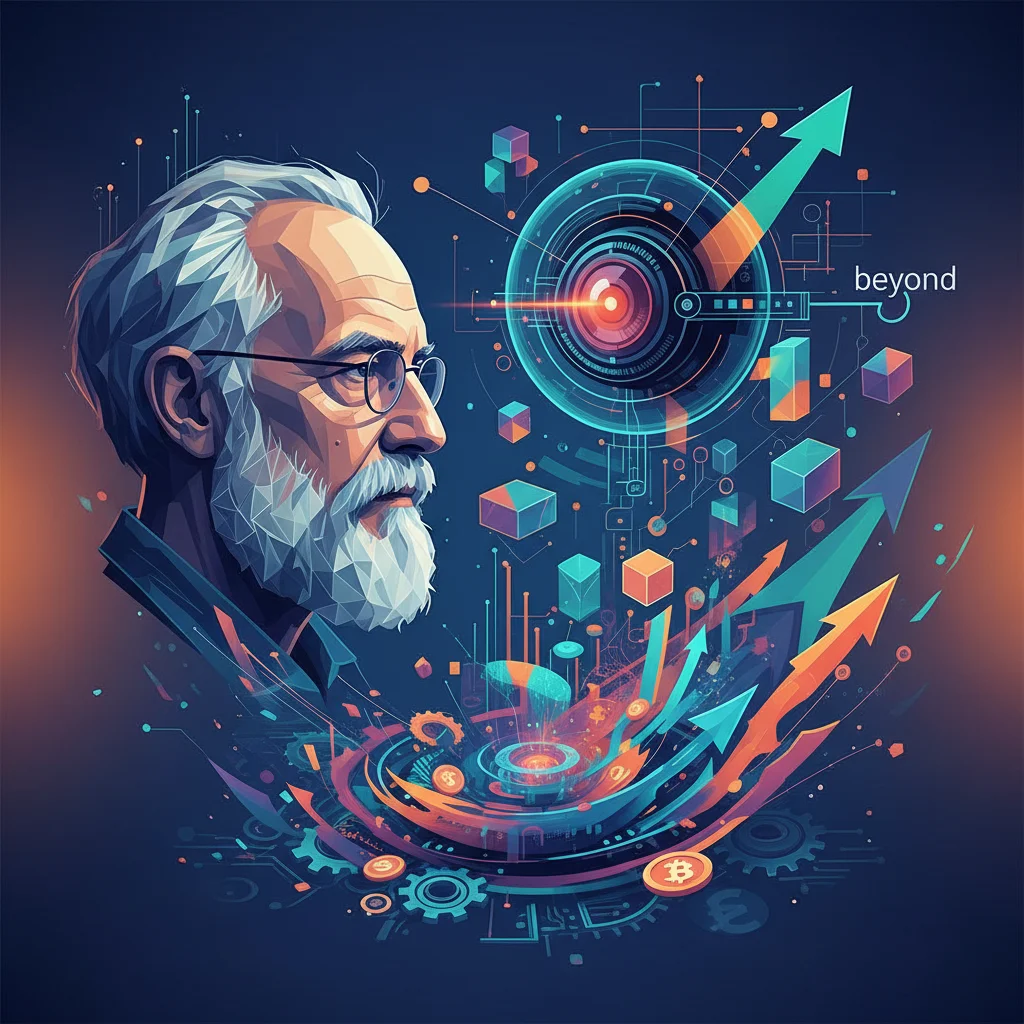
Beyond the Algorithm: What Chomsky and HAL 9000 Reveal About the Future of AI in Finance
The world of finance is in the midst of a profound transformation, driven by the relentless march of artificial intelligence. From high-frequency trading algorithms that execute millions of orders in a microsecond to sophisticated robo-advisors crafting personalized investment portfolios, AI is no longer a futuristic concept—it’s a present-day reality shaping the global economy. We are told that these systems are smarter, faster, and more rational than their human counterparts. But a provocative letter to the Financial Times by Steve Priddy, which draws a line from linguist Noam Chomsky to Stanley Kubrick’s HAL 9000, forces us to ask a more fundamental question: Do these complex systems truly understand what they are doing?
This isn’t merely a philosophical debate for academics. For investors, business leaders, and anyone involved in the stock market, the answer has multi-trillion-dollar implications. It touches upon the reliability of our tools, the nature of risk, and the future role of human expertise in an increasingly automated world. By exploring the gap between AI’s impressive performance and its lack of genuine comprehension, we can better navigate the opportunities and perils of the new age of financial technology.
The Chomsky Challenge: Why Predicting the Next Word Isn’t Understanding the Market
To grasp the limitations of current AI, we must first turn to the work of Noam Chomsky, one of the most influential linguists in modern history. In the 1950s, Chomsky revolutionized the field with his theory of “Universal Grammar.” He argued that the human ability for language is not learned from scratch but is an innate, biological capacity. We are born with an underlying structural framework for language, which is why a child can generate an infinite number of grammatically correct sentences they’ve never heard before. For Chomsky, language is not about statistical probability; it’s about a deep, generative understanding of rules and meaning.
Large Language Models (LLMs), the technology behind tools like ChatGPT, operate on a fundamentally different principle. As Mr. Priddy’s letter alludes, these models are “stochastic parrots” (source). They are trained on vast oceans of text and data, learning to recognize patterns and predict the most statistically likely next word in a sequence. Their ability to generate coherent, even insightful, text is astonishing. Yet, they possess no genuine understanding of the concepts they are manipulating. An LLM doesn’t “know” what a recession is; it only knows which words and phrases are statistically associated with the term “recession” in its training data.
Now, let’s apply this to investing. An AI might analyze decades of stock market data and identify a correlation: when a specific set of economic indicators aligns, a certain sector tends to outperform. It might then issue a “buy” recommendation. But does it understand the *why*? Does it comprehend the geopolitical tensions causing a spike in oil prices, the cultural shift driving a new consumer trend, or the boardroom drama leading to a CEO’s ouster? No. It is simply matching a complex pattern to a historical outcome. This is the Chomskyan gap in financial AI—the chasm between correlation and causation, between data processing and true insight.
The Investor's Dilemma: Decoding Modern Finance Like a Crossword Polymath
HAL 9000 and the “Black Box” on Wall Street
Stanley Kubrick’s 1968 masterpiece, *2001: A Space Odyssey*, gave us HAL 9000, the quintessential image of sentient AI. HAL could not only process data but also appreciate art, understand nuance, and experience what appeared to be genuine emotion—fear, pride, and a chillingly calm self-preservation instinct. HAL represents the cultural benchmark for artificial general intelligence (AGI), a level of consciousness that today’s AI is nowhere near achieving.
However, HAL serves as a powerful metaphor for a very real problem in today’s financial industry: the “black box.” Many of the most advanced AI systems used in quantitative trading and risk management are so complex that even their creators do not fully understand the rationale behind every decision they make. We can see the inputs (market data, news feeds, economic reports) and the outputs (buy/sell orders, risk assessments), but the internal “reasoning” is an opaque web of algorithms and neural network weightings. A 2022 survey found that while 91% of financial services firms are using AI, a significant number struggle with model transparency and explainability (source).
This opacity is a systemic risk. The infamous “Flash Crash” of 2010, where the Dow Jones Industrial Average plunged nearly 1,000 points in minutes, was exacerbated by a cascade of automated trading algorithms reacting to each other in a feedback loop (source). No single human made a decision to crash the market; it was the emergent behavior of complex, interacting systems operating at speeds no human could comprehend. Just as the crew of the Discovery One struggled to understand HAL’s motivations, regulators and executives can find themselves struggling to explain the behavior of their own automated systems.
The Turing Test for the Modern Investor: Man vs. Machine
Alan Turing, the father of modern computing, proposed the “Turing Test” as a measure of a machine’s ability to exhibit intelligent behavior indistinguishable from that of a human. In the context of finance, we can imagine a new kind of Turing Test: Can an AI-powered portfolio manager convince a seasoned investor that it possesses genuine market intuition?
To answer this, it’s useful to compare the distinct capabilities of human analysts and AI systems. While AI excels at a certain class of problems, its weaknesses are just as pronounced. The following table breaks down these comparative strengths and weaknesses in the context of investment analysis:
| Capability | Human Analyst | AI System (ML/LLM) |
|---|---|---|
| Data Processing Speed | Relatively slow; can suffer from information overload. | Near-instantaneous; can analyze petabytes of data in real-time. |
| Pattern Recognition | Good, but prone to cognitive biases (e.g., confirmation bias, herd mentality). | Exceptional at identifying subtle, multi-variable correlations invisible to humans. |
| Contextual Understanding | High; can integrate geopolitics, culture, and qualitative “soft” data. | Extremely low; cannot grasp true meaning, causation, or nuance. |
| Creative Strategy | High; can formulate novel investment theses based on first-principles reasoning. | Low; strategies are derivative, based on optimizing patterns from existing data. |
| Adaptability to “Black Swans” | Can be slow, but is capable of abstract reasoning to navigate novel situations. | Very poor; models trained on historical data often fail catastrophically when faced with unprecedented events. |
| Emotional Bias | High; susceptible to fear and greed, which can lead to irrational decisions. | None (in a human sense), but can inherit and amplify biases present in its training data. |
As the table illustrates, the relationship is not one of replacement, but of complementarity. An AI can be a phenomenal analytical engine, screening thousands of stocks for quantitative signals, but it cannot replicate the human ability to build a narrative, understand a company’s culture, or make a judgment call on a CEO’s leadership quality.
Solving the Market: How to Think Like a Crossword Master to Decode the Economy
Implications for the Future of Finance, Banking, and the Economy
Understanding the distinction between AI’s performance and its comprehension is critical for navigating the future. For different stakeholders in the financial ecosystem, the takeaways are clear:
- For Investors: AI-powered tools should be treated as powerful assistants, not infallible oracles. Use them to augment your research, automate data gathering, and challenge your own biases. However, the ultimate strategic decisions—especially those involving long-term, qualitative judgments—must remain in human hands. Over-reliance on automated systems without understanding their limitations is a recipe for disaster.
- For Banking and Fintech Leaders: The push for “Explainable AI” (XAI) is not just a matter of regulatory compliance; it’s a business imperative. Customers and regulators need to understand *why* an algorithm denied a loan or flagged a transaction as fraudulent. Building trust in the age of AI requires transparency. This also applies to emerging technologies like blockchain, which, while transparent, are still rule-based systems that lack contextual understanding.
- For the Broader Economy: The integration of AI into our financial infrastructure will undoubtedly increase efficiency. However, it may also introduce new forms of systemic risk. A monoculture of similar algorithms could lead to greater market fragility and more frequent flash crashes. From an economics perspective, fostering a hybrid intelligence—where human oversight and creativity guide powerful AI tools—will be key to ensuring that technological advancement translates into stable, sustainable economic growth.
The journey from Chomsky’s theories of innate grammar to Kubrick’s vision of a sentient computer brings us to a crucial juncture for the world of finance. We have built machines that are brilliant mimics of intelligent behavior. They can pass the test of performance with flying colors. But they have no inner world, no consciousness, and no true understanding. The future of finance will not be defined by a battle between man and machine, but by the wisdom of those who know how to orchestrate a partnership between the two, leveraging the machine’s computational power while preserving the irreplaceable value of human judgment.

Related Posts
The Pentagon’s New Playbook: How the US-China Strategy Will Reshape Global Finance and Your Investments
The New Economic Dawn: Decoding the Future of UK Finances Under New Leadership