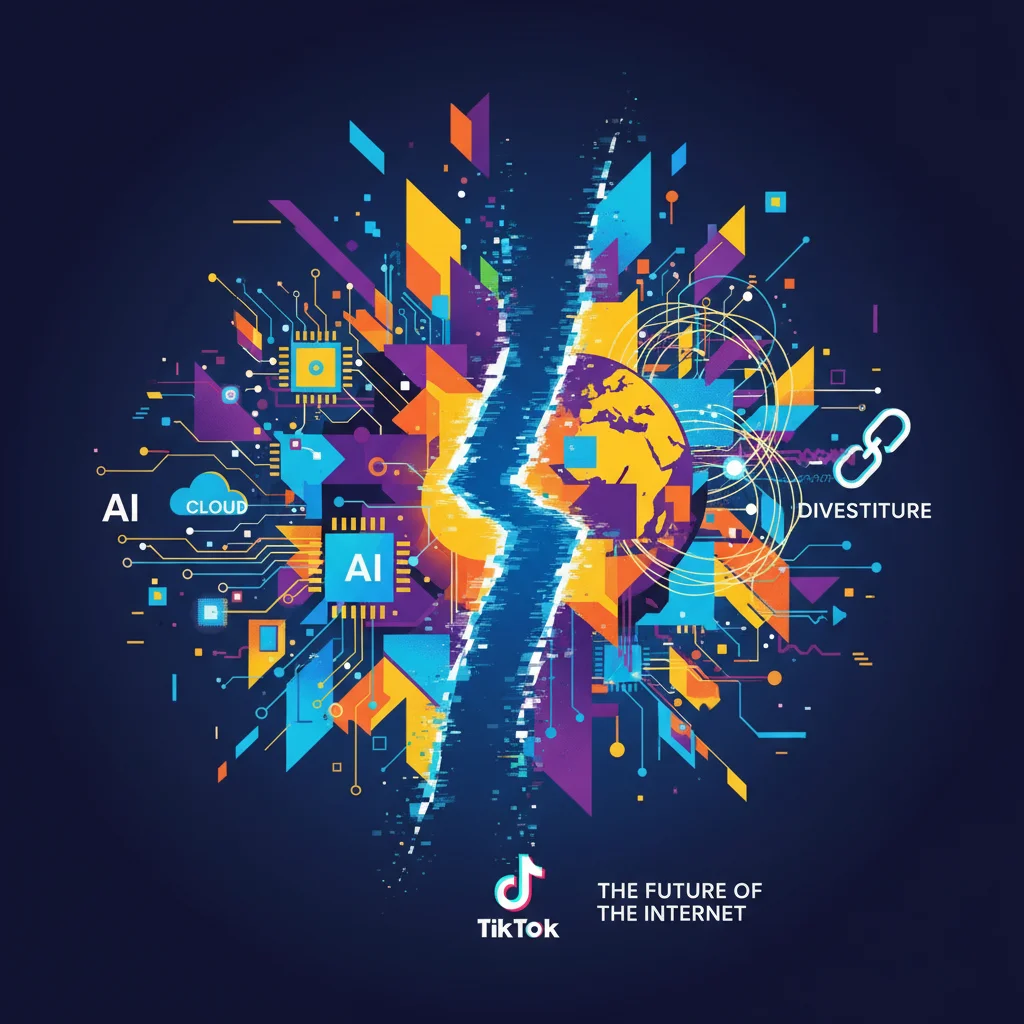
TikTok’s Great Divide: What the US Divestiture Really Means for AI, Cloud, and the Future of the Internet
The saga of TikTok’s future in the United States has been a rollercoaster of headlines, political maneuvering, and corporate drama. Now that a path has been forged—a forced divestiture or an outright ban—the dust is beginning to settle. But as it does, the real questions are just starting to emerge. For the roughly one-third of American adults who use the platform, the immediate concern is simple: “Will my ‘For You’ page change?”
While that’s a valid question, the implications of this monumental shift run far deeper. This isn’t just about an app; it’s a landmark event at the intersection of technology, geopolitics, and digital sovereignty. It’s a story about the very nature of modern software, the immense power of artificial intelligence, and the colossal engineering challenges of splitting a digital titan in two. For developers, entrepreneurs, and tech professionals, the TikTok divestiture is a live-action case study in the complexities of global tech, with profound lessons in cloud architecture, cybersecurity, and the future of innovation.
Let’s peel back the layers and explore what this deal truly means—not just for users, but for the entire tech ecosystem.
The Core of the Conflict: It’s Not Just About Data, It’s About the Algorithm
To understand the “why” behind this forced sale, we need to look beyond the surface-level fears of data privacy. While the prospect of U.S. user data being accessible to the Chinese government is a significant concern, the real anxiety in national security circles revolves around something far more powerful: the algorithm. TikTok’s recommendation engine is a masterclass in machine learning. It’s the “secret sauce” that keeps millions of users scrolling for hours, and it represents a formidable piece of AI technology.
The concern is twofold:
- Data Access: The potential for ByteDance, TikTok’s Chinese parent company, to provide U.S. user data to the Chinese government under its national security laws.
- Algorithmic Influence: The potential for the Chinese government to subtly manipulate the algorithm to shape public opinion, promote certain narratives, or suppress content critical of its policies. This is a powerful, almost undetectable form of influence.
This situation has forced a global conversation about “data sovereignty”—the principle that a nation’s data is subject to the laws and governance structures of that nation. As the digital and physical worlds become increasingly intertwined, we’re seeing countries worldwide demand more control over the technology platforms operating within their borders. The TikTok case is arguably the most high-profile test of this principle to date.
The proposed solution—forcing ByteDance to sell its U.S. operations—is an attempt to sever these ties. However, this raises a billion-dollar question: can you actually sell an algorithm? Beijing has complicated matters by updating its export control rules to cover technologies like recommendation algorithms, suggesting it would not allow ByteDance to sell its most valuable asset. This means a new U.S. owner might acquire the brand, the user base, and the content, but not the AI that makes it all tick. They would be tasked with rebuilding the heart of the machine, a challenge of incredible technical and strategic difficulty.
The Grok Lawsuit: When AI Gets Personal, Who's Accountable?
The Digital Divorce: A Herculean Feat of Software and Cloud Engineering
Imagine being asked to surgically separate one part of a global, interconnected organism while keeping both parts alive and functioning. That’s the scale of the technical challenge facing any potential new owner of TikTok’s U.S. operations. This is far more complex than a typical corporate acquisition; it’s a fundamental re-architecting of a massive, live system. The process involves a trifecta of daunting tasks: codebase separation, data migration, and cybersecurity fortification.
Let’s break down the monumental engineering hurdles involved:
| Technical Challenge | Description | Key Disciplines Involved |
|---|---|---|
| Codebase Separation | Untangling the U.S.-specific code from the global ByteDance repository is not a simple copy-paste. It involves identifying and isolating millions of lines of code, microservices, and API dependencies. A single missed dependency could break critical features. | Software Engineering, DevOps, Programming |
| Petabyte-Scale Data Migration | Moving all U.S. user data—profiles, videos, comments, metadata—from ByteDance’s servers to a new, independent cloud infrastructure. This is a high-stakes migration where data integrity and zero-downtime are paramount. | Cloud Architecture, Database Administration, Network Engineering |
| Algorithm Reconstruction | If the core machine learning models are not part of the sale, the new entity must build a new recommendation engine from scratch. This involves training new models on the migrated data to try and replicate the addictive “For You” page experience. | Data Science, Artificial Intelligence, MLOps |
| Cybersecurity Overhaul | Building an entirely new security stack to protect the platform and its data. The new entity must prove its independence, which requires robust new security protocols, monitoring, and threat detection systems, likely leveraging significant automation. | Cybersecurity, SecOps, Compliance |
This process, often referred to as “Project Texas” in its earlier incarnation with Oracle, is estimated to be a multi-billion dollar effort requiring thousands of engineers. According to a Reuters report, the complexity of this separation is a primary reason for the extended timeline given in the legislation. It’s a testament to how deeply integrated modern global SaaS platforms truly are.
Ant & Dec's New Podcast: A Masterclass in Tech-Driven Brand Evolution?
The Ripple Effect: A New Landscape for Startups, SaaS, and Global Tech
The TikTok divestiture isn’t happening in a vacuum. Its outcome will send shockwaves across the tech industry, setting new precedents and creating both opportunities and risks.
- For Startups & Entrepreneurs: This could be seen as a double-edged sword. On one hand, it may create a chilling effect for foreign startups hoping to enter the U.S. market, forcing them to consider complex corporate structures from day one. On the other, the potential disruption of a major player could create a vacuum, opening the door for domestic competitors to capture market share.
- For the SaaS Ecosystem: The creation of a new, independent U.S. TikTok is a massive greenfield opportunity for SaaS companies. The new entity will need everything: cloud hosting, cybersecurity solutions, developer tools, analytics platforms, and more. This represents a potential multi-billion dollar contract pipeline for the enterprise software industry.
- For Developers and the Creator Economy: The stability of the platform is key. Developers who have built tools on the TikTok API and creators who rely on it for their livelihood face a period of uncertainty. A change in ownership could lead to shifts in API access, monetization policies, and the all-important creator fund. According to the BBC, securing the platform’s future has been a key goal, but the nature of that future is what’s now in question.
So, What Happens to Your “For You” Page?
This brings us back to the original question: what will U.S. users actually see? In the short term, probably not much. Any transition would be designed to be as seamless as possible to avoid user churn.
The long-term, however, is where things could get interesting. If a new recommendation engine has to be built, your “For You” page might feel… different. It could take months or even years for a new AI to learn the nuanced preferences of 170 million users with the same spooky accuracy as the original. You might be served more generalized, less hyper-personalized content initially as the new machine learning models find their footing.
Furthermore, the pace of innovation could change. The global version of TikTok might roll out new filters, features, and editing tools, while the U.S. version could lag behind as its new engineering team gets up to speed. The two platforms, once identical, could slowly drift apart, becoming digital cousins rather than twins.
The BBC's YouTube Gambit: A Legacy Broadcaster's Bold Leap into the AI-Powered Streaming Age
A Defining Moment for the Digital Age
The forced sale of TikTok’s U.S. operations is far more than a corporate transaction. It is a defining moment in the history of the internet—a point where the ideals of a borderless, global digital commons collide with the realities of national interest and geopolitical competition.
The path forward is fraught with unprecedented challenges in software engineering, cloud computing, and AI development. The outcome will not only determine the fate of a beloved app but will also serve as a blueprint for how the world’s major powers navigate the turbulent waters of technological sovereignty. For everyone in the tech industry, from the solo developer to the enterprise CEO, this is a moment to watch closely. The rules of the game are being rewritten in real-time.