Greenland’s Glaciers, Wall Street’s Jitters: Decoding the Economic Fallout of an Arctic Power Play
In the world of global finance, market-moving headlines can come from anywhere: a central bank announcement, an earnings report, or a sudden shift in economic data. But occasionally, a headline emerges that is so unexpected it forces investors and business leaders to redraw their maps—both literally and figuratively. Such was the case when news broke of then-President Donald Trump’s serious intention to purchase Greenland, a move that sent immediate, albeit temporary, shockwaves through the stock market and currency exchanges.
The initial reaction was one of disbelief, but the financial markets, ever the pragmatists, quickly priced in the implications. The dollar and Wall Street stocks dipped following President Trump’s confirmation that there was “no going back” on his campaign to acquire the vast Arctic territory from Denmark (source). While the numbers were not catastrophic, the sentiment was clear: the markets abhor uncertainty, and this move injected a potent dose of geopolitical unpredictability into an already tense global landscape.
This single event, however, was more than just a fleeting headline. It was a stark revelation of the intersecting forces shaping the 21st-century economy: the growing competition for strategic resources, the economic consequences of climate change, and the profound impact of geopolitics on investment portfolios. This article delves beyond the initial shock to analyze the deep-seated economic, financial, and strategic currents that this Arctic proposition brought to the surface.
The Geopolitical Chessboard: Why Greenland?
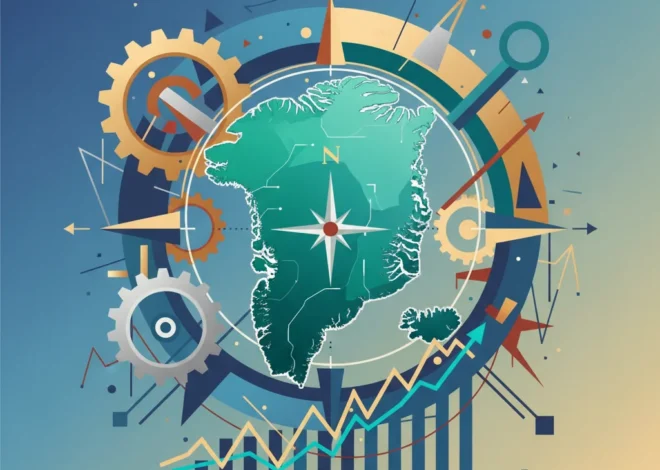
To understand the financial reaction, one must first grasp why Greenland, a semi-autonomous territory of Denmark with a population of just over 56,000, suddenly became a focal point of US foreign policy. The interest is not new; the US offered to buy the island for $100 million in 1946. Today, however, the stakes are exponentially higher, driven by three critical factors.
- Military and Strategic Location: Greenland is home to the Thule Air Base, the U.S. armed forces’ northernmost installation, which is a critical component of its global surveillance and missile warning systems. As Russia reasserts its military presence in the Arctic and China declares itself a “near-Arctic state,” controlling this territory offers an unparalleled strategic foothold in a region of escalating importance.
- Untapped Natural Resources: As the island’s ice sheet melts, it is revealing what could be one of the world’s largest reserves of untapped natural resources. This includes not just oil and natural gas but, more critically, a vast wealth of rare earth elements (REEs). These minerals are essential for everything from smartphones and electric vehicles to advanced defense systems—a market currently dominated by China. Gaining access to these resources is a matter of long-term economic and national security.
- New Maritime Trade Routes: Climate change is opening up new Arctic shipping lanes like the Northwest Passage and the Northern Sea Route. These routes could drastically shorten transit times between Asia, Europe, and North America, revolutionizing global logistics. Influence over Greenland means influence over the gateways to these future arteries of global trade.
The table below provides a snapshot of the estimated resource potential that makes Greenland such a strategic prize in the global economics of the 21st century.
| Resource Category | Estimated Potential & Significance |
|---|---|
| Rare Earth Elements (REEs) | Potentially one of the largest deposits outside of China, crucial for high-tech manufacturing and the green energy transition. A 2021 discovery highlighted significant concentrations (source). |
| Oil & Gas | The U.S. Geological Survey estimates the region could hold up to 50 billion barrels of undiscovered oil and natural gas liquids (source). |
| Base Metals & Minerals | Significant deposits of zinc, lead, iron ore, gold, and uranium are believed to exist, attracting international mining interest. |
| Freshwater | As global water scarcity increases, Greenland’s massive ice sheet represents one of the world’s largest freshwater reserves. |
Bitcoin's Holding Pattern: Why the Crypto Market is Coiling for a Major Breakout
From Geopolitics to Market Jitters: Why Wall Street Flinched
The stock market‘s negative reaction wasn’t a verdict on the viability of purchasing Greenland. Instead, it was a response to the methodology and the implications for global stability. For investors, the move signaled several red flags:
- Increased Transatlantic Tension: The blunt, transactional approach risked alienating Denmark, a key NATO ally, and by extension, the entire European Union. In an era of delicate trade negotiations, opening a new diplomatic rift with a major economic partner introduces friction that can disrupt trade flows, investment, and banking relationships.
- Heightened Policy Unpredictability: For those involved in long-term investing, policy predictability is paramount. This out-of-the-blue initiative amplified perceptions of an erratic foreign and economic policy, making it harder for businesses to plan and increasing the risk premium on US assets.
- Distraction from Core Economic Issues: At the time, markets were already on edge due to the escalating US-China trade war. This new geopolitical gambit was seen as a distraction that could divert political capital away from resolving the economic disputes that were actively weighing on corporate earnings and global growth.
The Broader Impact on Finance and Technology
The ripple effects of such geopolitical shifts extend into every corner of modern finance. A world characterized by strategic rivalry rather than cooperation puts stress on the globalized financial system. This environment can, paradoxically, accelerate innovation in financial technology.
When trust in traditional state-to-state banking and payment channels is eroded, a premium is placed on systems that are decentralized and resilient. While not a direct consequence of the Greenland incident, this type of event highlights a world where technologies like blockchain could gain traction. The appeal of a secure, transparent, and politically neutral ledger for verifying the provenance of strategic resources or settling cross-border transactions becomes more compelling in a fragmented world. This trend forces financial institutions to innovate or risk being outmaneuvered by more agile fintech solutions designed for a new geopolitical reality.
Long-Term Investment Strategy in an Unpredictable World
For investors and business leaders, the key takeaway is the necessity of integrating sophisticated geopolitical analysis into their decision-making frameworks. The Greenland affair serves as a powerful case study in how seemingly distant political events can have immediate financial consequences.
This new reality demands a multi-faceted approach to investing and trading:
- Sector-Specific Analysis: Investors must identify sectors directly impacted by this new resource competition. Mining companies with assets in politically stable regions, defense contractors, and shipping and logistics firms poised to benefit from new Arctic routes are all areas that warrant closer inspection.
- Supply Chain Diligence: Businesses must critically evaluate their supply chain vulnerabilities. Over-reliance on a single country—particularly for critical components like rare earth minerals—is a significant liability. Diversification is no longer just a financial strategy but a crucial operational imperative.
- Geopolitical Hedging: Portfolio managers may need to consider new ways to hedge against geopolitical risk, whether through currency trading, commodity futures, or investments in regions that stand to benefit from the shifting strategic landscape.
The Hundred Billion Dollar Question: Is Big Tech Building AI's Future on an Outdated Blueprint?
Conclusion: The New Nexus of Geography and Finance
The audacious proposal to buy Greenland was ultimately dismissed by Denmark as “absurd.” Yet, the underlying logic of the move reveals a fundamental truth about the modern global economy: geography is back with a vengeance. The melting ice of the Arctic is not just a climate story; it is a story about economics, resources, and power.
The brief shudder that ran through Wall Street was a reminder that financial markets are inextricably linked to the tectonic plates of global politics. For the modern investor, trader, or CEO, a deep understanding of political science, geology, and strategic studies is becoming as indispensable as a firm grasp of traditional economics and finance. The future of wealth creation and preservation will belong to those who can read the geopolitical map as skillfully as they read a balance sheet.