Beyond the Ban Hammer: How AI and a Free Market Can Fix Our Information Crisis
We’re caught in a digital tug-of-war. On one side, a tidal wave of disinformation threatens to erode public trust and destabilize everything from elections to public health. On the other, the looming specter of censorship, where a handful of powerful platforms or governments get to be the sole arbiters of truth. It feels like we’re forced to choose between chaos and control, a free-for-all versus a walled garden.
But what if this is a false choice? What if the best way to fight bad information isn’t to ban it, but to build a better, more transparent system for verifying the good information? A recent article from the Financial Times champions a powerful idea: combating disinformation must not be confused with censorship. The solution isn’t a top-down Ministry of Truth, but a bottom-up “free market of ideas” where independent assessment, powered by technology, gives power back to the user.
For developers, entrepreneurs, and tech professionals, this isn’t just a philosophical debate. It’s one of the most significant market opportunities of the next decade. It’s a call to build the tools, the platforms, and the very infrastructure of digital trust. Let’s explore how we can move beyond the ban hammer and engineer a more resilient information ecosystem.
The Flawed Debate: Censorship vs. Anarchy
The current approach to content moderation is fundamentally broken. When platforms de-platform a user or label a post as “misinformation,” they are often accused of political bias and stifling free speech. This centralized model, where a small group of employees makes decisions affecting billions, is brittle and unsustainable. As the FT article wisely points out, granting this power to governments is even more perilous, as it can be “weaponised for political ends.”
Conversely, a completely hands-off approach has proven disastrous. Unchecked, disinformation spreads faster and further than truth, poisoning public discourse and causing real-world harm. We can’t simply hope that good ideas will magically win out in a digital world optimized for outrage and engagement.
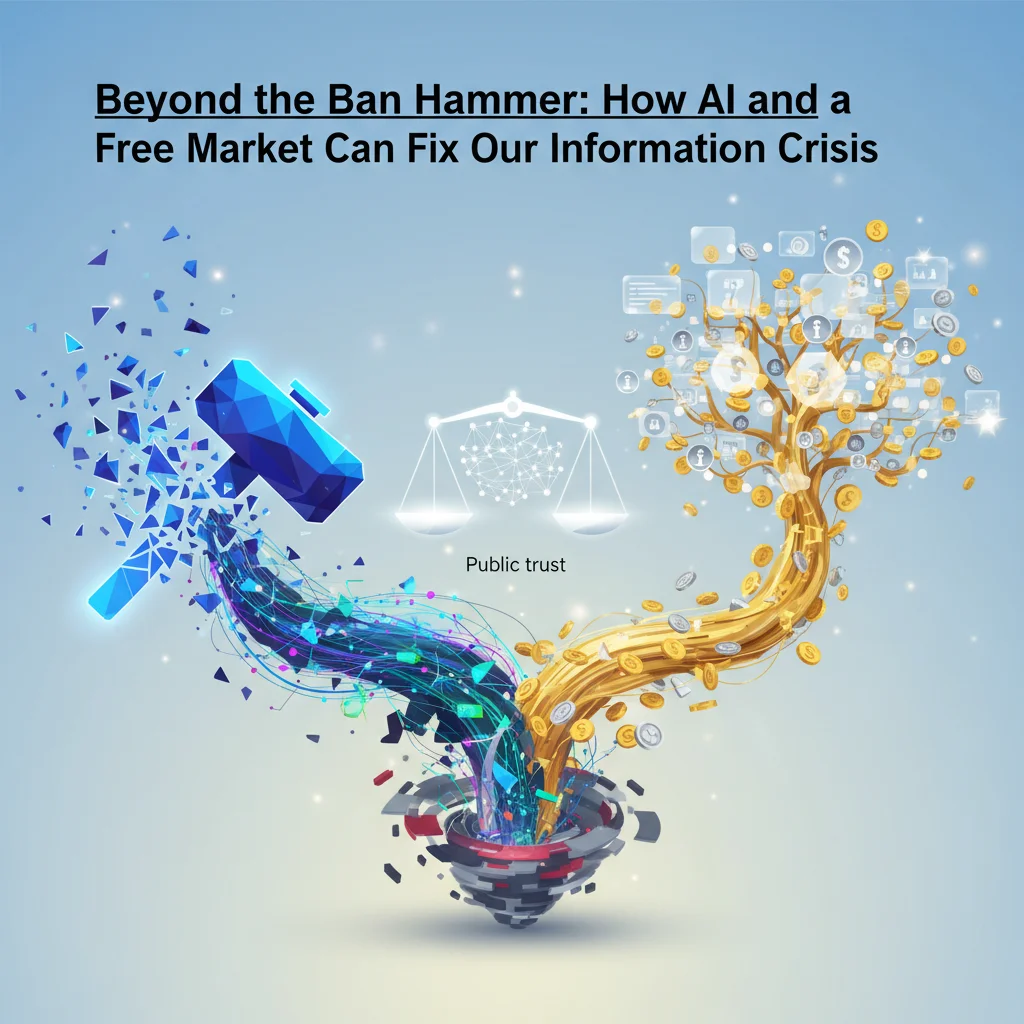
This is where the paradigm shift comes in. The goal shouldn’t be to silence voices, but to provide context. Instead of a single, monolithic “truth” dictated by a platform, imagine a competitive marketplace of verification services. Users could choose which “lenses” they want to apply to their information feeds, empowering them to make their own informed decisions.
To better understand this shift, let’s compare the two models:
| Feature | Centralized Censorship Model (The Status Quo) | Decentralized Verification Market (The Future) |
|---|---|---|
| Decision-Maker | Platform administrators or government bodies. | A competitive market of independent verification services. |
| Mechanism | Content removal, account suspension, shadow-banning. | Context labels, trust scores, source provenance, user-selected filters. |
| User Role | Passive recipient of moderation decisions. | Active consumer choosing their preferred trust providers. |
| Primary Goal | Remove “harmful” content. | Provide context and empower user judgment. |
| Key Weakness | Prone to bias, creates martyrs, lacks transparency. | Requires user education, potential for “filter bubbles” of trust. |
The Tech Stack for a Trust Economy
This vision of a verification market isn’t science fiction. The foundational technologies to build it exist today, waiting for entrepreneurs and developers to assemble them into cohesive solutions. This new ecosystem will be built on a stack of cutting-edge tech.
Artificial Intelligence and Machine Learning as Verifiers, Not Censors
The same AI and machine learning models currently used for blunt content moderation can be repurposed for sophisticated analysis and context generation. Instead of a simple “remove/allow” binary, AI can power:
- Content Provenance: Tracing the origin of an image, video, or claim. Was this photo from the event it claims to be, or was it taken five years ago in a different country? AI can analyze metadata, reverse image search at scale, and detect subtle signs of manipulation.
- Deepfake and Synthetic Media Detection: As generative AI evolves, so must our tools to detect it. Advanced models can identify the tell-tale artifacts of AI-generated content, flagging it not for removal, but for transparency.
- Automated Fact-Checking: Using Natural Language Processing (NLP), automation can scan an article, identify key claims, and cross-reference them against a vast database of trusted sources (academic papers, official statistics, established encyclopedias) in real-time. The output isn’t “true/false,” but a report card: “This claim is supported by X, contradicted by Y, and Z is unverified.”
This is a fundamental shift from using AI as a hammer to using it as a high-powered magnifying glass.
Grok Under Fire: Is AI's "Rebellious Streak" a Ticking Time Bomb for Tech Giants?
SaaS and Cloud: Delivering Trust-as-a-Service
How would this market function practically? The answer is a “Trust-as-a-Service” model, built on scalable cloud infrastructure. Imagine startups offering APIs that any application can plug into:
- A social media platform could allow users to subscribe to different verification services. One user might choose a service that specializes in scientific accuracy, while another might opt for one focused on geopolitical fact-checking.
- A web browser extension could overlay “trust scores” on search results, sourced from a user’s chosen provider.
- Corporate clients could use a SaaS dashboard to monitor brand mentions and flag disinformation campaigns in real-time, leveraging a verification API to assess the threat level.
This SaaS model unbundles the role of “arbiter” from the role of “publisher.” Facebook doesn’t have to be the source of truth; it can be a platform where third-party truths compete. This approach is more aligned with the principles of a free market, where consumers of information are free to choose their preferred validators.
Cybersecurity and Innovation in Authenticity
This new infrastructure would instantly become a high-value target for malicious actors. Therefore, cybersecurity is not an afterthought; it’s a core component. Protecting the integrity of these verification systems is paramount.
Moreover, there’s a huge field of innovation emerging around content authenticity. Initiatives like the Content Authenticity Initiative (CAI) are developing standards for cryptographically signing media at the point of creation. A photo taken on a future smartphone could have a secure, verifiable “birth certificate” showing when and where it was taken and if it has been altered. This creates a foundational layer of trust that our AI verification tools can then build upon.
The New AI Tollbooth: Why Google's Bet on Ads in Generative Search Changes Everything
The Trillion-Dollar Opportunity: Startups as the New Arbiters
For entrepreneurs, this is a call to action. The demand for reliable, unbiased information is an evergreen market. The failure of existing institutions to provide it has created a vacuum that tech startups are uniquely positioned to fill.
We could see the rise of entirely new categories of companies:
- Niche Verification Services: A service that only verifies claims in biotech research, another for financial market rumors, and a third for political campaign statements. Specialization builds trust and expertise.
- Reputation-as-a-Service: Platforms that provide dynamic trust scores for online sources, journalists, and public figures based on their track record of accuracy.
- Developer Tools: Companies that provide the core software and APIs for integrating these trust layers, making it easy for any developer to add verification features to their app.
The challenge for these startups will be building a brand that people trust. Their “source code” for verification—their methodologies, data sources, and AI models—will need to be radically transparent to earn that trust. The business model could be B2B (selling APIs to platforms) or B2C (premium subscriptions for power users), but the core product is always the same: verifiable, transparent credibility.
What This Means for All of Us
This shift has profound implications for everyone in the tech ecosystem and beyond.
For Developers and Programmers: Start thinking about a “trust layer” in your application stack. How can you give your users more context about the information they see? Integrating a verification API could become as standard as integrating a payment gateway.
For Founders and Entrepreneurs: If you’re looking for a problem worth solving, this is it. The world is desperate for solutions that go beyond censorship. Building a company that successfully commercializes trust could not only be lucrative but also essential for a functioning digital society.
The Uncaged AI: Why Ofcom's Investigation into Musk's Grok is a Watershed Moment for Tech
For All Internet Users: The future of navigating the web won’t be passive. It will require us to be active participants in our information consumption. It means choosing our validators, understanding their biases, and ultimately, taking back the responsibility of critical thinking—but this time, with far more powerful tools at our disposal.
Conclusion: Building a Resilient Future
The path out of our current information crisis isn’t through more control, but through better tools. It’s not about building higher walls, but about giving everyone a map and a compass. By embracing a free market of verification, we can foster competition, innovation, and transparency.
The technology—from artificial intelligence and SaaS platforms to next-generation cybersecurity—is ready. The challenge is to build the businesses and foster the user mindset to support this new ecosystem. It’s a move away from the futile game of whack-a-mole censorship and towards building a resilient, self-correcting, and ultimately freer information landscape for everyone.