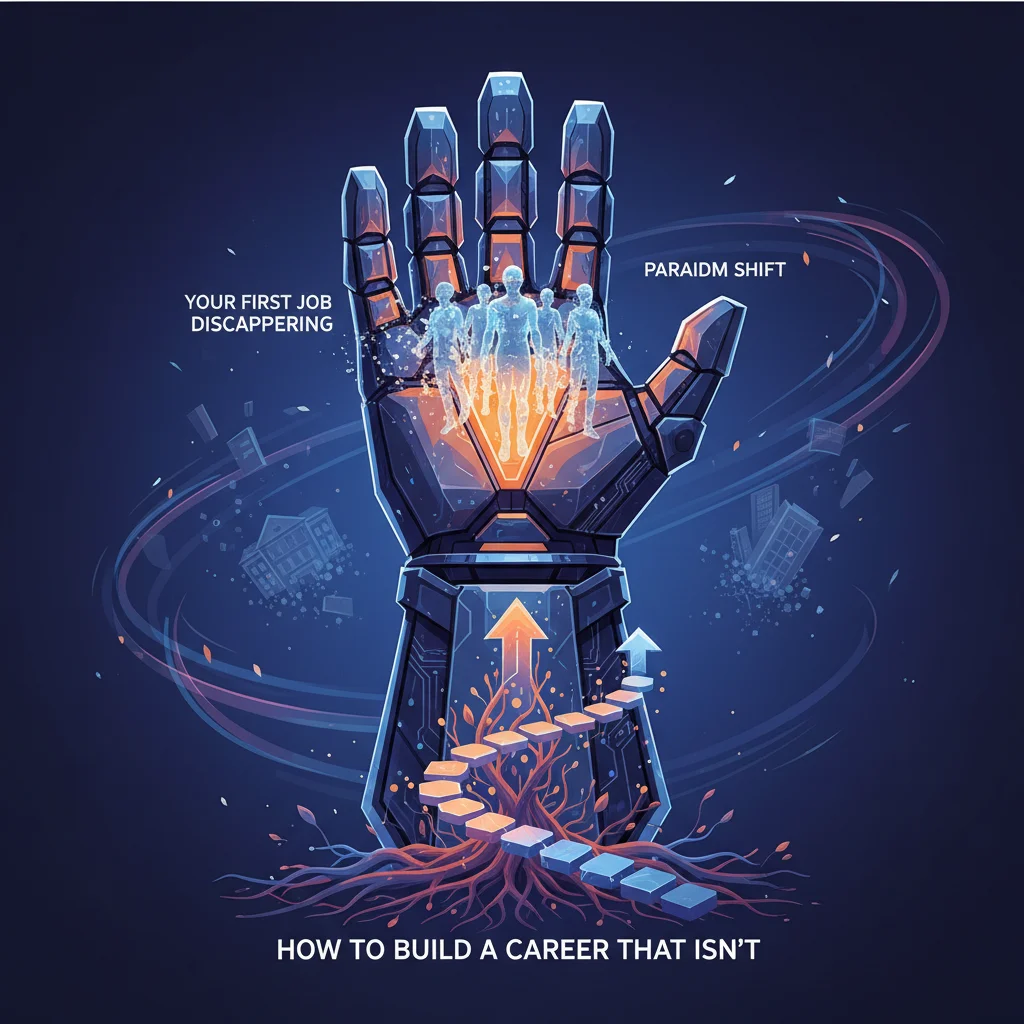
The AI Gauntlet: Why Your First Job is Disappearing (And How to Build a Career That Isn’t)
There’s a palpable anxiety in the air, a low hum of uncertainty that’s growing louder every day. It’s the sound of a paradigm shift, and it’s echoing loudest in the halls of universities and the home offices of recent graduates. For years, the career path was relatively clear: get a degree, land an entry-level job, and start climbing the ladder. But what happens when the first rung of that ladder is being systematically dismantled by artificial intelligence?
This isn’t science fiction or a distant future scenario. The impact of AI on the job market is happening now, and it’s disproportionately affecting the very roles designed to give newcomers a foothold in the professional world. A recent analysis from the Financial Times highlights a growing concern: the plight of recent graduates is set to worsen as AI-powered automation takes over tasks that were once the bedrock of junior positions. But this isn’t a story about the end of careers; it’s a story about the beginning of new ones. It’s about understanding the shift, adapting your skills, and learning to thrive in a world where your most powerful colleague is a machine.
The Crumbling Foundation: Why Entry-Level Roles are Ground Zero
Why are junior roles so vulnerable? The answer lies in the nature of the work. Entry-level positions have traditionally been about learning the ropes by performing foundational, often repetitive, tasks: summarizing documents, writing basic code snippets, creating first-draft marketing copy, analyzing spreadsheets, or handling customer service inquiries. These tasks are crucial for learning but are also, coincidentally, the exact kinds of structured, data-driven activities that modern generative AI excels at.
Think about the tools that have exploded in popularity over the last two years. AI assistants can now generate marketing emails, debug **programming** scripts, and create detailed reports from raw data in seconds. Companies, especially agile **startups** and tech giants, are rapidly integrating this technology to boost efficiency. From their perspective, why hire a junior employee to spend a week on a task that an **AI** tool, often delivered via a **SaaS** subscription on the **cloud**, can complete in an hour? This economic reality is accelerating a hollowing out of the bottom of the corporate ladder. The traditional apprenticeship model, where you learn by doing the basics, is being fundamentally challenged.
The numbers are beginning to reflect this reality. While concrete data is still emerging, anecdotal evidence and early studies suggest a slowdown in hiring for roles with tasks that can be easily automated. Concerns are mounting that this trend will create a “lost generation” of graduates who struggle to gain the initial experience necessary to build a long-term career.
Grok Blocked: Why Two Nations' Stand Against AI Deepfakes is a Global Wake-Up Call for Tech
A Glimpse into the AI-Augmented Workplace
To understand the shift, it’s helpful to compare the “before” and “after” of specific roles. This isn’t about job elimination as much as it is about job transformation. The value is moving from “doing the task” to “directing the outcome.”
Here’s a look at how some common entry-level tasks are evolving:
| Job Function | Traditional Entry-Level Task | AI-Augmented Professional’s Task |
|---|---|---|
| Marketing | Write 10 social media posts for a campaign. | Develop a creative brief, use AI to generate 50 post variations, then curate, edit, and A/B test the top 5 to optimize engagement. |
| Software Development | Write boilerplate code for a basic API endpoint. | Define the system architecture, use an AI co-pilot to generate the boilerplate, and focus on complex logic, integration testing, and security. |
| Data Analysis | Clean a dataset and create basic summary charts in Excel. | Use natural language to ask an AI tool to clean the data, identify correlations, and generate an interactive dashboard. Focus on interpreting the insights and forming business strategy. |
| Paralegal / Legal | Review hundreds of documents for specific keywords (discovery). | Train an AI model on the case specifics, have it perform the initial review of thousands of documents, and focus on analyzing the flagged exceptions and building the legal argument. |
As the table shows, the human is not removed from the loop. Instead, they are elevated to a role of strategist, editor, and quality controller. The mundane is automated, freeing up human potential for higher-order thinking.
The New Skill Stack: How to Become Indispensable
If the old entry-level jobs are fading, what replaces them? The future belongs to those who cultivate skills that AI cannot easily replicate. The focus is shifting from “what you know” to “how you think.” This is the new playbook for career survival and success in the age of **artificial intelligence**.
1. Strategic Thinking and Problem Framing
AI is an incredibly powerful answer-generating machine. But it’s only as good as the questions it’s asked. The most valuable human skill is the ability to look at a complex business problem, break it down into its core components, and frame the right questions for the AI to solve. This involves critical thinking, domain expertise, and a deep understanding of the business’s goals. You need to be the architect, not the bricklayer.
2. AI Command and Prompt Engineering
Interacting with sophisticated **machine learning** models is a skill in itself. Learning how to “talk” to AI to get the desired output—whether it’s generating code, text, or images—is the new digital literacy. This goes beyond just typing a question. It’s about understanding how the models work, how to structure prompts, and how to iterate on the results to refine them. This is a practical, technical skill that will be in high demand across all industries.
3. Curation, Judgment, and Ethical Oversight
AI can generate a thousand marketing slogans, but it can’t tell you which one will resonate with your brand’s specific audience and values. It can write code, but it can’t guarantee that the code is secure, efficient, and maintainable. The human role is shifting to that of an expert curator and a quality control specialist. This requires a sharp eye for detail, deep domain knowledge, and a strong ethical compass, especially in sensitive fields like finance, law, and even **cybersecurity**, where AI-generated vulnerabilities are a new threat vector (source).
Beyond the Hype: Why Your AI Strategy Might Be a Repeat of 90s Tech Flops
4. Interpersonal and Collaborative Skills
As routine tasks get automated, the skills that make us uniquely human become more valuable. Empathy, communication, persuasion, and teamwork cannot be outsourced to an algorithm. The ability to collaborate with a diverse team, manage stakeholders, and inspire action will set you apart. In a world full of AI-generated content, authentic human connection becomes a premium commodity.
A Call to Action for the Entire Ecosystem
This challenge isn’t just for individuals to solve. It requires a coordinated effort from educational institutions, businesses, and entrepreneurs.
- Universities must urgently update their curricula. Instead of just teaching the “how” of a task, they need to focus on the “why.” Students need to graduate not just with knowledge, but with a framework for critical thinking and a proficiency in using the latest AI tools.
- Companies need to rethink their hiring and training programs. Instead of seeking candidates who have 3-5 years of experience doing tasks that are now being automated, they should look for raw talent, adaptability, and a knack for problem-solving. Investing in robust internal training on how to leverage **AI** tools is no longer a perk; it’s a necessity for survival and **innovation**.
- Entrepreneurs and Startups have a massive opportunity. The gaps created by this transition are fertile ground for new **software** and **SaaS** products. Tools that help companies manage AI workflows, train employees, and ensure quality control will be essential. The next generation of unicorns will be built on enabling this new way of working.
The AI Startup's Dilemma: Are You Building a Feature or a Fortress?
Don’t Fear the Machine—Learn to Steer It
The rise of artificial intelligence is undeniably one of the most profound economic and social shifts of our lifetime. For those just starting their careers, it can feel like the ground is shifting beneath their feet. The familiar paths are disappearing, and the future looks uncertain.
But every technological revolution has created more opportunity than it has destroyed. The key is to look where the **automation** is going and skate to where the value is headed. The value is no longer in performing the task, but in orchestrating it. It’s in the creativity to ask a novel question, the critical judgment to evaluate the answer, and the wisdom to apply it effectively.
The gauntlet has been thrown down. The challenge for the next generation isn’t to compete with AI, but to master it. Your first job might not look like you expected, but the career you build with these new skills could be more impactful and rewarding than you ever imagined.

Related Posts

The Cloud Wars Get a New Titan: Is ByteDance’s AI Gamble a Threat to Alibaba?

Beyond the Spreadsheet: Why ‘AI Fluency’ is the New Must-Have Skill in Finance and Consulting