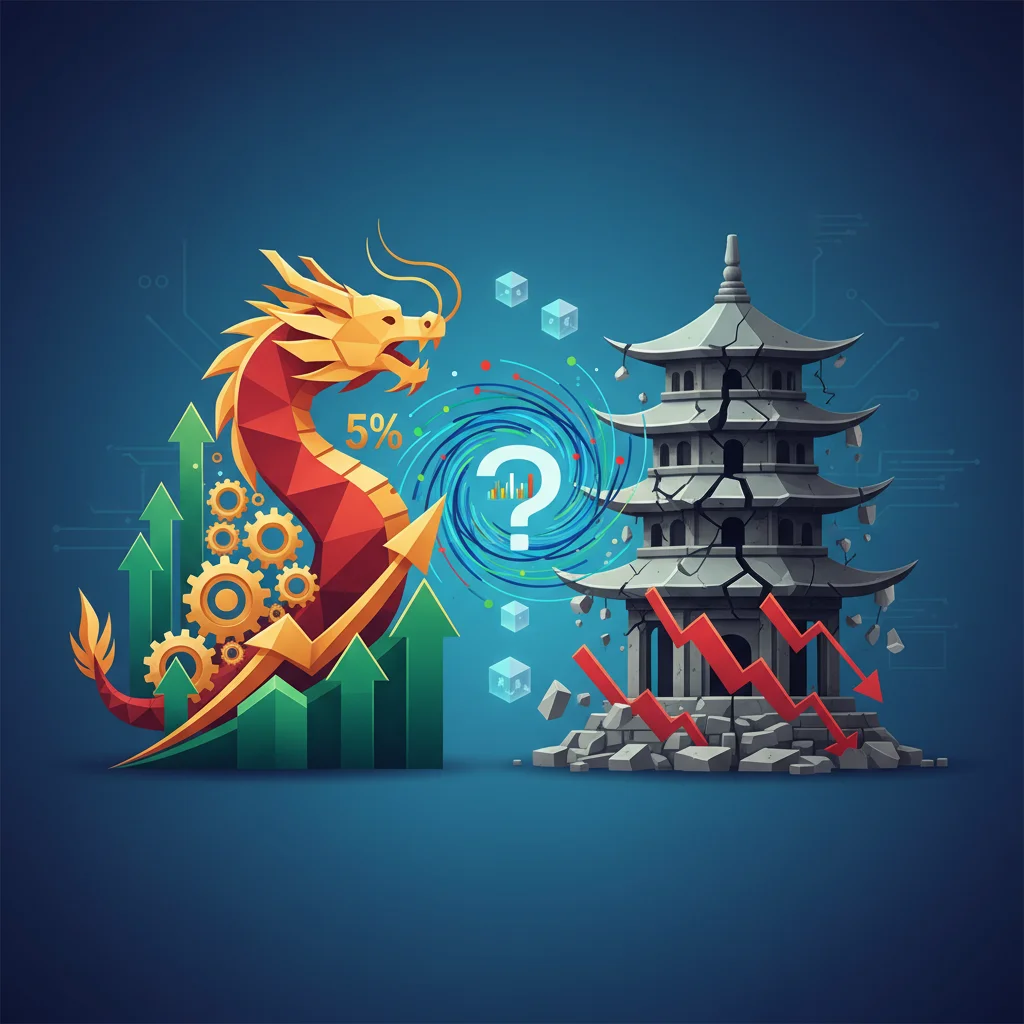
China’s Economic Paradox: What the 5% GDP Growth in 2025 Really Means for Investors
At first glance, the latest figures from Beijing paint a picture of resilience. China’s economy reportedly expanded by 5% in 2025, a number that many developed nations would envy. It suggests a powerful economic engine humming along, seemingly on track to meet its ambitious targets. However, digging beneath this headline figure reveals a far more complex and precarious reality: a starkly divided, two-speed economy.
On one side, a powerful export machine is firing on all cylinders, propping up growth and sending goods across the globe at a formidable pace. On the other, a sputtering domestic engine is plagued by weak consumer confidence, a protracted property crisis, and mounting deflationary pressures. This divergence isn’t just an academic footnote in an economics textbook; it’s a critical fault line with profound implications for global finance, international relations, and your investing portfolio. As Beijing navigates this challenging landscape, further complicated by the specter of renewed trade tensions with a potential Trump administration, understanding this paradox is essential for any serious investor, business leader, or market observer.
The Roaring Dragon: Unpacking China’s Export Juggernaut
The primary driver behind the 5% growth figure is an undeniable surge in China’s export sector. While the rest of the world grapples with inflation and sluggish growth, Chinese factories have ramped up production, capitalizing on a global restocking cycle and a competitive edge sharpened by a relatively weaker yuan. This isn’t just about cheap toys and textiles anymore; the composition of these exports tells a story of a nation rapidly climbing the value chain.
Key sectors leading this charge include:
- Electric Vehicles (EVs) and Green Tech: Chinese manufacturers of EVs, batteries, and solar panels have flooded international markets, often offering advanced technology at prices Western competitors struggle to match.
- Advanced Electronics: From high-end smartphones to sophisticated consumer drones, China continues to solidify its position as the world’s electronics workshop.
- Industrial Machinery: As developing nations build out their infrastructure, they are increasingly turning to Chinese firms for heavy machinery and equipment, a testament to the country’s growing industrial prowess.
This export boom has been a lifeline for the Chinese economy, offsetting deep-seated weaknesses elsewhere. For investors, this has created clear winners on the stock market, with shares of export-oriented manufacturing and shipping companies outperforming their domestic-focused peers. However, this heavy reliance on external demand creates its own set of vulnerabilities, particularly in a world of fracturing trade relationships.
The Great Wealth Transfer Illusion: Why Boomer Fortunes May Not Rescue Millennials
The Silent Consumer: Why China’s Domestic Engine is Stalling
In stark contrast to the bustling ports stands the subdued landscape of the domestic economy. Beijing’s long-stated goal of rebalancing its economy towards consumption-led growth—the so-called “dual circulation” strategy—appears to be faltering. The core of the problem is a crisis of confidence stemming from the ongoing turmoil in the property market.
For decades, real estate was the primary vehicle for household wealth accumulation. With property values now stagnant or falling, and major developers like Evergrande and Country Garden becoming cautionary tales, the average Chinese citizen feels poorer and is saving more, spending less. This has a chilling effect on everything from retail sales to big-ticket purchases.
The following table illustrates the stark divergence between China’s external and internal economic pillars in 2025:
| Economic Indicator (2025 Forecast) | Growth Rate | Implication |
|---|---|---|
| Export Growth (in USD terms) | +8.5% | Strong external demand is propping up industrial production and GDP. |
| Retail Sales Growth | +2.1% | Extremely weak consumer confidence, well below pre-pandemic levels. |
| Fixed Asset Investment | +1.5% | Dragged down by a severe contraction in property investment. |
| New Home Sales (by value) | -15.0% | The property sector remains a significant drag on the entire economy. |
This internal weakness is a major headwind. It means that global brands relying on the Chinese consumer are facing a tough market, and domestic-focused companies are struggling with low demand and shrinking margins. The government has implemented stimulus measures, but they have so far failed to meaningfully reignite animal spirits, as the fundamental issue of confidence remains unresolved (source).
Crude Politics: The Financial Fallout of a US-Cuba-Venezuela Showdown
The Geopolitical Wildcard: Bracing for a Potential Trump 2.0
Layered on top of this economic imbalance is a significant geopolitical risk. The original article highlights that Beijing is “grappling with Donald Trump’s trade policies” in 2025, suggesting that the prospect of his return to the White House is already forcing a strategic rethink. A second Trump term could usher in a new era of aggressive protectionism, with the potential for across-the-board tariffs that would dwarf those of his first term.
This threat directly targets China’s primary growth driver: exports. For businesses, this creates massive uncertainty in supply chain planning and investment decisions. The “China+1” strategy—diversifying manufacturing to other countries like Vietnam, Mexico, or India—is no longer just a buzzword but an urgent strategic imperative for many multinational corporations.
This geopolitical tension has significant implications for the world of finance. It could lead to:
- Increased Market Volatility: The trading environment could become highly sensitive to political rhetoric and policy announcements.
- Currency Fluctuations: A trade war could put downward pressure on the Chinese yuan, impacting global currency markets and the strategies of central banking institutions.
- Rethinking Globalisation: A further escalation could accelerate the trend of de-globalisation, forcing a fundamental realignment of capital flows and investment theses.
Actionable Insights for Investors and Business Leaders
Navigating China’s two-speed economy requires a nuanced and discerning approach. A broad, passive investment in the Chinese market could be a recipe for disappointment. Instead, a more surgical strategy is required.
For Investors:
- Be Sector-Specific: Favour companies in the export-oriented, high-tech manufacturing space that have a global competitive advantage. Be deeply cautious about sectors reliant on domestic consumption, particularly real estate, banking (due to property loan exposure), and consumer discretionary goods.
- Hedge Geopolitical Risk: Consider diversifying away from companies that are heavily reliant on the US market and would be most vulnerable to tariffs. Look for those with a more diversified global customer base.
- Monitor Policy Signals: Pay close attention to stimulus announcements from Beijing. Any significant shift towards direct consumer support could signal a turning point for the domestic market. Advancements in financial technology and digital payment systems could be the mechanism for such stimulus, making the fintech sector one to watch.
For Business Leaders:
- Diversify Supply Chains: The “China+1” strategy is no longer optional. The geopolitical climate demands resilience and redundancy in your supply chain. While it’s impossible to decouple completely, reducing sole reliance on China is prudent risk management.
- Target Premium Niches: If your business targets the Chinese domestic market, focus on premium or niche segments that are less sensitive to the economic woes of the average consumer.
- Leverage Technology: Utilise advanced financial technology and even experimental blockchain applications for supply chain transparency to better navigate potential trade disruptions and compliance requirements.
The Unseen Ledger: Are Stricter Drink-Driving Laws Bankrupting Rural Britain?
Conclusion: A Fragile Balance
China’s 5% GDP growth in 2025 is a testament to its formidable manufacturing power, but it’s a figure that conceals a fragile internal structure. The nation stands at a critical juncture, balancing on a knife’s edge between a booming external sector and a languishing domestic one. This model, propped up by exports, is inherently vulnerable to the whims of global demand and the rising tide of protectionism.
For the global community, the path China chooses next will have cascading effects. A successful rebalancing could unleash a new wave of consumer demand, benefiting the entire global economy. A failure to do so could lead to greater reliance on exports, increased trade friction, and a prolonged period of volatility. For now, the dragon’s roar on the global stage is loud, but it cannot completely drown out the worrying silence at home.