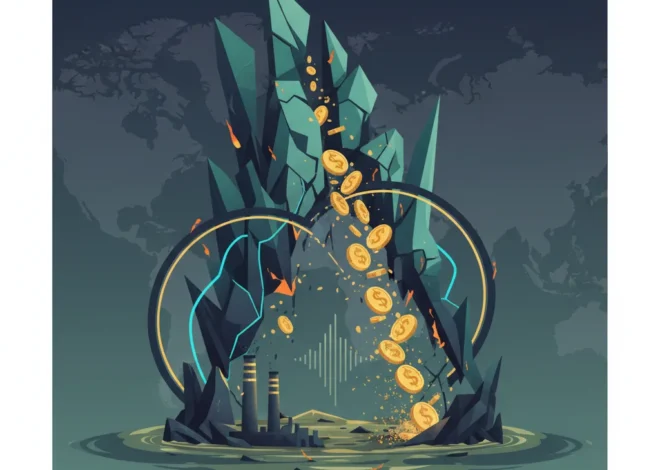
The Greenland Gambit: Trump’s Tariff Threat Ignites a New Era of Geopolitical Economics
In a move that has sent shockwaves through the global financial community, former US President and current political figure Donald Trump has escalated his long-standing interest in purchasing Greenland from a real estate proposition into a high-stakes economic ultimatum. According to a startling report, Trump has threatened to impose a 10% tariff on several key European allies, effective this coming February, in response to their opposition to his acquisition plans (source). This unprecedented linkage of a territorial ambition to international trade policy has been swiftly condemned as “unacceptable” by European leaders, catapulting a once-dismissed idea into a potential flashpoint for a new transatlantic trade war.
For investors, business leaders, and finance professionals, this development is more than just a political headline; it’s a seismic event that could redefine the rules of the global economy. The announcement forces us to confront a new reality where geopolitical ambitions and economic leverage are fused in unpredictable ways, with profound implications for the stock market, international investing, and the very architecture of global trade.
A Brief History of an Arctic Ambition
To fully grasp the gravity of the current situation, we must revisit the origins of this peculiar saga. In August 2019, news first broke that then-President Trump had privately expressed a serious interest in the United States purchasing Greenland, an autonomous territory of the Kingdom of Denmark. The idea was met with a mix of incredulity and derision globally, with Danish Prime Minister Mette Frederiksen calling the suggestion “absurd.”
While the proposal seemed outlandish, it wasn’t without historical precedent. The United States has a history of expanding its territory through purchases, most notably the Louisiana Purchase from France in 1803 and the Alaska Purchase from Russia in 1867. The latter, initially derided as “Seward’s Folly,” proved to be an incredibly shrewd investment. Proponents of the Greenland idea pointed to the island’s immense strategic value. However, the blunt refusal from Denmark and Greenland’s own government seemed to put the matter to rest. This new tariff threat signals a dramatic and aggressive revival of the issue, transforming it from a transactional inquiry into a coercive demand.
Maersk's Green Gambit: Why a Pivot to Ethanol Could Reshape Global Trade and Sideline Beijing
Why Greenland? The Geostrategic and Economic Prize
The persistent focus on Greenland is not an arbitrary whim. The island represents a critical nexus of geopolitical, economic, and military interests, making it one ofthe most valuable strategic locations of the 21st century.
- Vast Natural Resources: Greenland’s ice sheets are melting at an accelerating rate, revealing what the U.S. Geological Survey and other researchers believe to be one of the world’s largest untapped reserves of minerals. This includes significant deposits of rare earth elements, which are essential for everything from smartphones and electric vehicles to advanced military technology. Controlling this supply would give the US a decisive edge in its technological and economic competition with China, which currently dominates the rare earth market.
- Arctic Dominance: As climate change opens up new Arctic shipping lanes, such as the Northwest Passage and the Northern Sea Route, Greenland’s location provides a commanding position over these emerging corridors of global trade.
- Military Positioning: The US already operates its northernmost military base, Thule Air Base, in Greenland. Full sovereignty would allow for an unparalleled projection of military power in the Arctic, a region where Russia and China are increasingly active.
Deconstructing the Tariff Threat: A Global Economic Impact Analysis
A 10% tariff on key European allies is not a surgical strike; it’s a broadside against the foundations of the transatlantic economic partnership. This move would have immediate and far-reaching consequences for the global economy, disrupting supply chains, rattling the stock market, and potentially triggering a retaliatory spiral that would harm businesses and consumers on both sides of the Atlantic.
The impact would be felt most acutely in sectors where trade between the US and EU is most concentrated. Let’s examine the potential fallout for some of Europe’s largest economies.
| Country | Key Export Sectors to the U.S. | Potential Economic and Market Impact |
|---|---|---|
| Germany | Automobiles (BMW, Mercedes, VW), Machinery, Pharmaceuticals | Significant disruption for the German auto industry, a cornerstone of its economy. A 10% tariff could reduce profitability, force production shifts, and negatively impact stock prices of major car manufacturers. |
| France | Aerospace (Airbus), Luxury Goods (LVMH, Kering), Wine & Spirits | The aerospace sector, already in a competitive battle with Boeing, would face new cost pressures. The highly profitable luxury goods market could see reduced demand from American consumers, impacting a key driver of the French economy. |
| Italy | Luxury Cars (Ferrari, Maserati), Fashion, Machinery, Food Products | Similar to France, Italy’s iconic luxury brands would be directly targeted. Its specialized machinery and high-end food and beverage exports would also become less competitive, impacting numerous small and medium-sized enterprises. |
This tariff would introduce a massive new layer of uncertainty into the global financial system. Corporate finance departments would be forced to re-evaluate their supply chains and pricing models. The international banking sector would have to brace for increased credit risk among affected industries. From a macroeconomic perspective, such a move could fuel inflation in the US, weaken economic growth in Europe, and destabilize an already fragile global economy still recovering from recent shocks. The principles of economics suggest that such trade barriers ultimately lead to deadweight loss, harming overall welfare for all parties involved.
Navigating the Turmoil: Investing and Trading in an Unpredictable World
For those in finance, the immediate question is how to navigate the market’s reaction. The announcement would likely trigger a flight to safety, with investors moving capital from equities into traditional safe-haven assets like U.S. Treasury bonds and gold. Currency trading would see significant volatility, with the Euro likely weakening against the US dollar.
The stock market would experience sector-specific turbulence. European automotive, aerospace, and luxury goods stocks would be under immediate pressure. Conversely, their American competitors might see a short-term benefit. However, a full-blown trade war would ultimately create a risk-off environment, dragging down the broader market as the costs of disruption and retaliatory tariffs are priced in.
This environment underscores the growing importance of sophisticated risk management. This is where modern financial technology comes into play. Advanced fintech platforms can provide companies with real-time analytics to model the impact of tariffs on their supply chains. AI-driven trading algorithms can help investors hedge their portfolios against sudden geopolitical shocks. In a world where political headlines can move markets in an instant, leveraging cutting-edge financial technology is no longer an option—it’s a necessity for survival.
The Blockchain Question: A Hedge Against State Power?
In moments of intense geopolitical friction, conversations inevitably turn to decentralized alternatives. Could blockchain and cryptocurrencies offer a refuge from state-controlled economic warfare? The theory is that assets like Bitcoin, which operate outside the traditional banking system, are immune to the decisions of any single government or central bank. While this remains a highly speculative and volatile area of investing, the Greenland tariff threat highlights the appeal of a financial system that cannot be easily weaponized by political actors. It’s a long-term thesis, but one that gains traction every time a major power uses the conventional financial system as a tool of coercion, as seen in previous discussions around sanctions and trade disputes (source).
The .6 Billion Casino Showdown: How Bain Capital Seized a Native American Dream in South Korea
Conclusion: The New Geopolitical Reality for Finance
The threat of tariffs over Greenland is a watershed moment. It signals a potential future where the norms of international relations and global economics are rewritten. For the general public, it’s a stark reminder that the stability of the global economy is not guaranteed. For business leaders, it necessitates a complete re-evaluation of geopolitical risk. And for finance professionals, it demands a new level of agility and foresight.
Whether this threat materializes or remains a negotiating tactic, the damage is already done. The seed of radical unpredictability has been planted. The world of finance and investing must now adapt to a landscape where a real estate deal can become a trade war, and a map can be as important as a balance sheet. The key takeaway is clear: in the 21st-century economy, understanding geopolitics is no longer optional—it is fundamental to sound financial strategy.

Related Posts
Trump’s Tariff Playbook: A Deep Dive into Economic Impact and Future Investment Risks

The New Strategic Gold Rush: Why a US-Brazil Alliance on Rare Earths Could Reshape Global Finance and Technology