The VAR Paradox: Why We Forgive Human Error But Despise Flawed Algorithms in Finance
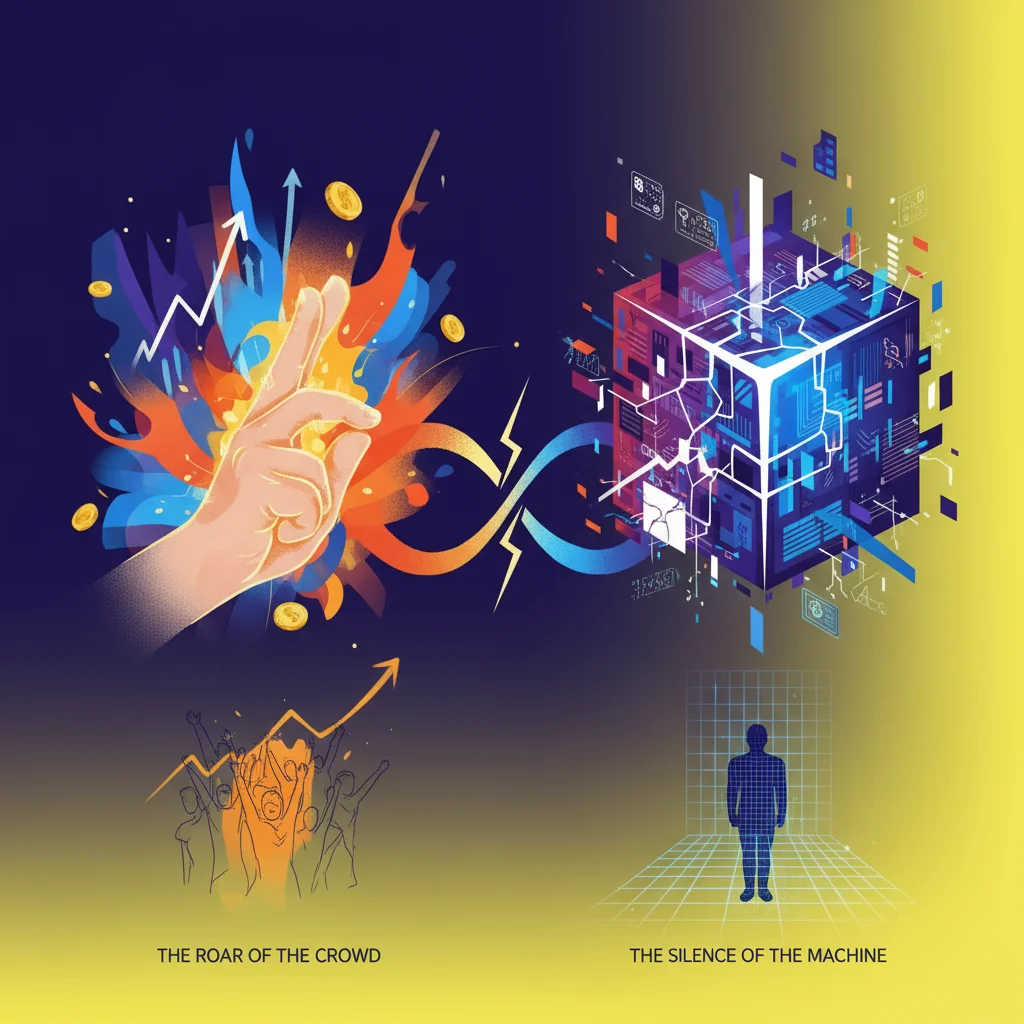
The Roar of the Crowd, The Silence of the Machine
Anyone who has watched a top-flight football match in the last few years is familiar with the scene: a breathtaking goal is scored, the stadium erupts, and players celebrate with unbridled joy. Then, a pause. The referee puts a finger to their ear. The letters V-A-R appear on the giant screen, and a wave of collective anxiety washes over tens of thousands of fans. The beautiful, chaotic, emotional game is now subject to the cold, frame-by-frame analysis of a machine. When the technology confirms the goal, the relief is palpable but muted. When it overturns the decision for a microscopic offside, the outrage is volcanic.
This phenomenon, as highlighted in a recent Financial Times analysis, isn’t just about sports. It’s a powerful real-world experiment in human psychology that holds critical lessons for the worlds of finance, investing, and technology. The core finding is simple yet profound: we are fundamentally less tolerant of machine-related errors than we are of human ones. A bad call from a human referee is frustrating, but we accept it as part of the game. A perceived error from the “infallible” Video Assistant Referee (VAR), however, feels like a betrayal of the system’s very promise.
This psychological quirk, often termed “algorithm aversion,” has monumental implications for an economy increasingly reliant on automated systems. From the trading floor to the retail banking app, we are placing immense trust in algorithms to manage our wealth and shape our financial futures. But as the VAR experiment shows, when these systems fail—or are even perceived to fail—the backlash can be severe, eroding trust far more quickly than any human mistake. For investors, business leaders, and fintech innovators, understanding this paradox is no longer optional; it’s essential for survival.
Algorithm Aversion: The Unseen Risk on the Trading Floor
For decades, the stock market was the domain of human intuition, gut feelings, and face-to-face transactions. Today, it is a realm dominated by algorithms. High-Frequency Trading (HFT) systems execute millions of trades in milliseconds, leveraging complex models to exploit tiny market inefficiencies. This is the financial world’s equivalent of VAR—a technological layer designed to optimize for speed, efficiency, and objectivity, removing human emotion from the equation.
The benefits are clear: increased liquidity, tighter spreads, and greater market efficiency. Yet, the risks mirror the football stadium’s fury. When a human trader makes a disastrous call, it’s often ring-fenced as an individual failure. But when a trading algorithm goes haywire, it can trigger a “flash crash,” wiping billions of dollars from the market in minutes. The 2010 Flash Crash, for instance, saw the Dow Jones Industrial Average plummet nearly 1,000 points in minutes before recovering, an event largely attributed to the interplay of automated trading programs (source).
The reaction to such events is not just financial; it’s deeply psychological. Investors and regulators don’t just see a mistake; they see a fragile, opaque system that has run amok. The trust deficit created by one algorithmic failure is immense. We built the machine to be perfect, and its imperfection feels like a fundamental breach of contract. This is the core of algorithm aversion: we will often choose a flawed human expert over a superior but imperfect algorithm, simply because we understand and can forgive human fallibility in a way we cannot for a line of code.
The Digital Euro: Europe's Final Defense for Monetary Sovereignty?
From Robo-Advisors to Blockchain: The Uncanny Valley of Trust
The VAR paradox extends far beyond the stock market, permeating the entire fintech landscape. The rise of robo-advisors, for example, promises democratized, low-cost investment management. These platforms use algorithms to build and manage portfolios based on a user’s risk tolerance. For the most part, they work exceptionally well. But what happens during a sudden, unprecedented market downturn? If a robo-advisor underperforms a human-managed fund, users aren’t just disappointed; they feel let down by the technology itself. The promise of data-driven superiority evaporates, and trust can be difficult to regain.
This challenge is also present in modern banking. AI-driven credit scoring models are designed to be fairer and more accurate than human loan officers, who can be prone to conscious or unconscious bias. However, when a person is denied a loan by a “black box” algorithm, the experience is profoundly alienating. There is no one to reason with, no context to provide. The computer says no, and the finality of that judgment feels far harsher than a decision made by a person you can speak with. As one study on the subject notes, people are quicker to abandon an algorithm than a human expert after seeing them both make the same mistake (source).
To better understand this dynamic, consider the key differences in how we perceive errors from human and automated financial systems.
| Factor | Human Financial Advisor | Automated System (e.g., Robo-Advisor, AI) |
|---|---|---|
| Source of Error | Perceived as misjudgment, bias, or lack of information. | Perceived as a fundamental flaw in the code or logic. |
| Psychological Reaction | Frustration, but often with an understanding of human fallibility. | Betrayal, confusion, and a rapid loss of trust in the entire system. |
| Path to Forgiveness | An apology, an explanation, and a plan to correct course. | Requires a system-wide update, greater transparency, and proof of improved performance. |
| Accountability | Clearly assigned to an individual or a team. | Diffuse and opaque. Who is to blame? The programmer? The data? The algorithm? |
Even blockchain, a technology built on the very concept of “trustless” verification, is not immune. A blockchain ledger is designed to be an immutable, objective record—the ultimate arbiter of truth, much like VAR aspires to be. Yet, when a poorly written smart contract is exploited, as in the infamous DAO hack, the fallout is catastrophic. Because the system was designed to be autonomous and perfect, its failures are seen as absolute. The “code is law” mantra breaks down when the code is flawed, leaving users with little recourse and a deep-seated distrust of the technology’s promise.
The Silent Shock: How Energy Poverty is Reshaping the US Economy and Your Investment Portfolio
Lessons for the Modern Economy: Building Resilient Systems for Imperfect Humans
The ongoing saga of VAR in football is more than just a sporting debate; it’s a crucial case study for the digital transformation of our economy. As we embed financial technology deeper into the fabric of our lives, we must design systems with human psychology in mind. The goal should not be to create a mythical, infallible machine, but to build resilient, transparent, and collaborative systems that can earn and maintain human trust, even when they inevitably make mistakes.
For business leaders and investors, this means asking critical questions:
- Is our system transparent? Can users understand, at a high level, how a decision was made? “Black box” algorithms breed suspicion. Explainable AI (XAI) is becoming a necessity, not a luxury.
- Is there a clear path for recourse? When an automated system fails, is there an efficient and empathetic human-led process to resolve the issue? A frustrating chatbot loop only deepens the anger.
- Are we managing expectations? Technology should be marketed on its realistic capabilities, not on a promise of perfection. Acknowledge the possibility of error and explain the safeguards in place.
Ultimately, our relationship with technology is emotional, not purely rational. We seek partners, not just tools. Just as football fans long for the flawed, human drama of the game, investors and consumers need to feel that they are still in control of their financial destiny. The most successful fintech innovations of the next decade will be those that don’t just offer superior performance, but also master the delicate art of building trust in an imperfect world.
Beyond the Cones: Unpacking the Hidden Financial Costs of Infrastructure Gridlock