The ‘Farage Clause’: Brussels’ New Brexit Gambit and Its High-Stakes Impact on the UK Economy
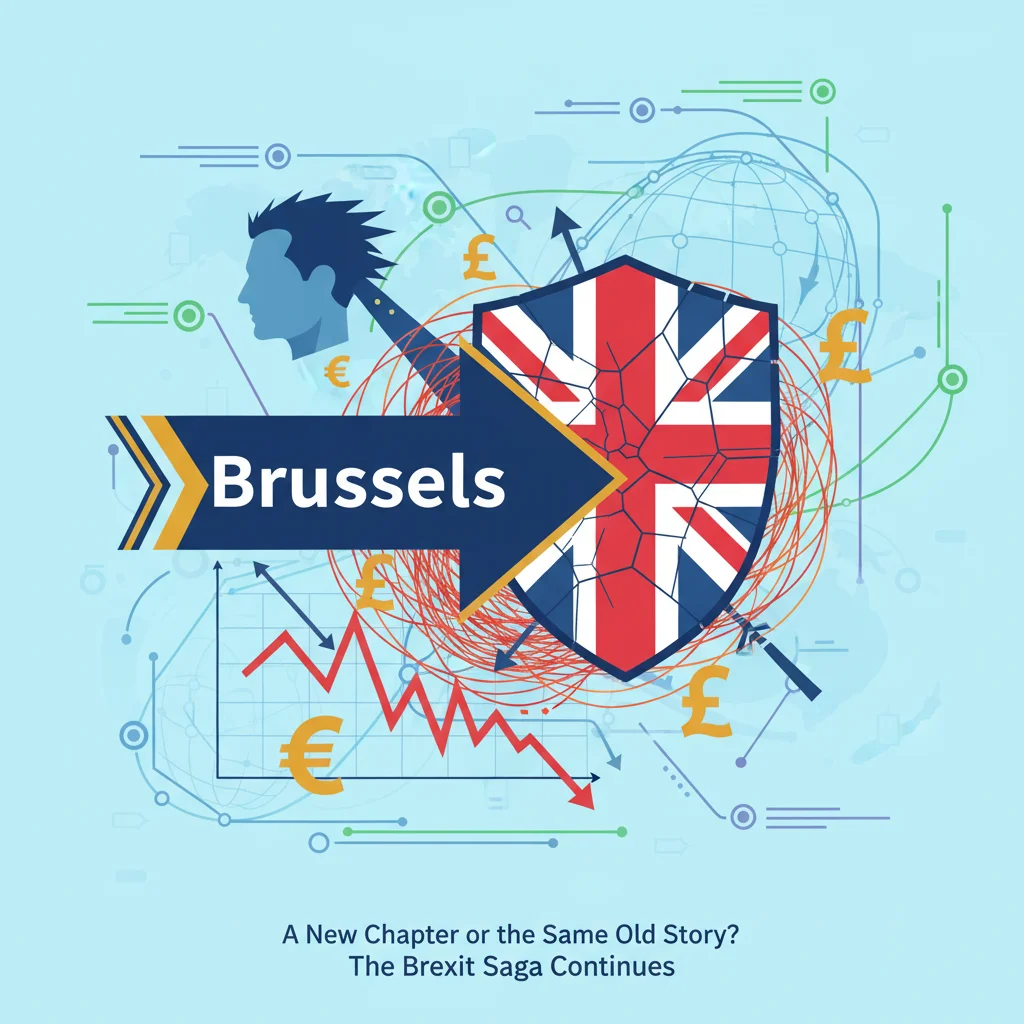
A New Chapter or the Same Old Story? The Brexit Saga Continues
In the ever-evolving drama of post-Brexit relations, a new and provocative term has entered the lexicon: the “Farage clause.” As Britain and the European Union attempt to reset their often-fractious relationship, Brussels has tabled a demand that could fundamentally reshape the future of the UK economy. This proposal, unearthed in recent talks, would grant the EU the power to unilaterally suspend parts of their trade agreement if it deems that the UK has diverged from EU rules to gain an “unfair” competitive advantage. According to a report from the Financial Times, this mechanism represents a significant hardening of the EU’s position on maintaining a “level playing field.”
For investors, business leaders, and finance professionals, this development is far more than a political headline. It introduces a new layer of systemic risk and uncertainty into the UK’s economic framework. The clause, unofficially named after the former UKIP leader Nigel Farage who championed a vision of a deregulated, post-Brexit Britain, strikes at the very heart of the sovereignty debate. It raises critical questions about the UK’s ability to forge its own economic path and the long-term stability of its trade relationship with its largest partner. This post will dissect the “Farage clause,” explore its profound implications for key sectors like finance and fintech, and analyze what it means for the future of investing in the UK.
Deconstructing the “Farage Clause”: More Than Just a Name
At its core, the proposed clause is a dynamic and potent enforcement tool. The existing UK-EU Trade and Cooperation Agreement (TCA) already contains “level playing field” provisions designed to prevent either side from undercutting the other on standards related to labour, environment, and state aid. However, these mechanisms are often seen as slow and subject to lengthy arbitration.
The “Farage clause” would be a significant escalation. It would empower the EU to act swiftly and pre-emptively. If the UK government decided to, for example, dramatically slash regulations in the financial technology sector to attract global talent and capital, the EU could, under this clause, respond by imposing targeted tariffs or suspending access for that sector. It’s a mechanism designed to create a “regulatory corridor” for the UK, where the freedom to diverge is perpetually checked by the threat of economic consequences.
The EU’s rationale is clear: to prevent a “Singapore-on-Thames” scenario. Brussels fears a future where a low-tax, low-regulation UK acts as a competitive thorn in its side, siphoning off investment and jobs. The clause is a preventative measure, a way to future-proof the trade deal against a UK government that might aggressively pursue the very deregulatory agenda that many Brexit proponents, like Farage, championed (source). For the UK, however, it represents a potential constraint on its sovereign ability to set its own laws and economic policy—the very prize Brexit was supposed to deliver.
The '1, 2, 4, 8, 16…?' Puzzle: A Masterclass in Financial Misdirection
The Economic Shockwaves: A Sector-by-Sector Analysis
The implications of such a clause would reverberate across the entire UK economy, but some sectors are more exposed than others. The constant threat of retaliatory measures creates a chilling effect that could stifle innovation and deter investment.
Finance and Banking
London’s status as a global financial hub is built on a sophisticated regulatory environment. The UK’s financial services sector was largely left out of the original TCA, operating on a limited “equivalence” framework. A key UK ambition has been to use its regulatory freedom to enhance the City’s competitiveness. However, any significant divergence from EU norms in areas like capital requirements, derivatives trading, or asset management could be a prime target for the “Farage clause.” This would put the UK’s banking and finance industry in a difficult position: innovate and risk being locked out of European markets, or align with EU rules and forfeit a key post-Brexit advantage. This uncertainty could impact valuations on the London stock market for financial institutions with heavy European exposure.
Fintech and Blockchain
The UK is a world leader in fintech, a sector that thrives on agile and forward-thinking regulation. The government has ambitions to become a global hub for crypto-assets and blockchain technology, which requires creating bespoke legal frameworks that do not yet exist in the EU. This is a clear area of potential divergence. If the UK creates a highly attractive regulatory and tax environment for crypto firms, the EU could argue this constitutes an unfair competitive advantage, potentially triggering the clause. This creates immense uncertainty for venture capital investing in UK-based financial technology startups, as their potential access to the vast EU market could be switched off with little warning (source).
Beyond the Cones: Unpacking the Hidden Financial Costs of Infrastructure Gridlock
The Divergence Dilemma: A High-Stakes Balancing Act
For business leaders and policymakers, the “Farage clause” presents a stark choice between sovereign ambition and economic pragmatism. The table below illustrates the potential trade-offs across key sectors.
| Sector | Potential Upside of Regulatory Divergence | Potential Downside (The ‘Farage Clause’ Risk) |
|---|---|---|
| Finance & Banking | More competitive capital markets, tailored rules to boost London’s appeal, faster adoption of new trading technologies. | Loss of market access for UK banks, retaliatory tariffs on financial services, increased compliance costs. |
| Fintech & Blockchain | Becoming a global hub for crypto and digital assets, attracting top talent and investment with agile regulation. | EU could block UK-based fintech platforms, data flows could be restricted, investor confidence could evaporate. |
| Life Sciences & Pharma | Faster drug approval processes, bespoke R&D incentives, attracting global pharmaceutical HQs. | UK-approved drugs face barriers to the EU market, supply chain disruptions, loss of research collaboration. |
| Manufacturing & Automotive | Simplified environmental and product standards to lower production costs for the domestic market. | Tariffs imposed on UK exports to the EU, making British goods uncompetitive; complex ‘rules of origin’ checks. |
The Investor’s Playbook: Navigating a New Era of Uncertainty
For those involved in investing and finance, this development demands a recalibration of strategy. The binary “deal or no deal” risk of the past has been replaced by a more nuanced, persistent regulatory risk.
- Price in Regulatory Risk: Asset managers and analysts must now explicitly model the risk of EU retaliation in their valuations of UK-listed companies, particularly those with significant revenue from the EU. The potential for sudden tariffs or market access restrictions is no longer a tail risk but a core consideration.
- Monitor Sector-Specific Policy: The impact will not be uniform. Investors need to pay close attention to the UK government’s policy direction in specific, high-stakes sectors like finance, tech, and life sciences. A government signaling aggressive deregulation could trigger market volatility for those industries.
- Favor Resilience and Diversification: Companies with globally diversified revenue streams and those less dependent on EU market access or supply chains will likely be viewed as safer investments. Conversely, UK-centric businesses in regulated industries face a higher risk profile.
The Lego Principle: What "Smart" Toys Teach Us About Dumb Investments
Conclusion: The Price of Freedom
The EU’s demand for a “Farage clause” is a pivotal moment in the post-Brexit journey. It is an attempt to draw a hard line around the UK’s economic sovereignty, effectively tethering Britain’s regulatory future to that of the continent. While it may be presented as a tool to ensure fair competition, it is perceived by many in the UK as a mechanism to limit British competitiveness.
For the worlds of finance, economics, and investment, the message is clear: the turbulence is not over. The path forward for the UK economy will be defined by a continuous negotiation between the political desire for divergence and the economic necessity of market access. The “Farage clause,” whether it is ultimately adopted or not, has already succeeded in framing the debate and highlighting the profound and lasting economic consequences of the UK’s historic decision to leave the European Union.

Related Posts

The High Price of Silence: Why Corporate America’s Climate Inaction is a Systemic Risk to the Global Economy

The High-Stakes Showdown: Why Political Interference with the Federal Reserve Threatens Your Portfolio and the Global Economy