Beyond the Farmgate: The Brutal Economics of the Milk Price Crisis
The Unseen Crisis in Your Morning Coffee
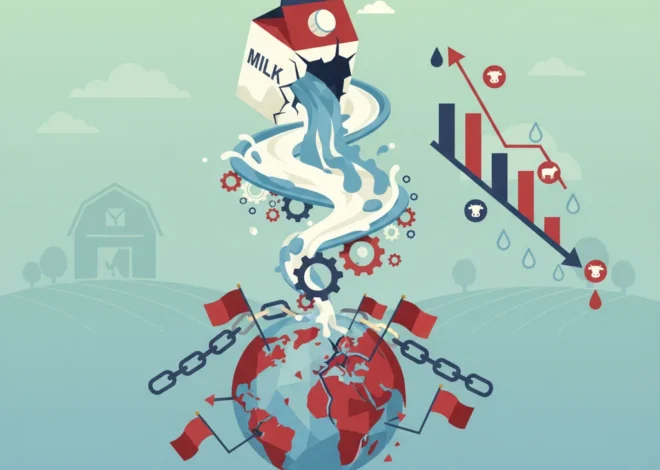
For many of us, the price of milk is a simple line item on a grocery receipt. But for farmers like Adam and Lucy Johnstone, it’s the line between survival and ruin. In a story that encapsulates a crisis rippling through the agricultural heartland, the Johnstones have watched the price they receive for their milk—the “farmgate” price—plummet by a staggering 25% in just three months. Their declaration, “We’re in survival mode,” is not hyperbole; it is the stark reality for thousands of family-run farms caught in the unforgiving gears of the global economy.
This isn’t just a story about agriculture. It’s a critical case study in commodity market volatility, supply chain economics, and the immense financial pressures on small businesses that form the bedrock of a nation’s food security. For investors, finance professionals, and business leaders, understanding the dynamics behind the Johnstones’ struggle offers profound insights into the fragility of our supply chains, the risks inherent in commodity-based industries, and the powerful economic forces that dictate prices from the farm to the stock market.
The Anatomy of a Price Collapse: A Perfect Storm
Why would the price of such a staple commodity fall so dramatically? The answer lies in a confluence of global and local pressures that expose the vulnerability of producers at the bottom of the value chain. Unlike a tech company that can pivot its services, a dairy farm is a high-inertia operation with massive fixed costs and a perishable product. They cannot simply stop milking cows when the price is low.
Several key factors are contributing to this downturn:
- Global Supply Gluts: Major milk-producing regions around the world have seen strong production levels, leading to an oversupply on the global market. This surplus inevitably pushes down prices for everyone.
- Fluctuating Input Costs: While the price farmers receive has fallen, their costs have not. The price of animal feed, fertilizer, and energy remains stubbornly high, squeezing profit margins to non-existent levels. According to a report from the Agriculture and Horticulture Development Board (AHDB), feed costs can represent over 50% of the variable costs on a dairy farm, making farmers highly sensitive to grain and soy market fluctuations.
- Supermarket Price Wars: Large retailers often use staple goods like milk as “loss leaders” to attract customers, engaging in intense price competition. This pressure is passed down the supply chain, ultimately forcing processors to offer lower prices to farmers.
- Shifting International Demand: Changes in import policies or economic slowdowns in major dairy-importing nations, such as China, can have an immediate and significant impact on global demand, creating a ripple effect that reaches farms in the UK and beyond.
This brutal combination of falling revenue and high, inflexible costs creates a cash flow crisis that can quickly become existential. Beyond the Algorithm: Securing Your Finance Career in the Age of AI
A Financial Snapshot: The Razor-Thin Margins of Dairy Farming
To truly grasp the severity of a 25% price drop, it’s essential to look at the economics of a typical family dairy farm. These are not just farms; they are complex businesses with significant capital investment and operational expenses. A price drop isn’t a minor inconvenience; it’s a direct threat to their solvency.
Consider this simplified monthly financial breakdown for a hypothetical mid-sized family dairy farm. This table illustrates how quickly a profitable enterprise can plunge into the red.
| Expense/Revenue Category | Before Price Drop (per litre) | After 25% Price Drop (per litre) | Monthly Impact (Example) |
|---|---|---|---|
| Revenue (Farmgate Price) | £0.48 | £0.36 | – £24,000 |
| Variable Costs | |||
| Feed Costs | £0.18 | £0.18 | £0 |
| Veterinary & Medicine | £0.03 | £0.03 | £0 |
| Fixed Costs | |||
| Labor | £0.08 | £0.08 | £0 |
| Energy & Utilities | £0.04 | £0.04 | £0 |
| Machinery & Maintenance | £0.05 | £0.05 | £0 |
| Banking & Loan Repayments | £0.06 | £0.06 | £0 |
| Total Costs (per litre) | £0.44 | £0.44 | £0 |
| Profit/Loss (per litre) | +£0.04 | -£0.08 | – £24,000 |
*Note: Figures are illustrative, based on a hypothetical farm producing 200,000 litres per month. Actual costs vary significantly.
As the table demonstrates, a previously sustainable, albeit slim, profit margin is instantly transformed into a catastrophic loss. This is where the role of banking becomes critical. Farms like the Johnstones’ rely on loans and lines of credit to manage cash flow and invest in equipment. A prolonged period of loss-making production puts them in breach of covenants and at risk of foreclosure, highlighting the systemic financial risk embedded in the agricultural sector.
From Dairy Farms to Digital Trading: Agriculture in the Financial Markets
The financial world is not detached from this crisis; it is deeply intertwined with it. Agriculture is a major asset class for sophisticated investors. The same forces tanking the Johnstones’ income are creating opportunities and risks in the world of investing and trading.
Investors can gain exposure to the dairy and broader agricultural sector through several avenues:
- Commodity Futures: Traders can buy and sell contracts for future delivery of milk, cheese, and other dairy products on exchanges like the CME Group. This is a direct play on price volatility.
- Publicly Traded Companies: Investing in the stock market through shares of large dairy processors and food conglomerates (e.g., Danone, Nestlé, Kraft Heinz) offers a different kind of exposure. These companies are often better insulated from farmgate price swings due to their scale, brand power, and diversified operations.
- Exchange-Traded Funds (ETFs): Agricultural ETFs provide diversified exposure to a basket of commodities or agribusiness stocks, spreading the risk.
The paradox is that while the primary producer is in “survival mode,” the vast financial ecosystem built around agricultural commodities continues to thrive. This highlights a structural issue within the economy: value is often captured furthest from the source of production. Beyond the Headlines: Decoding Iran's Economic Uprising and Its Global Ripple Effect
Can Technology Offer a Lifeline? The Promise of Agri-Fintech
While the outlook seems bleak, emerging innovations in financial technology could offer new models that empower farmers and disrupt the traditional, opaque supply chain. This is where the worlds of agriculture and fintech are beginning to collide.
One of the most promising areas is the application of blockchain technology. A blockchain-based system can create an immutable, transparent record of a product’s journey from farm to shelf. Imagine a carton of milk with a QR code. A consumer could scan it to see:
- The exact farm of origin (e.g., the Johnstone family farm).
- The date of milking and processing.
- Certifications (e.g., organic, grass-fed, antibiotic-free).
This level of transparency, as explored in research by institutions like IBM Food Trust, allows farmers to differentiate their product beyond a simple commodity. It enables them to build a brand, connect with consumers, and justify a premium price that insulates them from the volatility of the bulk market. It transforms milk from a fungible good into a verifiable, high-quality product.
Beyond blockchain, other fintech solutions are emerging:
- Direct-to-Consumer (D2C) Platforms: E-commerce and logistics platforms that help farmers sell directly to local consumers or businesses, cutting out intermediaries.
- Peer-to-Peer Lending: Financial platforms that connect farmers seeking capital directly with investors, offering an alternative to traditional banking.
- Micro-Hedging Tools: User-friendly apps that could allow smaller producers to hedge against price drops in the commodity markets, a risk management tool typically only accessible to large corporations.
These technologies are not a panacea, but they represent a potential shift in power back towards the producer. Apollo's European Power Play: Why a Leadership Shake-Up Signals a New Era of Dealmaking
The Final Word: A System in Need of an Overhaul
The story of Adam and Lucy Johnstone is a potent reminder that behind the abstract charts of the stock market and the complex theories of economics, there are real people and real businesses facing profound challenges. Their struggle is a symptom of a food system that is often inefficient, inequitable, and dangerously fragile.
For business leaders and investors, the milk price crisis is more than a headline; it’s a signal of systemic risk in a vital global industry. It underscores the need for innovation not just in farming techniques, but in the very financial and logistical structures that govern our food supply. The future of farming may well depend on our ability to integrate new financial models and technologies that create a more transparent, fair, and resilient path from the farmgate to the dinner table.