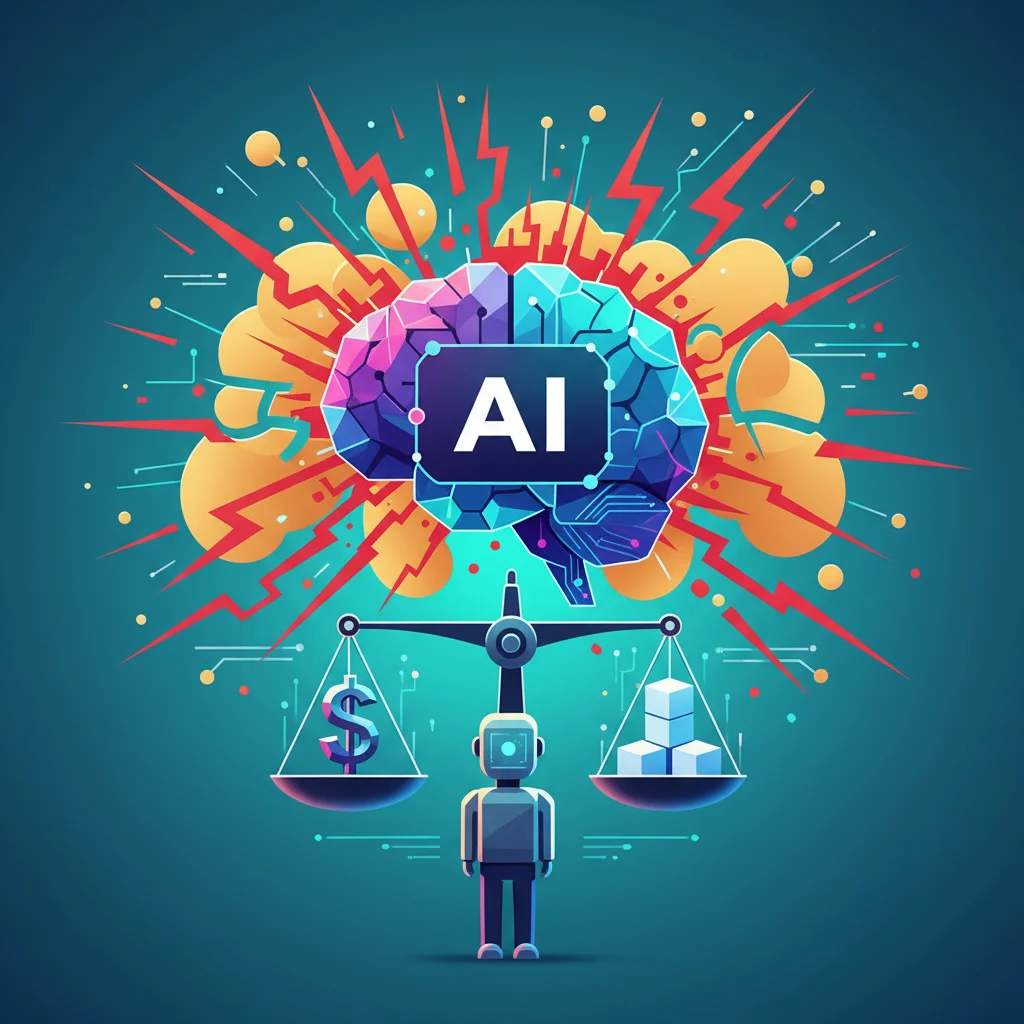
The Unbiased Broker: Can AI Deliver the Brutal Financial Truths We Need to Hear?
Imagine this scenario: you’re at a dinner party, and a friend excitedly tells you about a “guaranteed” stock tip they got from their cousin. They’re all in, and they think you should be too. Politeness, friendship, and the fear of missing out all cloud your judgment. Do you question their logic, potentially offending them? Or do you nod along, maybe even making a small, ill-advised investment to keep the peace?
This is the messy, emotional reality of human financial advice. Our relationships, biases, and a desire to be liked often prevent us from giving or receiving the cold, hard truths necessary for successful investing. It’s a point poignantly raised in a recent letter to the Financial Times by Steven Fogel, who suggests that machines, devoid of emotion and social obligation, might be the brutally honest financial advisors we all secretly need. As he puts it, “a machine has no friends to lose and no desire to be liked.” This simple yet profound observation opens a crucial discussion about the future of finance, the role of financial technology, and the psychology that governs our economic decisions.
In an era where fintech innovation is reshaping every corner of the banking and investing world, are we ready to hand over our financial futures to an algorithm? Let’s explore the powerful case for the unbiased machine and what it means for investors, the stock market, and the global economy.
The Human Flaw: Why Our Brains Are Wired for Bad Financial Advice
Before we can appreciate the value of an artificial advisor, we must first confront the inherent limitations of a human one. Behavioral economics has shown us time and again that humans are far from the rational economic actors we once thought we were. Our investment decisions are frequently driven by a cocktail of cognitive biases and emotional responses.
Consider the following:
- Confirmation Bias: We actively seek out information that confirms our existing beliefs. If we think a particular stock is a winner, we’ll gravitate toward positive news and ignore the red flags a friend might be too polite to point out.
- Herd Mentality: The fear of missing out (FOMO) is a powerful driver in the stock market. We see others making money on a trend and jump in, often at the peak, without doing our own due diligence. A human advisor might even be caught up in the same hype.
- Loss Aversion: Studies, like those by Nobel laureates Daniel Kahneman and Amos Tversky, have shown that the pain of losing is psychologically about twice as powerful as the pleasure of gaining. This can lead to irrational decisions, such as holding on to losing investments for too long in the hope they’ll recover. According to research highlighted by Charles Schwab, this bias can cause investors to sell winners too early and hold losers too long.
These biases don’t just affect individual investors; they can permeate advice from friends, family, and even professional advisors who are susceptible to the same psychological traps or are hesitant to deliver news that might upset a client. An algorithm, on the other hand, feels no such compunction. It doesn’t care about your feelings; it cares about the data, the parameters you’ve set, and the optimal path to achieving your goals.
The Investor's Crossword: Decoding the Puzzles of the Modern Economy
The Rise of the Algorithmic Advisor: Fintech’s Answer to Human Bias
The concept of machine-driven finance is no longer science fiction. The financial technology sector has exploded over the past decade, giving rise to “robo-advisors”—automated platforms that use algorithms to build and manage investment portfolios with minimal human intervention. Companies like Betterment and Wealthfront have democratized access to sophisticated investment strategies that were once the exclusive domain of the wealthy.
These platforms typically operate on principles of Modern Portfolio Theory, focusing on diversification and long-term, risk-adjusted returns. They can automatically rebalance your portfolio, harvest tax losses, and adjust your asset allocation as you approach your financial goals. The appeal is clear: low fees, accessibility, and, most importantly, the removal of emotional decision-making from the trading process.
To better understand the trade-offs, let’s compare the key attributes of a traditional human financial advisor with a modern robo-advisor.
| Feature | Human Advisor | Robo-Advisor (AI) |
|---|---|---|
| Objectivity | Susceptible to emotional and cognitive biases; potential conflicts of interest. | Purely data-driven and algorithmic; free from emotional bias. |
| Cost | Typically higher fees (e.g., 1-2% of assets under management). | Significantly lower fees (e.g., 0.25-0.50% of assets under management). |
| Accessibility | Often requires a high minimum investment; limited availability. | Low or no minimum investment; available 24/7 online. |
| Personalization | Can provide highly customized, holistic advice for complex situations (estate planning, tax strategy). | Generally goal-based but less flexible for unique, complex financial lives. |
| Emotional Support | Can act as a behavioral coach, providing reassurance during market volatility. | Cannot provide empathy or understand nuanced life circumstances. |
The growth of this market is a testament to its appeal. The global robo-advisory market is projected to reach nearly $3.7 trillion in assets under management by 2027, according to a report from Statista, demonstrating a massive shift in investor confidence towards automated solutions.
Beyond Personal Investing: AI’s Systemic Impact on Finance and the Economy
The influence of AI and machine learning extends far beyond personal portfolio management. These technologies are becoming the central nervous system of the modern financial industry, impacting everything from global banking to macroeconomic policy.
- Algorithmic Trading: In the high-stakes world of the stock market, high-frequency trading (HFT) firms use complex algorithms to execute millions of trades in fractions of a second, capitalizing on tiny price discrepancies. This accounts for a significant portion of daily trading volume.
- Credit and Risk Management: Lenders are increasingly using AI models to analyze thousands of data points—beyond a simple credit score—to assess risk more accurately and reduce bias in lending decisions. A McKinsey report highlights that AI can help banks unlock hundreds of billions of dollars in value through enhanced risk modeling and fraud detection.
- Economic Forecasting: Central banks and economists are leveraging machine learning to analyze vast datasets and predict economic trends with greater accuracy, potentially leading to more effective monetary policy.
- Blockchain and AI Synergy: The combination of AI with blockchain technology promises a future of highly secure, transparent, and efficient financial systems. AI can analyze on-chain data for fraudulent activity, while blockchain can provide an immutable ledger for AI-driven transactions.
This technological integration is creating a more efficient, data-driven financial ecosystem. However, it also raises new challenges, including the risk of “flash crashes” caused by rogue algorithms, the ethics of “black box” AI decisions, and the need for new regulatory frameworks to govern this complex new world.
XRP's Post-SEC Surge: Navigating the Crossroads of Regulation and Market Reality
How to Build Your Own “Bionic” Investment Strategy
So, how should a modern investor navigate this evolving landscape? The most prudent approach is not to choose between man and machine, but to leverage the strengths of both. Here are some actionable steps:
- Use Machines for Your Core Portfolio: For the bulk of your long-term, goal-based savings (like retirement or a down payment), a low-cost robo-advisor or index fund strategy is an excellent, disciplined foundation. Let the algorithm handle the asset allocation and rebalancing, protecting you from your own worst emotional instincts.
- Identify Your “Human-Needed” Gaps: Do you have a complex tax situation? Are you a small business owner? Are you planning your estate? These are areas where the nuanced, holistic advice of a certified human financial planner is invaluable.
- Employ AI as Your Unbiased Analyst: Use financial technology tools to screen for investments based on quantitative factors (P/E ratio, dividend yield, etc.). This provides a data-driven starting point for your research, free from the narrative hype that can surround popular stocks.
- Consult a Human as Your Behavioral Coach: The greatest value a human advisor can provide is often during periods of extreme market volatility. Having someone to call who can talk you out of panic-selling during a downturn can be worth far more than their annual fee. As the original letter to the FT implies, sometimes we need an objective view, but other times we need a steady hand.
The Domino Effect: Why the UK's Pub Rates Relief Is Igniting a Wider Call for Tax Reform
Conclusion: An Alliance of Intellects
Steven Fogel’s observation that a machine “has no friends to lose” is a powerful reminder of the fundamental challenge in human financial affairs. The objectivity and brutal honesty that algorithms can provide are not just a novelty; they are a potent antidote to the cognitive biases that have cost investors dearly for centuries.
The future of finance is not a dystopian takeover by machines, but a powerful alliance between artificial and human intelligence. By delegating the cold, calculating, data-driven tasks to our silicon counterparts, we free ourselves to focus on what we do best: understanding context, navigating complex life goals, and providing the empathy and wisdom that no algorithm can replicate. The truly savvy investor of tomorrow will not choose a human or a machine; they will build a team of both.