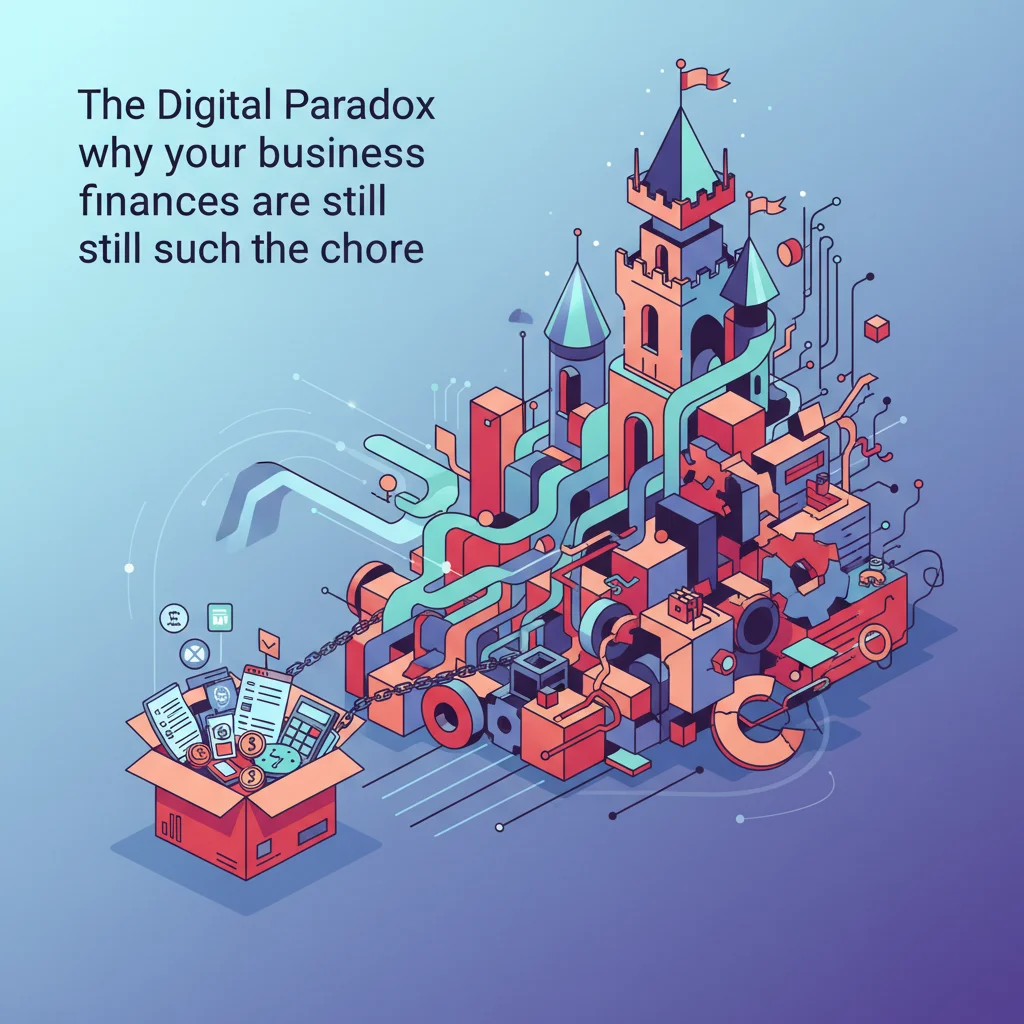
The Digital Paradox: Why Your Business Finances Are Still Such a Chore
The Unfulfilled Promise of Digital Finance
In the sleek, automated world promised by financial technology (fintech), the small business owner was supposed to be king. Freed from the tyranny of shoeboxes overflowing with receipts and cumbersome spreadsheets, they were meant to be strategic leaders, armed with real-time data and effortless financial clarity. Yet, for many, the reality is a far cry from this utopian vision. The tools have changed, but the fundamental burden of financial administration remains, a persistent drag on productivity and innovation.
This very issue was recently highlighted in a letter to the Financial Times by Stuart Miller, a director at the cloud accounting giant Xero. He pointed out a stark contradiction: while digital tools are indispensable, small and medium-sized enterprise (SME) leaders still dedicate an astonishing amount of their time—nearly a full day each week—to financial admin. According to research cited by Xero, this figure sits at nearly 10% of their working hours. This isn’t just a minor inconvenience; it’s a significant bottleneck in our economic engine, a silent tax on the very businesses we rely on for growth and job creation.
This article dives deep into this digital paradox. We will explore why bookkeeping, even with advanced software, remains a chore. We’ll analyze the wider implications for the economy, investing, and the future of financial technology. And finally, we’ll look over the horizon to the next wave of innovation that might finally deliver on the promise of a truly frictionless financial backbone for business.
From Ledgers to the Cloud: A Brief History of a Persistent Problem
To understand today’s challenges, we must appreciate the journey of business accounting. For centuries, the double-entry ledger was the pinnacle of financial technology—a revolutionary system of checks and balances, but one that was entirely manual, painstaking, and prone to human error. The advent of personal computers brought spreadsheets, offering a new level of calculation power but creating infamous problems of version control and formula errors.
The first wave of dedicated accounting software, like early versions of Sage and QuickBooks, digitized the ledger but kept it siloed on a single desktop. The real game-changer was the cloud. Platforms like Xero, the company Stuart Miller represents, ushered in an era of accessibility, collaboration, and real-time data. The benefits were, and still are, immense.
However, this evolution has also revealed a stubborn truth: digitizing a process is not the same as truly automating it. While the cloud solved the problems of access and data silos, it didn’t eliminate the core tasks. Invoices still need to be created, coded, and chased. Bank transactions must be reconciled. Expense reports need to be submitted and approved. The software provides a better interface for these chores, but it doesn’t always eliminate them.
The table below illustrates the gap between the promise of modern digital bookkeeping and the experienced reality for many SME leaders.
| The Promised Benefit | The Experienced Reality |
|---|---|
| Effortless Automation | Rule-based automation requires significant setup and manual review. Mismatches and exceptions still demand human intervention. |
| Seamless Integration | APIs can be fragile. Disconnected systems (e.g., CRM, e-commerce, banking) create data silos that require manual bridging. |
| Real-Time Insights | Data is only as good and as timely as its input. A lag in data entry means the “real-time” dashboard is actually a rear-view mirror. |
| Simplified Compliance | Software helps with tax calculations (like VAT), but the ultimate responsibility and complexity of compliance still rests on the business owner. |
This gap between expectation and reality is the source of the friction. Business owners are left managing a suite of powerful but partially disconnected tools, turning them into reluctant systems integrators on top of their primary roles. The Domino Effect: Why the UK's Pub Rates Relief Is Igniting a Wider Call for Tax Reform
The Macroeconomic Cost of Micro-Frustrations
The 10% of a business leader’s time spent on financial admin is not just lost time; it’s a colossal misallocation of a critical economic resource: entrepreneurial focus. SMEs are the lifeblood of modern economies. In the UK, they account for 99.9% of the business population and around three-fifths of employment. When their leaders are bogged down in bookkeeping, they are not engaging in the high-value activities that drive growth—strategy, product development, customer engagement, and sales.
This administrative drag has several cascading negative effects on the broader economy:
- Suppressed Productivity: A nation’s productivity is the aggregate of its businesses’ efficiency. A systemic 10% time sink across millions of SMEs acts as a powerful brake on national economic output.
- Inhibited Growth: Scaling a business requires strategic foresight. When leaders are trapped in the operational weeds of day-to-day finance, their ability to plan for the future is compromised, leading to slower growth trajectories.
- Increased Risk for Investors: For those involved in finance and investing, the quality and timeliness of an SME’s financial data are paramount. Inconsistent or delayed bookkeeping obscures a company’s true financial health, making it a riskier proposition for loans and equity investment. This can starve promising companies of the capital they need to expand.
- Barriers to Entrepreneurship: The prospect of navigating complex financial administration can be a significant deterrent for would-be entrepreneurs, potentially stifling the creation of new businesses that are vital for a dynamic economy.
Ultimately, the health of the stock market and the broader economy is intrinsically linked to the performance of the businesses that comprise it. Solving the administrative burden on SMEs isn’t a niche technological problem; it’s a macroeconomic imperative. Beyond the Hangover: The Multi-Billion Dollar Economics of Dry January
The Next Frontier: Towards a Zero-Admin Future
The good news is that the technology to solve this “last mile problem” is finally maturing. The next evolution in fintech is moving beyond simple digitization and towards intelligent, autonomous systems. This shift is being driven by a convergence of several key technologies.
A recent report by McKinsey & Company highlights that AI is reaching a pivotal moment in financial services, moving from a background process to a core driver of value. This is where the true transformation lies.
Here’s a look at the technologies poised to finally deliver on the promise of effortless finance:
| Technology | Impact on SME Financial Admin |
|---|---|
| Artificial Intelligence (AI) & Machine Learning (ML) | Goes beyond simple bank rules to intelligently categorize expenses with high accuracy, detect fraudulent transactions, and provide predictive cash flow forecasting based on historical patterns. |
| Open Banking & API Economy | Creates truly seamless, real-time, and two-way data flows between banks, payment processors, and accounting platforms, eliminating the need for manual reconciliation and data import/export. |
| Blockchain / Distributed Ledger Technology (DLT) | While still emerging for SMEs, it holds the long-term potential for creating a single, immutable “source of truth” for transactions between businesses, automating auditing and B2B invoicing/payments. |
| Embedded Finance | Integrates financial services (like lending, insurance, payments) directly into the business software SMEs already use, making access to capital and services a natural part of their workflow rather than a separate, arduous process. |
Imagine a future where an invoice is paid, and the transaction is automatically pulled via Open Banking, categorized with 99.9% accuracy by an AI, reconciled against the invoice, and reflected in a real-time cash flow forecast—all without the business owner lifting a finger. This is the “zero-admin” future that the fintech industry is striving for. It’s a future that transforms financial management from a reactive, historical chore into a proactive, strategic asset. XRP's Post-SEC Surge: Navigating the Crossroads of Regulation and Market Reality
Conclusion: Reclaiming the Entrepreneur’s Most Valuable Asset
Stuart Miller’s observation is more than a simple critique; it’s a call to action for the entire financial technology ecosystem. The first wave of digital accounting tools successfully moved us from paper to the cloud, but the job is not finished. The persistence of the “bookkeeping chore” is a clear signal that the true value lies not in creating better digital filing cabinets, but in building autonomous financial engines that run silently in the background.
For business leaders, the message is to be discerning and demanding of your technology partners. For those in banking and finance, recognizing that streamlined SME operations lead to better data and lower investment risk is key. And for investors, the fintech companies that are laser-focused on solving this fundamental, universal pain point represent the next multi-billion dollar opportunity in the market.
The ultimate goal is to give back the entrepreneur’s most precious and finite resource: time. By eliminating the 10% administrative drag, we can unlock a corresponding 10% increase in time spent on vision, strategy, and growth. Multiplied across millions of businesses, that is an economic stimulus of staggering proportions, one that will be built not by government policy, but by code.

Related Posts

The £1,500 Refund That Took 15 Months: A Case Study in Corporate Inefficiency and the Fintech Imperative

Beyond the Numbers: What a 10-Digit Puzzle Reveals About Our Financial World