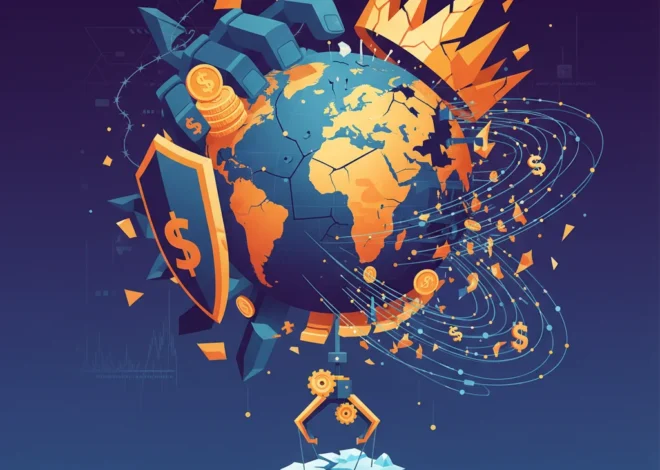
Global Crossroads: Why a Finance Giant is Ditching US Assets Amidst Geopolitical Shockwaves
In today’s interconnected world, the whispers from a bond trader’s desk in California can be as impactful as a politician’s declaration on the world stage. Seemingly unrelated events—a major investment firm shifting its strategy, a geopolitical statement concerning the Middle East, and a quiet diplomatic initiative in the Arctic—are not isolated incidents. They are threads in a complex tapestry, weaving a picture of a global economy at a critical inflection point. For investors, business leaders, and anyone engaged in the world of finance, understanding these connections is no longer optional; it’s essential for navigating the volatile landscape ahead.
This week, three such signals have emerged, each demanding closer inspection. PIMCO, one of the world’s largest asset managers, is making a significant pivot away from US assets, a move that raises profound questions about the future of the American economy. Simultaneously, geopolitical tensions are being stirred by former President Donald Trump’s comments on Iran, reminding markets that political risk is an ever-present variable. And far to the north, a new working group focused on Greenland hints at the burgeoning global competition for the resources that will power the next generation of financial technology and green energy. Let’s dissect these developments and explore what they signal for the future of global markets and investing.
PIMCO’s Pivot: A Canary in the Coal Mine for the US Economy?
When a behemoth like PIMCO, with over $1.8 trillion in assets under management, changes its tune, the entire market listens. The firm has recently signaled a strategic move to reduce its exposure to US government debt and credit. This is not a minor portfolio rebalancing; it’s a statement of conviction from one of the most influential players in the global bond market. The core of their concern lies with the United States’ deteriorating fiscal position. The combination of a ballooning budget deficit and persistently high interest rates is creating a challenging environment for US-domiciled assets.
For years, US Treasuries have been the bedrock of the global financial system—the ultimate “risk-free” asset. However, PIMCO’s caution suggests this perception may be eroding. The firm is increasingly finding more attractive, risk-adjusted returns in other developed markets, including the UK, Canada, and Australia (source). This shift is driven by a simple calculation: other sovereign bond markets are offering compelling yields without the same level of fiscal overhang that currently plagues the US.
What does this mean for the average investor and the broader stock market? PIMCO’s move could be a leading indicator of a broader trend. If more large-scale institutional investors begin to favor non-US assets, it could lead to increased borrowing costs for the US government, put downward pressure on the US dollar, and introduce a new layer of volatility into equity markets. It’s a stark reminder that in the world of global economics, no dominance is permanent, and capital will always flow toward the most favorable conditions.
The Billion Playbook: Why Josh Harris is Betting Big on the Future of Sports
Geopolitical Tremors: The Market Impact of Political Rhetoric
While PIMCO’s decisions are rooted in deep economic analysis, the market is also constantly buffeted by the winds of geopolitics. In a recent development, former US President Donald Trump announced that he has received assurances from a “very high level” in Iran that protesters arrested during recent anti-regime demonstrations would not be harmed. While the statement’s immediate diplomatic impact is being debated, its effect on the market is more tangible: it injects another dose of uncertainty into an already fragile Middle East.
The US-Iran relationship has long been a critical factor in global energy markets. Any perceived shift in policy or increase in tensions can send shockwaves through the price of oil, which in turn affects everything from transportation costs to corporate earnings and consumer inflation. For those involved in commodities trading, such statements are immediate catalysts for price action. For long-term investors, they serve as a crucial reminder that geopolitical risk must be a fundamental component of any robust investment thesis.
This event highlights a broader theme: the increasing weaponization of economic policy and the fusion of political rhetoric with market dynamics. Modern investing is no longer just about analyzing balance sheets and economic forecasts; it’s also about understanding the complex interplay between world leaders, national interests, and their potential to disrupt global supply chains and capital flows. The line between Wall Street and Washington has never been more blurred.
The Greenland Gambit: Securing the Future of Technology and Energy
Far from the immediate noise of markets and politics, a quieter but equally significant development is taking place in the Arctic. The establishment of a new “Greenland working group” by the US and its allies signals a strategic push to secure access to the island’s vast, untapped mineral resources. Greenland is believed to hold one of the world’s largest deposits of rare earth elements—the essential building blocks for modern technology.
These are not just obscure elements on the periodic table; they are critical components in everything from smartphones and electric vehicle batteries to advanced defense systems and the very servers that power the fintech revolution. The global supply chain for these minerals is currently dominated by China, a strategic vulnerability that Western nations are now urgently seeking to address.
Below is a look at some of the key resources in Greenland and their vital applications in today’s economy.
| Mineral/Element | Primary Application | Strategic Importance |
|---|---|---|
| Neodymium (Nd) | High-strength magnets for EV motors and wind turbines | Crucial for the green energy transition |
| Dysprosium (Dy) | Enhances magnet durability at high temperatures | Essential for high-performance electronics and defense |
| Terbium (Tb) | Used in high-efficiency lighting and advanced sonar systems | Key to both energy efficiency and military technology |
| Zinc (Zn) | Galvanizing steel, batteries, and alloys | Fundamental industrial metal for infrastructure and manufacturing |
This focus on Greenland represents a long-term strategic play with profound implications for investing. It highlights the shift towards supply chain resilience and the “friend-shoring” of critical industries. Companies and countries are realizing that dependence on a single source for vital materials is an unacceptable risk. This will likely spur a wave of investment in mining, refining, and processing capabilities in politically stable regions. For investors, this opens up new opportunities in the materials sector, green technology, and the entire ecosystem supporting the electrification of the global economy. Even the world of blockchain is getting involved, with platforms being developed to ensure the ethical and transparent sourcing of these critical minerals.
The Coming Copper Crisis: Why a Metal Shortage Poses a Systemic Risk to the Global Economy
Conclusion: A New Playbook for a New Era
The pivot by PIMCO, the political posturing over Iran, and the strategic maneuvering in Greenland are not just headlines to be consumed and forgotten. They are vital data points that, when connected, reveal the contours of a new global landscape. The era of straightforward, fundamentals-only investing is giving way to a more complex, multi-faceted reality.
The key takeaway for anyone in business or finance is the need for a holistic and adaptive strategy. This means looking beyond traditional economic indicators to understand the deep currents of fiscal policy, geopolitical risk, and the long-term competition for resources. The decisions being made today in corporate boardrooms, government offices, and remote Arctic outposts will shape the investment returns, technological advancements, and economic realities of tomorrow. Navigating this new world requires vigilance, a multidisciplinary perspective, and the recognition that in our globalized system, everything is connected.
Beyond the Burger: Why McDonald's Harassment Allegations Are a Red Flag for Investors