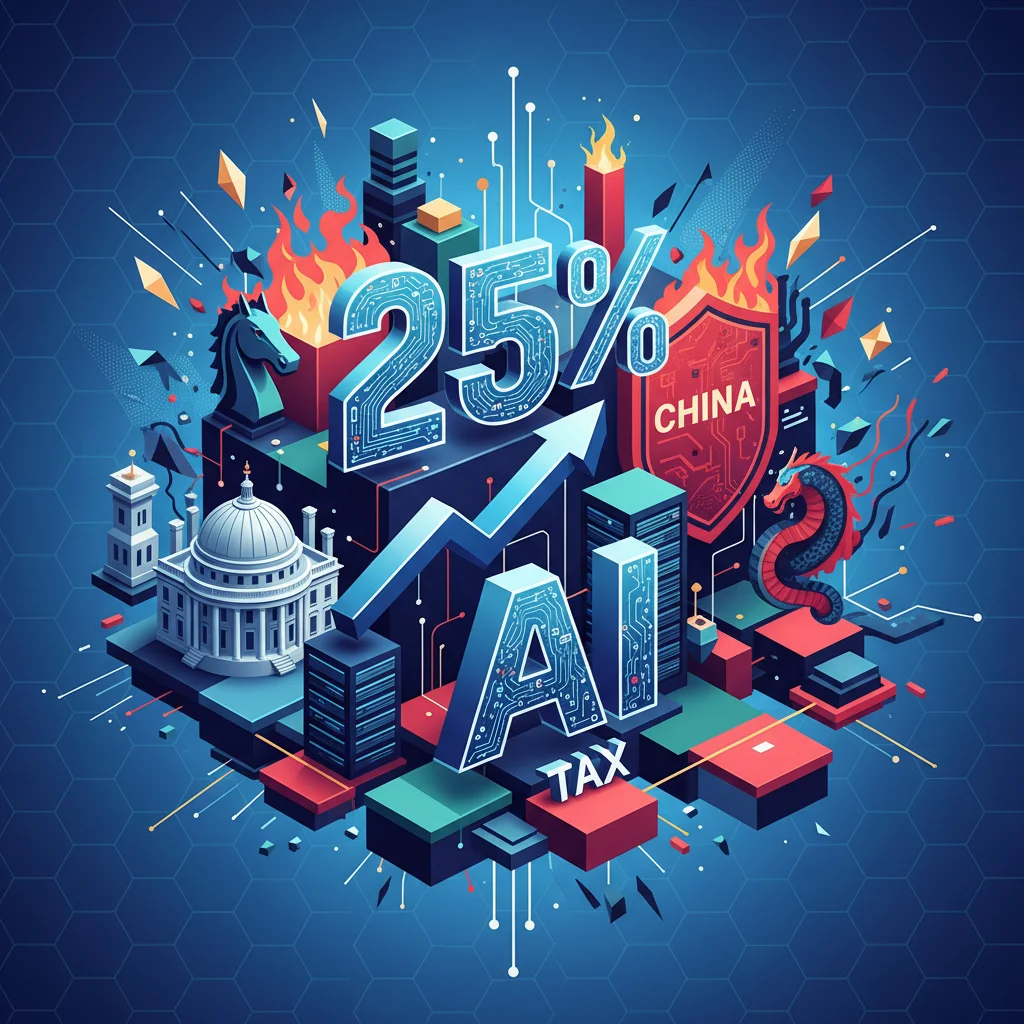
The 25% AI Chip Tax: Unpacking the White House’s New Gambit in the Tech War with China
In the high-stakes chess match for global technological supremacy, the United States has just made a bold and unexpected move. It’s not a sweeping ban or a fiery proclamation, but something far more nuanced and, perhaps, more telling. The White House is set to impose a 25% tariff on high-end artificial intelligence (AI) processors sold by American giants like Nvidia and AMD to China. This isn’t just another trade headline; it’s a fundamental shift in strategy that will send ripples through every corner of the tech world, from sprawling cloud data centers to the garage-based startups dreaming of the next big thing in machine learning.
For years, the narrative has been about outright restrictions and export controls designed to cut off China’s access to the bleeding-edge hardware that powers modern AI. This new policy, however, changes the game. Instead of building a wall, the U.S. is building a tollbooth. According to a report from the Financial Times, these semiconductor levies are the culmination of a deal originally cut by the Trump administration, signaling a rare and powerful bipartisan consensus on how to manage competition with Beijing.
But what does this 25% “AI tax” truly mean? Is it a clever way to slow down a rival while still allowing American companies to profit? Or is it a move that could backfire, accelerating China’s own journey toward semiconductor independence? In this deep dive, we’ll unpack the mechanics of this new tariff, explore its strategic implications, and analyze what it means for developers, tech professionals, and entrepreneurs caught in the geopolitical crossfire.
From Ban to Tollbooth: Understanding the Strategic Shift
To grasp the significance of this move, we need to look at the context of the ongoing U.S.-China tech war. Previously, the primary weapon of choice for the U.S. was the “Entity List,” which effectively blacklisted Chinese tech giants like Huawei and restricted their access to American technology. This was followed by sweeping export controls aimed at preventing the most advanced AI chips—like Nvidia’s A100 and H100 GPUs—from reaching Chinese shores.
The goal was clear: deny China the tools needed to build advanced machine learning models for both commercial and military applications. However, this approach had its drawbacks. It created a complex cat-and-mouse game, with chipmakers designing slightly less powerful “export-compliant” chips and intermediaries finding creative ways to smuggle restricted hardware into China.
This new tariff represents a tactical pivot. Instead of a complete blockade, the U.S. is now saying, “You can have the chips, but it’s going to cost you.” This 25% levy, as reported by the FT, formalizes a deal that allows shipments to continue under new economic terms. Why this change in approach?
- Slowing, Not Stopping: An outright ban risks completely ceding the massive Chinese market to future domestic competitors. A tariff, on the other hand, makes building large-scale AI infrastructure significantly more expensive for Chinese companies. This can slow their pace of innovation and deployment without cutting off a crucial revenue stream for Nvidia and AMD, whose earnings are closely watched by Wall Street.
- Funding the Home Team: While not explicitly stated, it’s plausible that the revenue generated from these tariffs could be used to fund domestic initiatives like the CHIPS and Science Act, which aims to bolster semiconductor manufacturing on U.S. soil. It’s a way of making a strategic rival indirectly pay for strengthening American competitiveness.
- Pragmatism Over Purity: Enforcing a total ban is notoriously difficult. A tariff acknowledges the reality that these chips will likely find their way to China one way or another. By taxing the transaction, the U.S. government ensures it extracts a price, regardless of the supply chain’s twists and turns.
To better understand this evolution in policy, let’s compare the different strategies the U.S. has employed.
| Strategy | Description | Key Players Involved | Primary Goal & Impact |
|---|---|---|---|
| Entity List Restrictions | Blacklisting specific companies (e.g., Huawei), requiring U.S. firms to obtain a special license to sell to them. | Department of Commerce, Huawei, ZTE | Isolate and cripple targeted firms. Highly effective but narrow in scope. |
| Sweeping Export Controls | Banning the sale of specific high-performance chips (e.g., Nvidia A100) to any entity in China. | Nvidia, AMD, ASML, U.S. Government | Deny access to cutting-edge technology. Led to workarounds and “export-friendly” chips. |
| The New 25% AI Chip Tariff | Imposing a 25% tax on the sale of AI processors to China, making them more expensive but not illegal. | White House, Nvidia, AMD, Chinese AI firms | Raise the cost of AI development for China, slow its progress, and potentially generate revenue. |
This table illustrates a clear progression from targeted attacks to broad restrictions, and now to a more flexible, economic form of warfare. It’s a sophisticated adjustment that acknowledges the complexities of a globally integrated tech ecosystem.
Bricks vs. Bytes: The Battle for the Soul of London's Truman Brewery
However, the long-term risk is immense. Every dollar this tariff adds to the cost of an Nvidia GPU is another dollar of incentive for Beijing to pour into its domestic semiconductor industry. This could be the very catalyst that accelerates China’s self-sufficiency, turning a long-term problem into a medium-term one. We might look back at this moment not as a masterstroke of economic statecraft, but as the moment the U.S. inadvertently kicked China’s domestic chip innovation into overdrive. The line between clever and too clever is razor-thin.
The Ripple Effect: What This Means for the Tech Ecosystem
A 25% price hike on the most critical hardware for artificial intelligence isn’t a localized event. Its effects will cascade across the entire industry, impacting everyone from cloud providers to individual programmers.
For Developers and Tech Professionals
If you’re a developer working on AI/ML projects, you might not be buying Nvidia H100s directly, but you are renting them through cloud services. Major Chinese cloud providers like Alibaba Cloud, Tencent Cloud, and Baidu AI Cloud are massive consumers of these chips. A 25% increase in their hardware costs will inevitably be passed on to customers. This could lead to:
- Higher Cloud Computing Costs: Companies and developers using Chinese cloud platforms for AI model training and inference will likely see their bills go up.
- Shifts in Global Software Development: For global companies, the cost-benefit analysis of using a Chinese cloud provider versus AWS, Google Cloud, or Azure might change, potentially shifting workloads and data to Western platforms.
- Impact on Open-Source Collaboration: As the cost to run and test large models increases in China, it could affect the contributions of Chinese developers and researchers to the global open-source AI community.
For Startups and Entrepreneurs
For startups, especially those in the AI space, this new tariff introduces both challenges and opportunities.
- Increased Geopolitical Risk: If your business model relies on a supply chain or customer base in China, the landscape just became more volatile. This tariff could be the first of many new economic tools that create unpredictable costs.
- A Spur for Hardware Innovation: The high cost and restricted access to top-tier GPUs could create a market opening for startups developing alternative AI acceleration hardware. Companies working on neuromorphic chips, optical computing, or more efficient silicon architectures may find new investors and customers.
- Re-evaluating SaaS and Cloud Strategy: SaaS startups serving the global market will need to think carefully about their infrastructure. The growing divergence in cost and regulation between tech ecosystems may require a multi-cloud strategy that isolates operations by region.
The Billion AI Deal Caught in the Crossfire: Why China is Scrutinizing Meta’s Latest Acquisition
For the Cybersecurity Landscape
At its core, this policy is a matter of national security, framed through an economic lens. The U.S. intelligence community has repeatedly warned that China could use advanced AI for military purposes, from autonomous weaponry to sophisticated surveillance and cyber warfare. The tariff is a tool to degrade a strategic competitor’s ability to develop these capabilities.
This move underscores the deep connection between commercial technology and national cybersecurity. The same GPUs used to create a viral deepfake video or power a recommendation engine can also be used to train models for cracking encryption or piloting autonomous drones. The 25% levy is a direct attempt to make the latter more difficult (source).
The Road Ahead: China’s Response and the Future of Global AI
The ball is now in Beijing’s court. China is unlikely to absorb this new cost without a response. We can anticipate several potential moves:
- Retaliatory Tariffs: The most straightforward response would be to impose tariffs on American goods in other sectors, such as agriculture or automotive, where U.S. companies have significant market share in China.
- Accelerated Domestic Investment: This is the most critical long-term reaction. Beijing will almost certainly double down on its national strategy to achieve semiconductor independence, pouring massive state subsidies into domestic champions like SMIC and Huawei’s HiSilicon.
- Legal Challenges: China may challenge the tariffs at the World Trade Organization (WTO), though such processes are often slow and their outcomes uncertain.
This escalating cycle of action and reaction threatens to cleave the world into two distinct technological spheres of influence: one led by the U.S. and its allies, and another centered around China. For the world of programming and software, this could lead to a “splinternet,” with different standards, platforms, and data governance regimes. The dream of a single, global, interoperable tech ecosystem is fading fast.
Grok, AI, and a Dark Web Discovery: Confronting the Shadow of Innovation
In conclusion, the White House’s 25% AI chip tariff is far more than a simple trade policy. It is a sophisticated, calculated maneuver in a generational struggle for technological leadership. It reflects a new doctrine that favors economic friction over outright technological blockades. While it may succeed in slowing China’s AI ambitions in the short term and giving American companies a continued foothold in the market, it also pours fuel on the fire of China’s quest for self-reliance.
For all of us in the tech industry, this is a stark reminder that the code we write, the products we build, and the platforms we use do not exist in a vacuum. They are inextricably linked to the grand currents of geopolitics. Navigating this new, more complex world will require not just technical skill, but strategic foresight and a keen understanding of the global landscape.