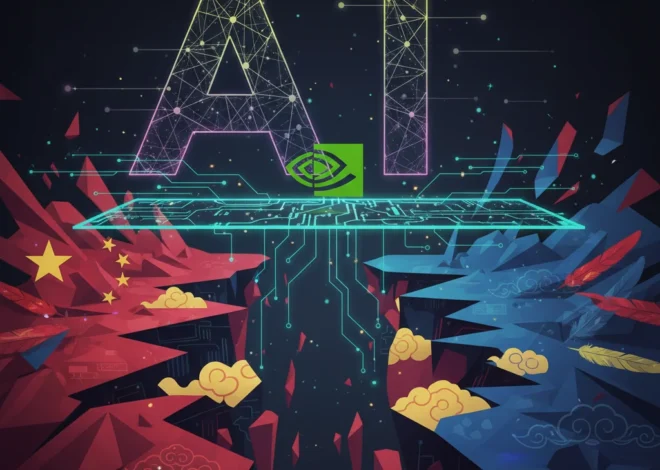
Nvidia’s Geopolitical Gambit: Decoding the US Approval of H200 AI Chip Sales to China
In the high-stakes world of global technology, the battle for artificial intelligence supremacy is the main event. At the heart of this contest lies a single company: Nvidia. For months, Nvidia has been the focal point of a geopolitical tug-of-war, caught between its largest market, China, and the stringent export controls of its home country, the United States. Now, in a move that has sent ripples through the finance and technology sectors, the US has reportedly approved the sale of Nvidia’s advanced H200 AI chips to China. This decision is not just a regulatory footnote; it’s a pivotal plot twist in the ongoing economic and technological narrative shaping our future.
This development raises critical questions for investors, business leaders, and anyone tracking the global economy. Is this a strategic concession from Washington, a sign of a shifting strategy, or a calculated risk? For Nvidia, it’s a potential lifeline to a crucial revenue stream. For China, it’s a vital component for its AI ambitions. For the stock market, it’s another variable in an already complex equation. In this analysis, we will dissect the layers of this decision, explore its profound implications for the semiconductor industry, and chart its potential impact on everything from international trade to your investment portfolio.
The Great Tech Decoupling: A Primer on US Export Controls
To understand the gravity of the H200 approval, one must first grasp the context of the fierce technological rivalry between the United States and China. Over the past several years, the U.S. government has implemented a series of increasingly restrictive export controls aimed at slowing China’s progress in advanced technologies, particularly those with potential military applications. The primary targets of these controls have been high-performance semiconductors—the very chips that power advanced AI models, supercomputers, and sophisticated weaponry.
The logic is simple: by restricting access to the most powerful computing hardware, the U.S. aims to create a bottleneck in China’s technological development. This strategy directly impacted Nvidia, the undisputed leader in AI-accelerating GPUs. In 2022, the U.S. Department of Commerce banned the sale of Nvidia’s top-tier A100 and H100 chips to China. This was a major blow, as China represented a significant portion of Nvidia’s data center revenue. According to some reports, the Chinese market accounted for as much as 20-25% of Nvidia’s data center business before the stringent controls were enacted (source).
Nvidia’s response was a masterclass in corporate adaptation. To comply with the regulations while still serving its Chinese clients, the company developed “watered-down” versions of its chips, such as the A800 and H800, which fell just below the performance thresholds set by the U.S. government. However, in October 2023, the rules were tightened again, closing these loopholes and effectively banning the A800 and H800 as well. This left Nvidia in a precarious position, seemingly locked out of a multi-billion dollar market and forcing Chinese tech giants like Baidu and Alibaba to seek alternatives or develop their own domestic solutions.
The Investor's Crossword: Decoding the Clues of Today's Complex Economy
The H200 Chip: A Surprising Green Light
The narrative took an unexpected turn with the news that the US has approved the sale of the H200 chip. The H200 is Nvidia’s latest and most powerful AI GPU, a successor to the wildly successful H100. It boasts significantly more memory bandwidth, a critical factor for training large language models (LLMs) and other generative AI applications. The approval is perplexing because, on the surface, it seems to contradict the very spirit of the export control regime. Why would the U.S. block the H100 only to approve its more powerful successor?
The answer likely lies in the fine print. It’s highly probable that the H200 chips approved for China are, once again, modified versions designed to specifically comply with the latest performance density parameters set by the Commerce Department. Nvidia has been developing a new trio of chips for the Chinese market—the H20, L20, and L2—all of which are based on the same architecture as their more powerful counterparts but have their capabilities curtailed to meet U.S. export rules (source). The “H200” designation in the recent news might refer to a chip that, while carrying the branding of the new generation, has performance characteristics closer to the H20 model.
To illustrate the technical differences, let’s compare the flagship H100 with the reported specs of the China-specific H20. This comparison highlights how Nvidia engineers its products to navigate complex trade regulations.
| Specification | Nvidia H100 (Banned in China) | Nvidia H20 (Designed for China) | Key Implication |
|---|---|---|---|
| Memory | 80 GB HBM3 | 96 GB HBM3e | H20 has more memory, but this is offset by other limitations. |
| Memory Bandwidth | 3.35 TB/s | Up to 4.0 TB/s | Higher bandwidth is good for LLMs, a key selling point for the H20. |
| FP32 Performance (Compute) | 67 TFLOPS | 21 TFLOPS (Estimated) | This is the critical difference. The H20’s raw compute power is significantly reduced to comply with U.S. rules. |
| Interconnect Speed (NVLink) | 900 GB/s | 400 GB/s | Slower interconnect speed hampers the ability to build massive, powerful supercomputers by linking many chips together. |
As the table shows, the H20 is a cleverly designed product. It offers improvements in some areas, like memory, to remain attractive to customers, but its core computational power and ability to scale are deliberately capped. This allows Nvidia to continue its business in China without directly violating U.S. national security concerns, a delicate balancing act that has massive implications for its stock market valuation and future revenue.
Financial Shockwaves: What This Means for the Economy and Your Portfolio
The constant back-and-forth of chip regulations creates significant volatility and opportunity in the financial markets. This latest development is no exception, with clear consequences for investors, the broader economy, and the future of financial technology.
1. Nvidia’s Stock Market Resilience
For Nvidia (NVDA), this approval is a significant bullish catalyst. The fear of being completely shut out of the Chinese market has been a persistent cloud over its otherwise stellar stock market performance. Gaining clarity and an approved pathway to sell *any* advanced chips provides a more stable revenue floor. This reduces uncertainty for investors and allows analysts to more confidently model future earnings. While the profit margins on these compliance-focused chips may be lower than their top-tier counterparts, the sheer volume of the Chinese market ensures it remains a lucrative endeavor. The news reinforces the narrative of Nvidia’s indispensability in the AI revolution and its adeptness at navigating macroeconomic challenges.
2. The Semiconductor Sector’s New Normal
This event sets a precedent for the entire semiconductor industry. Companies like AMD and Intel, which are also developing AI accelerators, now have a clearer picture of the regulatory “sandbox” they can play in. The U.S. government’s stance appears to be evolving from a blanket ban to a more nuanced approach of “managed competition.” This could lead to a new wave of “export-grade” products from various tech companies, creating a distinct and competitive market segment. For those investing in the sector, it’s crucial to analyze not just a company’s technology, but also its strategy for addressing these geopolitical constraints.
Beyond the Headlines: The Economic Toll and Investment Signals in the UK's New Road Safety Overhaul
3. Fueling the Fintech and Trading Engines
The availability of powerful AI chips has a direct impact on the financial technology (fintech) sector. Modern finance relies heavily on massive computational power for everything from high-frequency trading and algorithmic portfolio management to AI-driven risk analysis and fraud detection. While Chinese firms may not be getting the absolute best, the approved chips are still powerful enough to drive significant innovation in their domestic financial technology landscape. This ensures that the global race in fintech will remain competitive. The continued flow of advanced, albeit regulated, hardware is essential for the evolution of digital banking, decentralized finance (though blockchain applications are often less GPU-intensive than AI), and AI-powered economic modeling.
The Long Game: Future Outlook and Strategic Implications
While this approval provides a short-term solution for Nvidia and a much-needed supply for Chinese tech firms, the long-term strategic implications are complex. On one hand, the U.S. successfully maintains its goal of preventing China from accessing the absolute pinnacle of AI hardware, thus slowing the development of military-grade AI. The performance caps are specifically designed to hinder the training of the largest, most powerful foundational models that could have dual-use applications (source).
On the other hand, this strategy carries risks. By continuing to supply China with highly capable (though not cutting-edge) chips, the U.S. may be inadvertently subsidizing China’s AI ecosystem, allowing it to thrive and innovate within the established guardrails. Furthermore, it does little to halt China’s long-term ambition of achieving semiconductor self-sufficiency. Chinese firms like Huawei are aggressively developing their own AI accelerators, and while they still lag behind Nvidia, the persistent threat of sanctions is the ultimate motivator for their research and development.
For business leaders and finance professionals, the key is to view the U.S.-China tech relationship not as a simple on/off switch, but as a dynamic, constantly recalibrated system. The global economy is too interconnected for a complete decoupling. Instead, we are entering an era of managed, strategic competition where technology, finance, and geopolitics are inextricably linked.
A Raid or an Invasion? Polymarket's .5M Controversy and the High-Stakes Future of Fintech
In conclusion, the U.S. approval of Nvidia’s H200 chip sales to China is a landmark event that signals a new, more nuanced phase in the tech cold war. It is a testament to Nvidia’s remarkable ability to innovate both technologically and politically. For the investment community, it underscores the importance of looking beyond quarterly earnings and understanding the geopolitical currents that can define a company’s success or failure. The global race for AI dominance is far from over, and this latest move has just reset the board, ensuring that the game will be more complex, and more fascinating, than ever before.