Netflix’s Ultimate Endgame: Why a Warner Bros. Bid is a High-Stakes Play for AI and Cloud Dominance
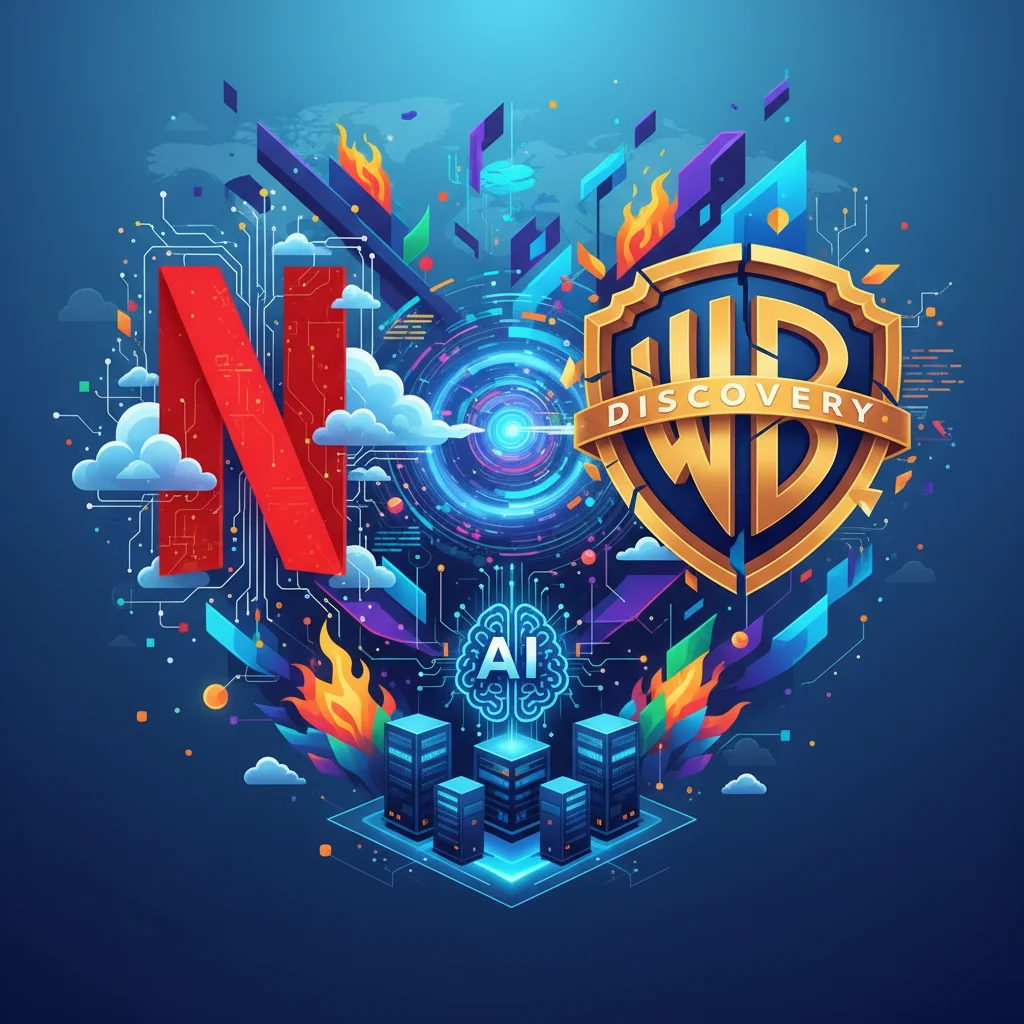
The rumor mill in Hollywood and Silicon Valley is spinning at full throttle. The latest bombshell? Netflix is reportedly gearing up for an all-cash offer to acquire Warner Bros. Discovery, a move designed to outmaneuver a rival bid from Paramount and Skydance. According to a report from the Financial Times, this isn’t just another corporate chess move; it’s a potential earthquake that could reshape the entire entertainment landscape.
At first glance, this looks like a classic content play. Warner Bros. holds the keys to an enviable kingdom of intellectual property (IP): Batman, Harry Potter, Game of Thrones, and the entire DC universe. For Netflix, a company that spends billions annually on original content, acquiring this treasure trove seems like a no-brainer.
But to see this merely as a content grab is to miss the forest for the trees. This potential acquisition is a deeply technological play, a strategic move rooted in data, artificial intelligence, and the relentless pursuit of efficiency through software and cloud infrastructure. For developers, entrepreneurs, and tech professionals, this is more than just a Hollywood drama; it’s a fascinating case study in how a tech-native giant plans to absorb and revolutionize a legacy institution. It’s a story about the future of media, powered by code and algorithms.
The State of Play: A Three-Way Royal Rumble
To understand the gravity of Netflix’s potential move, we need to look at the current battlefield. The “streaming wars” have matured from a land grab for subscribers into a brutal war of attrition. Profitability, not just growth, is now the name of the game. In this arena, three major players are at a crossroads:
- Warner Bros. Discovery (WBD): A legacy behemoth formed from a messy merger, WBD is saddled with enormous debt but also owns one of the world’s most iconic content libraries. They are struggling to find their footing, balancing a cinematic past with a streaming future.
- Paramount Global: Another legacy studio facing similar challenges. Their potential merger with David Ellison’s Skydance Media is an attempt to scale up and compete, appealing directly to shareholders for a path forward (source).
- Netflix: The original disruptor. Netflix is no longer a scrappy startup; it’s a global tech powerhouse. With a massive subscriber base and a sophisticated tech stack, it’s in a position of strength, looking for its next big evolutionary leap.
The Paramount-Skydance bid for WBD represents a consolidation of old media. Netflix’s potential all-cash offer is something entirely different: the new guard attempting to absorb the old. Below is a high-level comparison of these titans:
| Metric | Netflix | Warner Bros. Discovery | Paramount Global |
|---|---|---|---|
| Primary Business Model | Direct-to-Consumer Subscription (SaaS) | Diversified (Studio, Cable, Streaming) | Diversified (Studio, Cable, Streaming) |
| Tech Infrastructure | Cloud-Native, Microservices Architecture | Hybrid; Mix of Legacy and Modern Cloud | Hybrid; Mix of Legacy and Modern Cloud |
| Core Strength | Global Scale, Data & AI, User Experience | Iconic IP Library (DC, Harry Potter) | Strong Broadcast Network, IP (Mission: Impossible) |
| Strategic Challenge | Content Costs, Market Saturation | Massive Debt, Streaming Profitability | Scaling Streaming, Competing with Giants |
Beyond the Content: The AI and Machine Learning Engine
Acquiring the WB library isn’t just about having more movies to stream. It’s about acquiring a century’s worth of data and creative assets to feed into Netflix’s sophisticated machine learning models.
Think about it. Netflix’s success was built on its recommendation algorithm—a powerful piece of software that analyzes viewing habits to personalize the user experience and predict what content will perform well. Now, imagine feeding that algorithm the entire Warner Bros. catalog. This would allow Netflix to:
- Deconstruct Success: Use AI to analyze the narrative structures, character archetypes, and pacing of timeless classics. What makes “The Dark Knight” resonate differently than “Casablanca”? This isn’t just academic; these insights can inform the development of new original content with a higher probability of success.
- Unlock IP Potential: An AI could map out the entire DC universe, identifying underutilized characters or storylines ripe for a new series or film. It could analyze decades of audience data to predict which spin-off would have the highest ROI, moving beyond gut-feel creative decisions to data-driven ones.
- Hyper-Personalize Marketing: With a deeper well of content, Netflix’s automation tools could create millions of micro-targeted ad campaigns. Imagine an AI identifying users who love complex anti-heroes and gritty noir films, then serving them a custom trailer for a new Batman series that emphasizes those specific elements.
This is where the real value lies—not just owning the IP, but having the technological prowess to analyze, understand, and monetize it at a scale legacy studios can only dream of.
Humanoid Robots: Why China's Latest Leap Forward Should Have Silicon Valley on High Alert
The Ultimate SaaS Integration Challenge: Merging Hollywood with Silicon Valley
Netflix is, at its core, a SaaS company. Its product is entertainment, delivered via a highly scalable, resilient cloud architecture. The prospect of integrating Warner Bros., a company with decades of legacy workflows, physical assets, and a completely different corporate culture, is a monumental tech challenge.
This is a scenario familiar to many tech professionals and startups who have gone through mergers and acquisitions. How do you merge two vastly different tech stacks? How do you migrate terabytes—or more likely, petabytes—of archival data to the cloud? The integration would require a masterclass in:
- Cloud Migration: Moving WB’s vast digital archives, from film negatives to modern digital intermediates, onto a unified cloud platform like AWS (which Netflix heavily uses). This is a colossal undertaking in data management and logistics.
- Workflow Automation: Hollywood production is notoriously reliant on manual processes and fragmented systems. Netflix could implement its own production management software and automation pipelines to streamline everything from pre-production scheduling to post-production visual effects rendering, drastically cutting overhead.
- Cybersecurity Overhaul: The IP of Warner Bros. is a crown jewel for pirates and state-sponsored hackers. Securing this newly acquired digital territory would be a top priority. This involves implementing cutting-edge cybersecurity protocols to protect everything from employee emails to pre-release versions of blockbuster films, a task that has become increasingly complex in recent years.
Innovation as a Moat: The Future of Content Creation
This potential acquisition is also a profound statement about the future of innovation in media. For decades, the barriers to entry in Hollywood were capital and distribution. Today, the moat is increasingly technological.
Netflix isn’t just a distributor; it’s a technology company that produces content. It has pioneered the use of 4K HDR streaming, interactive storytelling (e.g., *Bandersnatch*), and a global content delivery network (CDN) that ensures a smooth experience for hundreds of millions of users. By acquiring Warner Bros., Netflix could use the studio as a real-world R&D lab for the next generation of entertainment technology.
Imagine Warner Bros. studios becoming a hub for AI-driven filmmaking. This could include:
- Virtual Production: Expanding the use of technologies like Unreal Engine for creating digital sets, allowing for more creative flexibility and lower production costs.
- AI-Powered Post-Production: Using machine learning for tasks like color grading, rotoscoping, and even initial editing cuts, freeing up human artists to focus on higher-level creative decisions.
- Generative AI Scripting: While controversial, AI tools could be used to brainstorm plot points, generate dialogue variations, or check for continuity errors, acting as a powerful assistant for writers and showrunners.
This fusion of creative artistry and cutting-edge programming could create an unassailable competitive advantage, making it nearly impossible for less tech-savvy competitors to keep up.
The Ultimate API: Is Vagus Nerve Stimulation the Future of Tech-Driven Wellness?
Why This Matters to You
Even if you’re not a Hollywood executive, this story is relevant. It’s a macro-level example of trends impacting every corner of the tech industry.
- For Entrepreneurs & Startups: It shows that even at a massive scale, the core principle of using technology to disrupt and optimize a legacy industry holds true. Netflix’s potential bid is the ultimate “build *and* buy” strategy.
- For Developers & Programmers: It highlights the immense career opportunities at the intersection of media and tech. The demand for engineers who understand cloud architecture, AI/ML, and data science is exploding in the entertainment sector.
- For Cybersecurity Professionals: It underscores the critical importance of protecting digital assets. As more value shifts from the physical to the digital realm, the role of cybersecurity becomes central to corporate survival.
The reported all-cash offer for a celebrated studio (source) is a clear signal. Netflix isn’t just trying to win the streaming wars—it’s trying to redefine the very nature of an entertainment company. It’s a vision where content and code are inextricably linked, where creative genius is amplified by artificial intelligence, and where a global SaaS platform becomes the foundation for the next century of storytelling. Whether the deal happens or not, the message is clear: the future of Hollywood will be written in Silicon Valley.
The Grok Dilemma: When AI Innovation Clashes with Human Dignity
The battle for Warner Bros. is more than a headline-grabbing acquisition. It’s a glimpse into a future where the lines between technology and media are completely blurred. It’s a high-stakes, all-cash bet that the company with the best algorithms, the most robust cloud infrastructure, and the most innovative software will ultimately wear the crown.