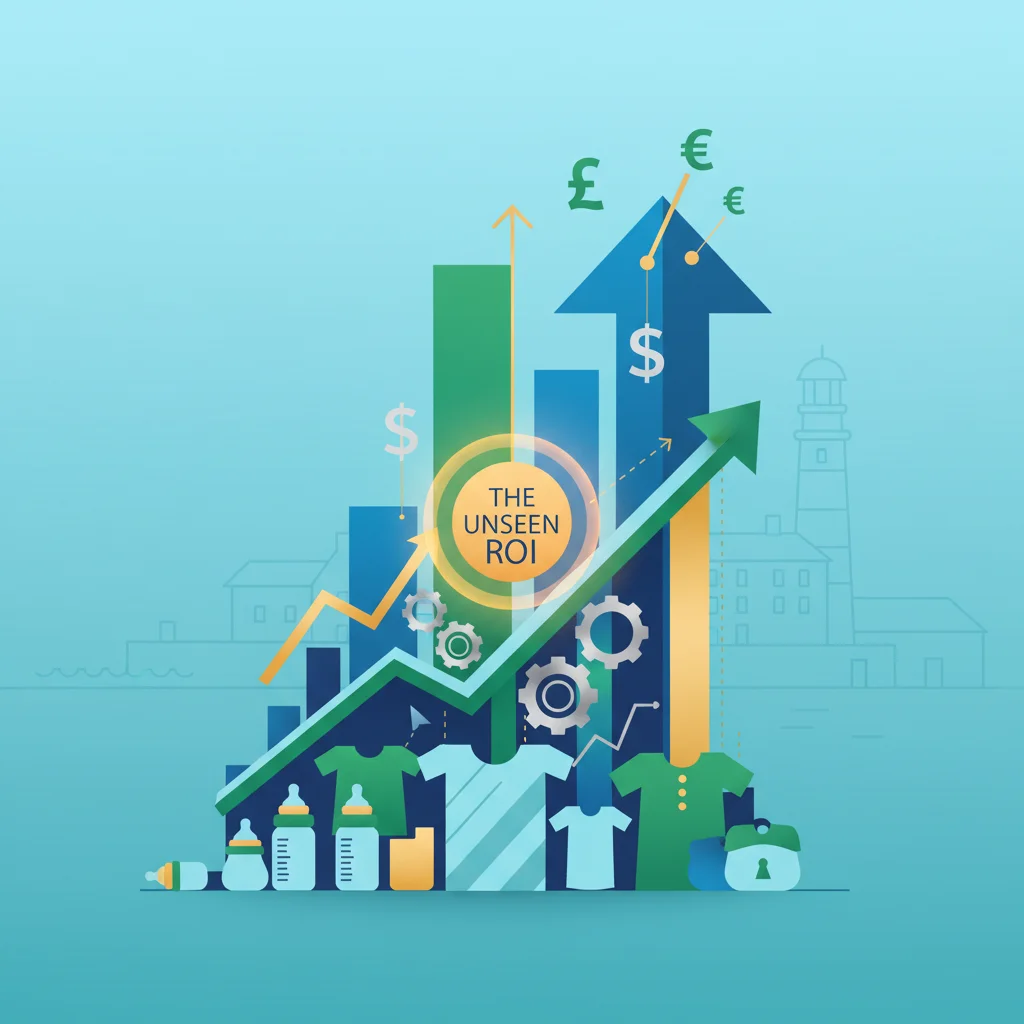
The Unseen ROI: Why a Local Baby Bank is a Masterclass in Economic Resilience and Smart Investing
In the coastal town of Weymouth, a small charity named Family Matters is doing remarkable work. It operates a “baby bank,” providing essential supplies to parents of young children. One of its volunteers was once a recipient of its services, a poignant story of a community support system coming full circle. On the surface, this is a heartwarming local news item, a story of kindness and civic duty. But for those in finance, investing, and business leadership, it represents something far more profound. This small operation is a living case study in one of the most critical and often overlooked assets in a modern economy: social capital.
What does a local charity have to do with the stock market, fintech innovation, or macroeconomic policy? The answer is: everything. The story of the Family Matters volunteer isn’t just about charity; it’s a perfect illustration of Social Return on Investment (SROI). It demonstrates how a small, targeted investment in a family’s stability can yield decades of positive returns, including workforce participation, reduced strain on public services, and the creation of a more resilient community. This is the foundational principle that savvy investors and policymakers are beginning to recognize as the cornerstone of sustainable economic growth.
The ‘Baby Bank’ as a Micro-Venture Capital Fund
To understand the economic power at play, we must reframe our perspective. Stop viewing a charity like Family Matters as a cost center and start seeing it for what it is: a highly efficient micro-venture capital fund for human potential.
- The Capital Injection: Instead of cash, the capital consists of donated goods (diapers, formula, clothing) and volunteer hours. This is a low-cost, high-impact initial investment.
- The Portfolio Company: The “startup” is the family unit. The investment is made at a critical early stage where it can have a disproportionately large effect on the long-term trajectory.
- The Return on Investment: The returns are not measured in quarterly earnings but in long-term societal and economic benefits. A child who has a stable, healthy start is more likely to succeed in school, become a skilled member of the workforce, and contribute to the tax base. The parent, freed from immediate existential stress, is better able to secure employment or education. The volunteer who was once helped, as highlighted in the original BBC report, embodies the ultimate dividend: a self-perpetuating cycle of positive contribution.
This model is a masterclass in the principles of long-term value investing. It prioritizes foundational stability over short-term gains, a lesson from which many in the world of corporate finance and public market trading could learn. The concept of SROI attempts to quantify this. While traditional ROI is a simple financial calculation, SROI measures the broader economic, social, and environmental value created. For every £1 invested in early years support, studies consistently show a return of multiple pounds in future savings on healthcare, social care, and the justice system, not to mention the added economic output. According to some analyses, the long-term economic cost of child poverty in the UK is estimated to be upwards of £39 billion a year, a staggering liability that proactive, community-level “investments” can directly mitigate.
Venezuela's Iron Fist: Analyzing the Economic Fallout of a New Political Crackdown
ESG Investing’s Litmus Test: From Corporate Pledges to Community Action
In recent years, Environmental, Social, and Governance (ESG) criteria have become a dominant force in the investing world. Trillions of dollars are now allocated based on metrics that go beyond the balance sheet. Yet, the “S” in ESG often remains the most ambiguous and difficult to measure. Corporations publish glossy reports on diversity initiatives and community engagement days, but the real, tangible impact on society happens at the grassroots level, in places like the Family Matters baby bank.
For investors and business leaders, these organizations are the litmus test for a company’s social commitment. A corporate partnership with a local charity provides a direct, verifiable channel for creating social value. It’s an opportunity to move beyond performative gestures and engage in authentic action that strengthens the communities where businesses operate. This isn’t just philanthropy; it’s a strategic imperative. A healthy, stable community provides a better workforce, a more vibrant customer base, and a lower-risk operating environment. As global advisory firm PwC notes, a strong ESG proposition can lead to higher financial performance and enhanced brand value, directly impacting a company’s position on the stock market.
The Stark Economics of Intervention vs. Inaction
The decision to support community initiatives is not merely a moral one; it is a stark economic choice between a low-cost, proactive investment and a high-cost, reactive liability. The data clearly shows that the cost of addressing the consequences of poverty and instability far outweighs the cost of preventing them.
Let’s consider a simplified comparison of these two economic pathways.
| Economic Pathway | Description | Associated Costs (Long-Term) | Economic Outcome |
|---|---|---|---|
| Proactive Investment (The ‘Baby Bank’ Model) | Community-based early intervention and support for families, providing essential resources and stability. | Low (donated goods, volunteer time, small operational grants). | Increased workforce participation, higher future tax revenues, lower healthcare costs, reduced crime, stronger local economy. |
| Reactive Liability (The ‘Inaction’ Model) | Waiting for crises to develop and then deploying state resources to manage the consequences. | High (unemployment benefits, emergency housing, child protective services, justice system costs, long-term healthcare). | Reduced GDP, increased strain on public finance, generational poverty cycles, decreased economic mobility. |
This table illustrates a fundamental principle of risk management familiar to any seasoned trader or investor: it is always cheaper to mitigate a risk than to recover from a disaster. The traditional banking and finance sectors are built on this idea, yet we have been slow to apply it to our most valuable asset: our people.
Hyundai's Robotic Workforce: A New Era for Manufacturing or a Reaction to a Troubled Past?
The Future: Scaling Social Impact with Financial Technology
If organizations like Family Matters are such efficient engines of social and economic value, the next logical question is: how do we scale them? This is where the world of fintech and financial technology offers revolutionary potential.
The current model of charitable giving, while well-intentioned, is often inefficient. New technologies can create a more direct, transparent, and impactful connection between capital and community needs.
- Blockchain for Transparency: Imagine a donation platform built on blockchain. A donor could give £20 and track its use in real-time, seeing exactly when a pack of diapers or a can of formula is given to a family. This radical transparency could unlock new levels of trust and donor engagement, revolutionizing the non-profit sector’s banking and accountability.
- Fintech-Powered Micro-Investing: Fintech apps could allow individuals to “invest” small sums directly into specific, verified needs—effectively creating a decentralized social impact fund. This moves beyond simple donations to a model of community-powered venture philanthropy.
- AI and Data Analytics: Advanced analytics could help charities predict areas of future need, optimize resource allocation, and, crucially, provide robust data to prove their SROI to larger institutional investors and corporate partners. This data-driven approach is essential for attracting serious capital.
This fusion of compassionate community action with cutting-edge financial technology represents the next frontier in building a more equitable and prosperous society. It transforms charity from a simple act of giving into a sophisticated, data-backed strategy for economic development.
Venezuela's Black Gold: The Ultimate High-Risk, High-Reward Investment?
From Weymouth to Wall Street: The Universal Lesson
The story of a volunteer at a Weymouth baby bank is more than a feel-good piece. It is a powerful reminder of where true value is created. It is a lesson in risk management, long-term investing, and the foundational importance of human capital. For business leaders, it’s a call to integrate authentic social impact into core strategy. For investors, it’s a guide to identifying the real, sustainable drivers of growth that exist beyond the quarterly reports. And for economists and policymakers, it is proof that the most powerful force in any economy is a stable, supported, and hopeful community.