When Politics Collide with Policy: Decoding the DOJ’s Probe into the Fed Chair
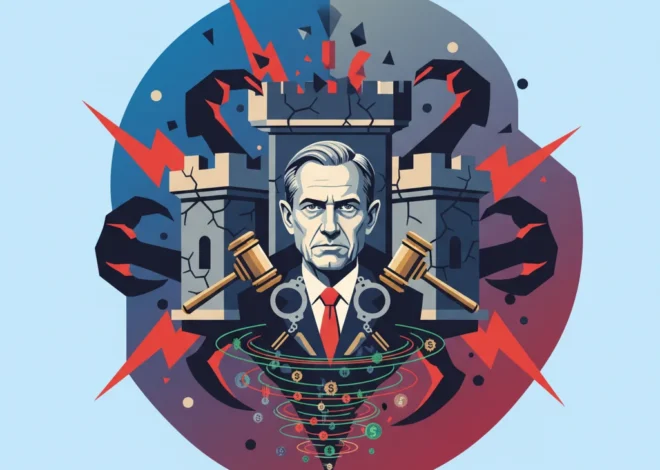
In the intricate world of global finance and economics, few institutions command as much influence as the U.S. Federal Reserve. Its decisions on interest rates can shape the stock market, dictate the flow of capital, and impact the daily lives of billions. Central to its power is a long-held tradition of political independence. Yet, this foundational principle is now facing what one official has called an “unprecedented” challenge: a criminal probe opened by the U.S. Justice Department into the Federal Reserve Chair following his refusal to bow to political pressure on monetary policy.
This development, stemming from demands by former President Donald Trump to lower interest rates, transcends typical political squabbling. It strikes at the very heart of the U.S. economic framework and raises profound questions for investors, business leaders, and anyone involved in the financial ecosystem. What does it mean when the levers of monetary policy are threatened by political retribution? And what are the cascading effects on the economy, investing, and the future of financial technology?
The Sanctity of Independence: Why the Fed Must Be a Political Island
To grasp the gravity of this situation, one must first understand why central bank independence is a cornerstone of modern economics. The Federal Reserve operates under a dual mandate from Congress: to promote maximum employment and maintain stable prices. Achieving this delicate balance often requires making decisions that are politically unpopular in the short term, such as raising interest rates to combat inflation, which can slow economic growth.
If a central bank were to become an arm of a political administration, it would face immense pressure to prioritize short-term political goals over long-term economic stability. For example, a president facing re-election might demand lower interest rates to create a temporary economic boom, even if it risks unleashing runaway inflation down the line. This is not a theoretical concern; it’s a lesson learned the hard way.
The “Great Inflation” of the 1970s is a stark reminder of this danger. During that period, political pressure on the Fed, particularly from the Nixon administration, contributed to overly loose monetary policy. The result was a debilitating decade of soaring prices, economic stagnation, and a loss of public confidence. It took the political courage of Fed Chair Paul Volcker in the early 1980s, who raised interest rates to punishing levels and induced a recession, to finally break the back of inflation. His success cemented a global consensus that for an economy to thrive, its central bank must be insulated from the electoral cycle. According to research from the Federal Reserve’s own history archives, this period underscored the critical need for a Fed that could make tough choices without fear of political reprisal.
Venezuela at a Crossroads: Decoding the Economic Shockwaves of a Post-Maduro Era
A Pattern of Pressure: From Whispers to Public Ultimatums
While the current probe is unprecedented, friction between the White House and the Federal Reserve is not new. Presidents have long sought to influence the Fed’s direction. However, the nature of this influence has dramatically changed. Historically, these efforts were conducted through private channels and subtle persuasion. The Trump administration’s approach marked a radical departure, with the President frequently using public platforms like Twitter to attack and threaten the Fed Chair for maintaining a course of monetary policy normalization.
To understand this shift, let’s compare historical instances of presidential influence with the recent events.
| Presidential Administration | Fed Chair | Nature of Pressure | Outcome |
|---|---|---|---|
| Lyndon B. Johnson | William McChesney Martin | Intense private pressure, including a famous physical altercation at Johnson’s ranch, to keep rates low to fund the Vietnam War and “Great Society” programs. | Martin eventually acquiesced, contributing to the inflationary pressures of the late 1960s and 1970s. |
| Richard Nixon | Arthur Burns | Direct pressure to stimulate the economy ahead of the 1972 election, as revealed by White House tapes. | Burns’ Fed pursued an expansionary policy, which many economists believe exacerbated the “Great Inflation.” |
| George H.W. Bush | Alan Greenspan | Public expressions of displeasure and private pressure for not cutting rates faster during the 1990-91 recession. | Greenspan largely resisted, solidifying his reputation for independence, though the administration blamed the Fed for the election loss. |
| Donald Trump | Jerome Powell | Sustained, public attacks via social media and interviews, threats of firing, and demands for specific rate cuts. Culminated in the DOJ probe. | Powell steadfastly defended the Fed’s independence and data-driven approach, leading to an unprecedented escalation. |
As the table illustrates, the recent actions represent a qualitative leap from historical precedent. Moving from private persuasion to public condemnation and, ultimately, the weaponization of the Justice Department against a sitting Fed Chair is a line that has never been crossed before.
Market Tremors: The Price of Uncertainty in Finance and Investing
For investors and the stock market, the most toxic element is uncertainty. The DOJ probe injects a massive dose of it directly into the heart of the financial system. The markets rely on the Federal Reserve to be a predictable, data-driven entity that acts as a stabilizing force. When its leadership is under political assault, that predictability evaporates.
- Increased Volatility: The stock market is likely to experience higher volatility as traders and algorithms try to price in the new political risk. Every public statement, every rumor about the probe could send ripples through the trading day.
- Impact on the Dollar: The U.S. dollar’s status as the world’s primary reserve currency is built on the foundation of stable, trustworthy U.S. institutions. An attack on the Fed’s independence chips away at this foundation. A report by the Council on Foreign Relations highlights that while the dollar’s dominance is resilient, it is not guaranteed, and erosion of institutional credibility is a key risk factor.
- Rethinking Investment Strategy: Prudent investors may need to adjust their strategies. This could mean increased diversification into international assets, a greater allocation to inflation hedges like commodities, or exploring assets that are theoretically insulated from the whims of a single government’s political turmoil.
The core of banking and finance is risk management. This event introduces a new, potent form of political risk that is difficult to model and hedge against, forcing a fundamental reassessment of the stability of U.S. financial markets.
The Billion Bet on Venezuela: Is the World's Largest Oil Reserve Back in Play for Investors?
A Catalyst for Decentralization? Fintech, Blockchain, and the Trust Deficit
Every crisis creates an opportunity, and this assault on traditional centralized finance (TradFi) could be a significant long-term catalyst for the world of fintech and blockchain. The entire premise of decentralized finance (DeFi) is to create a financial system that is transparent, permissionless, and not reliant on trusted (and potentially fallible) intermediaries like central banks and governments.
When the most powerful central bank in the world is subjected to overt political manipulation, the argument for decentralized alternatives becomes exponentially more compelling. This event serves as a real-world, high-stakes marketing campaign for the core principles of blockchain technology.
Here’s a comparison of how centralized and decentralized systems are perceived in light of such a crisis:
| Feature | Centralized Finance (TradFi) | Decentralized Finance (DeFi) / Blockchain |
|---|---|---|
| Governance | Controlled by a central authority (e.g., the Fed) which is now shown to be vulnerable to political pressure. | Governed by code and distributed consensus among network participants. Resistant to singular points of control or coercion. |
| Monetary Policy | Discretionary and set by a small committee. Can be influenced by political agendas, leading to uncertainty. | Programmatic and predictable. For example, Bitcoin’s supply schedule is fixed in its code and cannot be altered by any individual or government. |
| Trust | Requires trust in institutions and the individuals who run them. This trust is currently being eroded. | “Don’t trust, verify.” Trust is placed in the immutability and transparency of the underlying code and network. |
| Hedge Potential | Traditional hedges (e.g., gold) perform well, but the system itself is the source of risk. | Assets like Bitcoin are increasingly viewed by some as a hedge against institutional failure and monetary policy malpractice. |
This is not to say that blockchain is a panacea. The DeFi space is still nascent and carries its own significant risks. However, the “unprecedented” probe into the Fed chair provides a powerful narrative for why the world needs financial technology that is inherently more resilient to human and political failings. It could accelerate the exploration of central bank digital currencies (CBDCs), but also simultaneously boost the appeal of non-state-controlled digital assets as a check on governmental power over the economy.
The Brexit Reset: How Labour's Proposed EU Pivot Could Reshape UK Finance and Investment
Conclusion: A Dangerous Precedent for the Global Economy
The Justice Department’s probe into the Federal Reserve Chair is far more than a political headline. It is a foundational challenge to the operating system of the American and, by extension, the global economy. By attempting to criminalize independent monetary policy decisions, it sets a dangerous precedent that threatens to unravel decades of economic stability built on the principle of an apolitical central bank.
For investors, it signals a new era of heightened political risk that must be factored into every decision. For leaders in banking and finance, it is a stark warning about the fragility of the institutions they depend on. And for innovators in fintech and blockchain, it may well be the moment that the theoretical need for a decentralized alternative becomes tangibly, urgently real. The long-term consequences of this unprecedented act will reverberate through the markets and the halls of power for years to come, fundamentally reshaping the landscape of economics and trading.