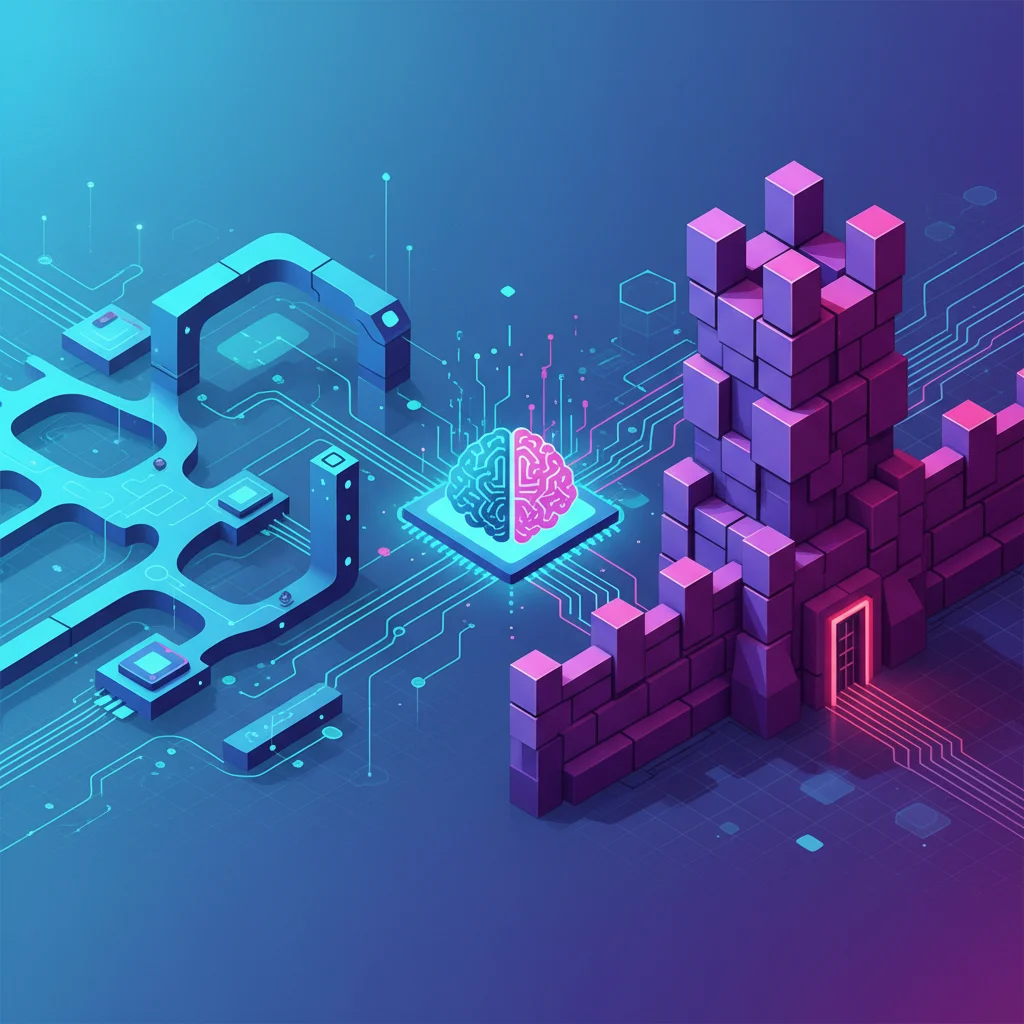
The AI Startup’s Dilemma: Are You Building a Feature or a Fortress?
The world of artificial intelligence is electric. We’re living through a modern-day gold rush, where startups are sprouting up overnight, each armed with a clever new AI-powered tool. From automating legal paperwork to generating flawless code, it seems there’s an AI solution for every conceivable niche. But beneath this frenzy of innovation lies a treacherous question that every founder, developer, and investor must ask: are we building durable companies, or just temporary features for someone else’s empire?
The dominant strategy for many new AI ventures is to be a “point solution”—a highly specialized tool that does one thing exceptionally well. It’s an attractive path. It’s focused, easier to market, and allows for rapid development on top of powerful foundational models from giants like OpenAI, Google, or Anthropic. However, a compelling argument, highlighted in a recent Financial Times analysis, suggests this is an incredibly risky bet. The future, it seems, may not belong to the nimble niche player, but to the sprawling, integrated software platform.
This isn’t just an academic debate. It’s a fundamental strategic crossroads that will determine which startups thrive and which become footnotes in the history of this technological revolution. Let’s dissect this platform-versus-point-solution dilemma and explore what it means for the future of software, automation, and AI innovation.
The Seductive Trap of the Point Solution
Imagine you’re an entrepreneur with a brilliant idea: an AI tool that drafts perfect marketing emails. You build it on GPT-4’s API, design a sleek interface, and launch it as a SaaS product. Customers love it. You’ve created a best-in-class point solution. What could go wrong?
The problem is that your product exists in a vacuum. Your customers are already using a suite of other tools: a CRM like Salesforce, an email platform like Mailchimp, and a collaboration suite like Microsoft 365 or Google Workspace. For them, your tool is yet another login, another subscription, and another silo of data.
Then, one Tuesday morning, Microsoft announces “Copilot for Outlook with Advanced Marketing AI,” or Salesforce unveils “Einstein GPT Email Composer.” Suddenly, your core feature is now a free (or low-cost) addition to a platform your customers already pay for and use daily. Your defensibility evaporates overnight.
This is the core risk. As the FT article notes, the tech giants are not sitting still. They are methodically integrating generative AI capabilities across their entire product ecosystems. They possess three monumental advantages:
- Distribution: They have millions of existing enterprise customers. They don’t need to find a market; they just need to upsell it.
- Data: Their platforms are where business data already lives. An AI that can access your company’s entire SharePoint, Salesforce records, and Slack history is infinitely more powerful than one that can’t.
- Integration: Their tools are designed to work together, creating seamless workflows that a standalone product can’t replicate without clunky, expensive custom programming.
For an enterprise IT or cybersecurity department, choosing a single, secure, compliant platform over a dozen disparate AI tools is a no-brainer. It simplifies vendor management, reduces security vulnerabilities, and ensures data governance. Startups selling “a thousand tiny AI features,” as one venture capitalist put it (source), will find it increasingly difficult to pass the rigorous procurement and security checks of large organizations.
AI vs. Shoplifters: Inside the High-Tech Battle for the Future of Retail
The Fortress: Why Platforms Are Positioned to Win
A software platform isn’t just a collection of features; it’s an ecosystem. It’s a central hub where work gets done, data accumulates, and value compounds over time. Think of Adobe’s Creative Cloud, Atlassian’s suite of developer tools, or the Salesforce ecosystem. Their power comes not from a single killer app, but from the “gravity” created by having everything in one place.
When these platforms embed artificial intelligence, it’s not just another feature. It’s a fundamental enhancement of the entire ecosystem. The AI has context. It understands your projects, your customers, and your team’s conversations. This “data network effect” is a powerful defensive barrier.
Let’s compare the two approaches with a simple table:
| Attribute | AI Point Solution (The Niche Player) | AI-Powered Platform (The Incumbent) |
|---|---|---|
| Core Value | Best-in-class performance on a single, specific task. | “Good enough” performance across a wide range of integrated tasks. |
| Go-to-Market | Must build a customer base from scratch. High marketing/sales cost. | Upsell to a massive, existing customer base. Low acquisition cost. |
| Data Access | Limited to the data users manually input or connect via API. | Access to a vast, proprietary pool of customer data already on the platform. |
| Defensibility | Low. Vulnerable to being replicated as a feature by larger platforms. | High. Protected by data gravity, high switching costs, and workflow integration. |
| Enterprise Appeal | Seen as another vendor to vet, manage, and secure. A potential cybersecurity risk. | Seen as a trusted, secure, and integrated extension of an existing partnership. |
Looking at this comparison, the outlook for a simple AI point solution seems bleak. The history of the software industry is a graveyard of innovative features that were absorbed by dominant platforms. As one executive noted, the big cloud providers have a “home-court advantage” that is incredibly difficult to overcome.
Survival Guide for the AI Startup: How to Avoid Becoming a Feature
So, is every AI startup doomed to be crushed by the likes of Google, Microsoft, and Oracle? Not necessarily. The game is difficult, but not impossible. Winning requires a deliberate and sophisticated strategy that goes beyond just having a cool piece of machine learning technology. Entrepreneurs and developers need to build a fortress, not just a tool.
Here are three potential paths to survival and success for AI startups in the age of platforms:
1. Go Vertical: Own a Complex Niche
Instead of building a horizontal tool for everyone (e.g., “AI meeting summarizer”), build a comprehensive solution for a specific, complex, and regulated industry. Think “AI for FDA drug trial documentation” or “AI-powered compliance automation for international banking.”
- Why it works: Incumbents are slow to tackle these niches because they require deep domain expertise, specialized data sets, and navigating complex regulations. The sales cycle is long, but the customers are sticky, and the problem is too specific for a generic “Copilot” to solve effectively. You become the platform for that specific vertical.
2. The Trojan Horse: Start Niche, Expand to Platform
This is the classic “land and expand” strategy. Start with a killer point solution that solves a painful, urgent problem to get your foot in the door. But from day one, have a clear roadmap to build adjacent features and workflows around that initial tool. Use your first product to build trust and gather unique data, then leverage that position to expand into a full-fledged platform.
- Why it works: It combines the speed of a point solution with the long-term vision of a platform. The key is to solve the initial problem so well that customers are willing to adopt your expanding suite of tools rather than stitch together solutions from larger vendors.
3. Be the “Intel Inside”: Become a Critical Ingredient
If you can’t beat the platforms, sell to them. Focus on building a truly foundational piece of AI technology—a specialized model, a unique data processing engine, a novel approach to machine learning—that is 10x better than anything the giants can build themselves. Your customer isn’t the end-user; it’s the platform itself.
- Why it works: You focus on deep tech and innovation, avoiding the costly game of sales and marketing. You become a critical component in the tech stack of multiple platforms, giving you leverage and a highly defensible business model. This requires world-class programming and research talent.
Code Isn't Enough: The High-Stakes Battle for America's Drone Future
The Choice Before Us
The rise of generative AI is not just a technological shift; it’s a market-shaping event that is forcing a brutal consolidation in the software industry. The allure of building a quick, slick AI tool is undeniable, but the strategic moats of the incumbent cloud and SaaS platforms are formidable.
For entrepreneurs and developers, the challenge is to think beyond the immediate feature and architect a business with lasting, defensible value. For tech professionals and business leaders, the challenge is to choose partners and tools that provide a long-term foundation, not just a short-term fix.
The next decade of software will be defined by this struggle. While the giants have the advantage, history has shown that true innovation, combined with a clever strategy, can still win the day. The question is, are you building a temporary tool that will be absorbed into the Borg, or are you building the foundation for the next great platform?