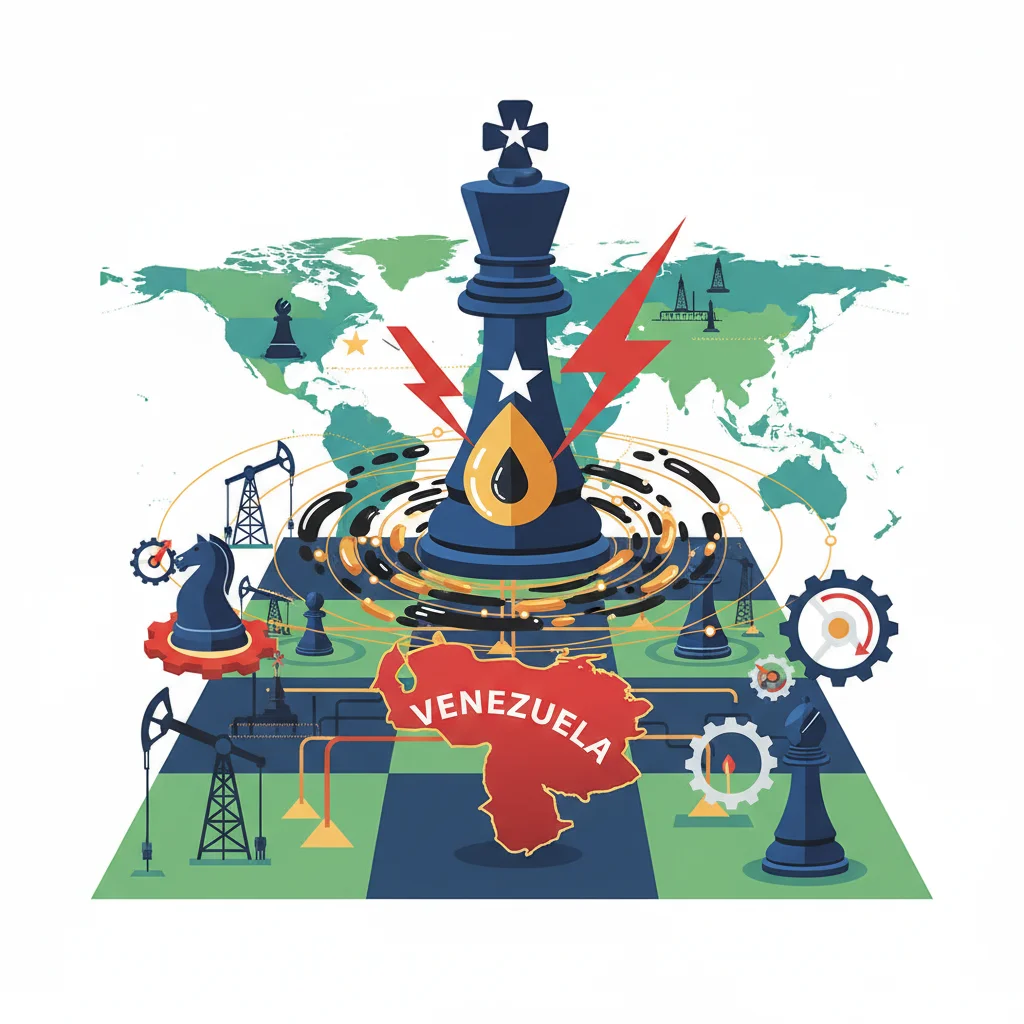
Geopolitical Chess: How U.S. Sanctions on Venezuela Are Reshaping the Global Oil Market
In the high-stakes world of global finance and energy, geopolitical events often act as the ultimate wild card, capable of upending the most carefully crafted forecasts. The recent decision by the Trump administration to impose stringent sanctions on Venezuela’s state-owned oil company, PDVSA, is a prime example. This move sent immediate ripples through the international oil markets, leaving investors, traders, and business leaders grappling with a critical question: Is this a catalyst for a sustained price surge, or merely a temporary disruption in an otherwise well-supplied market?
The initial reaction was a textbook case of market uncertainty. Oil prices flickered, caught in a tug-of-war between two powerful narratives. On one side, the potential removal of hundreds of thousands of barrels of Venezuelan crude from the daily global supply sparked fears of a tightening market. On the other, the formidable spare production capacity held by OPEC+, coupled with relentless growth in U.S. shale output, offered a powerful counterbalance.
This blog post will dissect this complex scenario, moving beyond the headlines to explore the fundamental dynamics at play. We will analyze the immediate market impact, the long-term implications for the global economy, and what this geopolitical chess match means for your investing strategy.
The Sanctions Unpacked: More Than Just a Headline
To understand the market’s reaction, we must first understand the mechanism of the sanctions. The U.S. measures effectively block PDVSA from exporting crude oil to the United States—its largest cash-paying customer—and prevent U.S. companies from selling Venezuela the light oil and diluents it desperately needs to blend with its heavy crude for export. According to the Financial Times, this move is designed to starve President Nicolás Maduro’s government of its primary source of revenue.
This isn’t just a simple trade embargo; it’s a sophisticated financial maneuver targeting the lifeblood of the Venezuelan state. The sanctions essentially trap the revenue from any oil sales within the U.S. financial system, placing it under the control of the opposition government led by Juan Guaidó. This creates a logistical and financial nightmare for PDVSA, forcing it to find new buyers, new financing, and new supply chains, all while navigating the complexities of international banking and maritime law.
The challenge for Venezuela is compounded by the nature of its oil. It primarily produces heavy, sour crude, which is dense and high in sulfur. This type of oil can’t be processed by all refineries. A significant portion of the U.S. Gulf Coast refining complex was specifically designed to process this very grade of crude, creating a symbiotic relationship that has now been severed. As noted by energy analysts at S&P Global Platts, these specialized refineries must now scramble to find alternative sources of heavy crude from places like Canada, Mexico, or the Middle East, which could lead to higher costs and tighter margins (source).
Beyond the Bargains: Decoding the Economic Signals of a Record-Breaking Boxing Day
The Great Debate: Supply Disruption vs. Global Glut
The core of the market’s indecision lies in the balance between the loss of Venezuelan barrels and the availability of oil from other sources. Let’s examine the two competing forces that are influencing oil trading desks worldwide.
The Bull Case: A Tighter Market Looms
The primary argument for higher oil prices is the direct removal of a significant supply source. While Venezuela’s production has been in a state of freefall for years due to underinvestment and mismanagement, it was still exporting around 500,000 barrels per day to the U.S. (source: U.S. Energy Information Administration). Removing this supply, especially the specialized heavy crude, forces a rapid and expensive reshuffling of global oil flows.
Furthermore, the sanctions add to a growing list of geopolitical hotspots affecting oil supply. With ongoing issues in Libya, tensions with Iran, and the inherent instability in other producing regions, the loss of Venezuelan oil reduces the global buffer against future shocks. For investors, this increases the “geopolitical risk premium”—an unquantifiable but very real factor that can add several dollars to the price of a barrel of oil.
The Bear Case: A Market Awash in Oil
The counterargument is equally compelling. The world is not short of oil. The OPEC+ group, led by Saudi Arabia and Russia, currently holds significant spare production capacity. Following their decision to cut production to stabilize prices, major producers can quickly ramp up output if they see a genuine supply shortage that threatens the global economy. According to OPEC’s most recent monthly report, Saudi Arabia alone holds over 2 million barrels per day of spare capacity that can be brought online relatively quickly (source).
Below is a simplified look at how Venezuela’s disrupted supply compares to the available spare capacity of key global producers, illustrating why the market remains hesitant to price in a major shortage.
| Entity | Estimated Production Impact / Capacity | Implication for Global Supply |
|---|---|---|
| Venezuela (Disrupted Exports to U.S.) | ~500,000 barrels/day | Significant loss of heavy sour crude, impacting specific refiners. |
| Saudi Arabia (Spare Capacity) | ~2.0 – 2.5 million barrels/day | Can more than cover the Venezuelan shortfall, but it’s lighter crude. |
| U.S. Shale Production (Growth) | Projected to add >1 million barrels/day this year | A constant source of new, light sweet crude that puts a ceiling on prices. |
| Other OPEC (Spare Capacity) | ~1.0 – 1.5 million barrels/day (UAE, Kuwait, Iraq) | Additional buffer that can be deployed if needed. |
Beyond OPEC, the shale revolution in the United States continues to be the most significant structural change in the energy market in a generation. U.S. crude production is at record highs and continues to grow, adding a steady stream of high-quality, light sweet crude to the market. This acts as a powerful cap on any potential price rally.
The Broader Economic Fallout and the Role of FinTech
The impact of these sanctions extends far beyond the oil pits. Fluctuations in energy prices are a key variable in the global economics equation. A sustained rise in oil prices could act as a tax on consumers, increase transportation costs for businesses, and fuel inflationary pressures that could force central banks to reconsider their monetary policy. The stock market often reacts negatively to oil price shocks, as higher energy costs can squeeze corporate profit margins.
This is where modern financial technology plays a fascinating role. Today’s commodity markets are driven by sophisticated algorithms that can analyze news headlines and execute trades in microseconds. The “wavering” price of oil described by the FT is the visible result of thousands of these high-frequency trading systems simultaneously processing the bullish and bearish news and battling for position.
Furthermore, fintech platforms provide investors with unprecedented access to data and analytical tools to navigate this volatility. Meanwhile, technologies like blockchain are being explored as a way to enhance transparency in supply chains, a tool that could one day be used to track oil shipments and more effectively enforce sanctions regimes by creating an immutable record of custody.
Actionable Insights for the Modern Investor
Navigating this complex environment requires a nuanced approach. Simply betting on oil prices to go up or down is a risky proposition. Instead, investors should consider several strategies:
- Focus on Quality in the Energy Sector: Rather than speculating on the commodity itself, look at best-in-class energy companies. This includes U.S. shale producers with low breakeven costs, midstream pipeline companies that earn fees regardless of price, and integrated supermajors with strong balance sheets.
- Understand the Refining Differential: The sanctions create winners and losers in the refining space. Refiners that can process light sweet crude from U.S. shale may see their margins improve, while those configured for heavy Venezuelan crude may struggle. This is a more sophisticated play but one that could yield significant returns.
- Hedge Your Portfolio: For those with broad market exposure, consider using energy-focused ETFs or other financial instruments as a hedge. If oil prices do spike, these positions can help offset potential losses in other sectors of your portfolio, such as transportation and consumer discretionary stocks.
- Keep a Global Perspective: The Venezuelan crisis does not exist in a vacuum. Monitor OPEC+ policy decisions, U.S. production data from the EIA, and, critically, signs of a slowdown in the global economy, particularly in China, as demand remains the most important long-term driver of prices.
The Bardot Economy: Timeless Lessons in Branding, Disruption, and Asset Valuation
Conclusion: A Fragile Equilibrium
The wavering of oil prices following the U.S. sanctions on Venezuela is a perfect microcosm of the modern energy market: a complex ecosystem where geopolitical actions are instantly weighed against market fundamentals by powerful technological forces. The immediate disruption to Venezuelan exports is a tangible, bullish factor. However, the immense spare capacity of OPEC and the relentless rise of U.S. shale provide a formidable ceiling, preventing a runaway price spike for now.
For investors, business leaders, and finance professionals, the key takeaway is that the era of straightforward, supply-driven oil shocks may be over. The market is now a multi-variable equation where politics, technology, and global economic health are all intertwined. The situation in Venezuela will continue to evolve, but its ultimate impact on your portfolio will depend less on the daily price ticks and more on the strategic positioning of the world’s other major producers and the resilience of global demand.

Related Posts
Trump’s Venezuelan Oil Gambit: A Multi-Billion Dollar Opportunity or a Geopolitical Quagmire?

The Bard’s Billions: What Shakespeare Can Teach Modern Investors About Building Wealth