The Venezuelan Paradox: Why U.S. Sanctions Unexpectedly Pushed Oil Prices Down
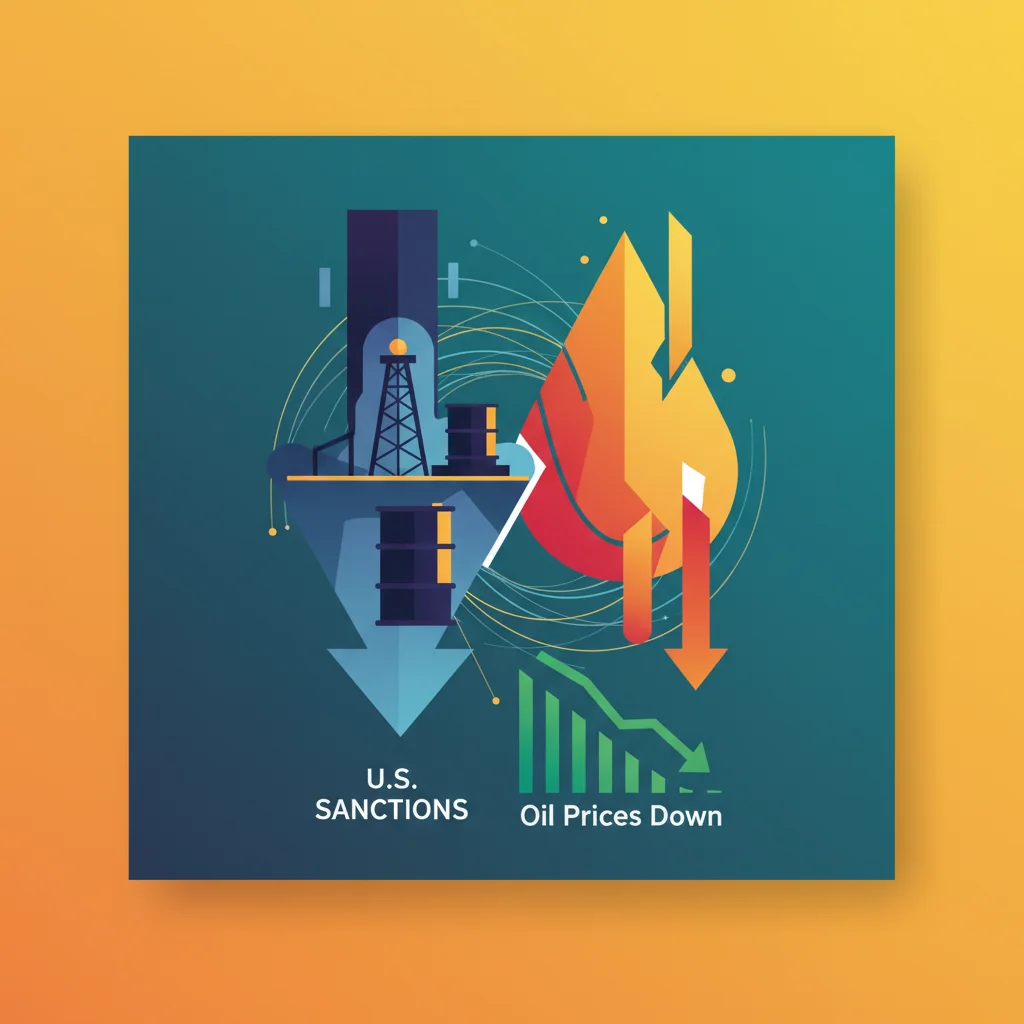
In the intricate dance of global finance and geopolitics, market reactions can often seem counterintuitive. A textbook lesson in economics would suggest that imposing sanctions on a major oil-producing nation should constrict global supply and send prices soaring. Yet, when the Trump administration levied powerful sanctions against Venezuela’s state-owned oil company, PDVSA, the market did the exact opposite. Brent crude, the international benchmark, slipped, leaving many investors and onlookers scratching their heads. This wasn’t a glitch in the system; it was the stock market and commodities traders pricing in a complex, high-stakes future.
This event peels back the curtain on the modern energy market, revealing a world where long-term possibilities can overshadow short-term realities. The dip in oil prices was not about the immediate loss of Venezuelan crude; it was a calculated bet on a post-Maduro Venezuela. Investors were weighing the temporary disruption against the tantalizing prospect of a new regime opening the floodgates to one of the world’s largest oil reserves. Let’s delve into the economic, political, and financial forces behind this paradoxical market reaction and explore what it means for the future of investing, trading, and the global economy.
The Sanctions and the Surprising Market Shrug
The sanctions imposed by the U.S. were designed to be crippling. They effectively blocked PDVSA from exporting crude oil to the United States, its largest customer, and cut off the Maduro regime from a critical source of hard currency. On the surface, this move threatened to remove hundreds of thousands of barrels of heavy crude from an already tight market. As the Financial Times reported, this action was one of the most significant strikes against the country’s oil sector.
The immediate market response was a testament to the forward-looking nature of finance. Instead of a price spike, Brent crude fell by 2.4 per cent to $59.81 a barrel. The logic was cold and clear: the market interpreted the sanctions not as a long-term supply constraint, but as the final push that could trigger regime change. In this scenario, a new, U.S.-aligned government would likely welcome back international oil companies like Chevron and ExxonMobil, leading to a massive influx of capital and technology. The potential for a revitalized Venezuelan oil industry to eventually pump millions of barrels back into the market created a powerful bearish sentiment that overwhelmed the immediate bullish news of supply cuts.
The Bardot Economy: Timeless Lessons in Branding, Disruption, and Asset Valuation
A Giant on its Knees: The Venezuelan Oil Sector in Context
To understand the market’s muted reaction to the supply disruption, one must first grasp the tragic decline of Venezuela’s oil industry. Venezuela sits atop the world’s largest proven oil reserves, estimated at over 300 billion barrels. It was a founding member of OPEC and, for decades, a powerhouse in the global energy economy. However, years of political instability, chronic underinvestment, corruption, and the nationalization of assets have left its state-run firm, PDVSA, in a state of near-collapse.
Infrastructure is crumbling, experienced engineers have fled the country, and production has plummeted from over 3 million barrels per day in the early 2000s to a fraction of that figure. The sanctions, therefore, were a blow to an already critically weakened player. The following table illustrates this dramatic decline, providing crucial context for why the market was not overly concerned with the immediate loss of its output.
Venezuela’s Crude Oil Production Decline (2010-2018)
| Year | Average Production (Million Barrels per Day) |
|---|---|
| 2010 | 2.68 |
| 2012 | 2.68 |
| 2014 | 2.63 |
| 2016 | 2.37 |
| 2018 | 1.51 |
Data sourced from U.S. Energy Information Administration (EIA) reports.
The Global Supply Equation: Who Fills the Void?
The market’s confidence wasn’t just built on a hypothetical Venezuelan future; it was also grounded in the realities of today’s global supply. The oil market of today is vastly different from that of a decade ago, primarily due to the U.S. shale revolution. The ability of American producers to rapidly increase output acts as a powerful ceiling on prices.
Furthermore, OPEC+, led by Saudi Arabia and Russia, maintains several million barrels per day of spare production capacity. In the event of a genuine supply crisis, the market trusts that these key producers would step in to stabilize the economy and prevent a damaging price spike. This combination of U.S. shale flexibility and OPEC’s spare capacity creates a robust safety net that allows the market to absorb shocks like the Venezuelan sanctions without panic. This dynamic is a core principle for anyone involved in modern commodities **trading**.
The Financial and Technological Ripple Effects
The implications of these sanctions extend far beyond the oil barrel, touching every corner of the global **finance** and **banking** ecosystem. For sanctioned entities, the immediate challenge is being cut off from the U.S. dollar-denominated financial system. This has led to speculation about the use of alternative systems to circumvent sanctions.
This is where emerging **financial technology** comes into play. There has been increasing discussion about whether sanctioned nations could turn to cryptocurrencies or develop state-backed digital assets to conduct international trade. While the volatility and scalability of most cryptocurrencies make them impractical for settling billions of dollars in oil sales, the underlying **blockchain** technology offers a theoretical pathway to create payment rails outside of traditional oversight. This represents a new frontier in the intersection of geopolitics and **fintech**, where technology is weaponized to both enforce and evade economic policy.
Actionable Insights for Investors and Business Leaders
For those engaged in **investing** and strategic business planning, the Venezuelan situation offers several critical takeaways:
- Geopolitics Drive the Narrative: The modern investor must be a student of geopolitics. The Venezuelan price drop is a clear signal that understanding the political endgame is just as important as analyzing supply and demand charts.
- The U.S. Shale Factor is Paramount: Any analysis of the energy market that underestimates the role of U.S. shale as a global swing producer is fundamentally flawed. Its influence dampens volatility and caps upside price potential.
- Look for Second-Order Effects: The direct play on oil prices is only one part of the story. The real opportunities and risks may lie in adjacent sectors. U.S. Gulf Coast refiners who depended on Venezuelan heavy crude must now find new suppliers, creating opportunities for Canadian and Mexican producers. Likewise, the logistics, engineering, and oilfield services companies that would be needed to rebuild Venezuela represent a high-risk, high-reward long-term investment thesis.
Navigating this complex landscape requires a deep understanding of **economics**, market psychology, and the ever-shifting sands of international relations. The **stock market** will continue to place bets on future outcomes, and those who can anticipate these shifts will be best positioned for success.
Audit Overhaul: Is the SEC Loosening the Leash on Corporate Watchdogs?
Conclusion: A Market Focused on the Horizon
The curious case of falling oil prices in the face of Venezuelan sanctions is a powerful lesson in modern market dynamics. It demonstrates that traders are not just reacting to today’s news but are constantly modeling and pricing in the future. The short-term loss of Venezuelan oil was deemed less significant than the long-term potential of its revival under a new government, all backstopped by the immense capacity of U.S. shale and OPEC.
This event underscores a new reality for the global **economy**: geopolitical events in the energy sector are now filtered through a different lens. While the potential for disruption remains, the market’s capacity to adapt has grown immensely. For investors, business leaders, and policymakers, the Venezuelan paradox is a clear signal that in the world of global finance, it’s not just about the reality of today, but the perception of tomorrow.