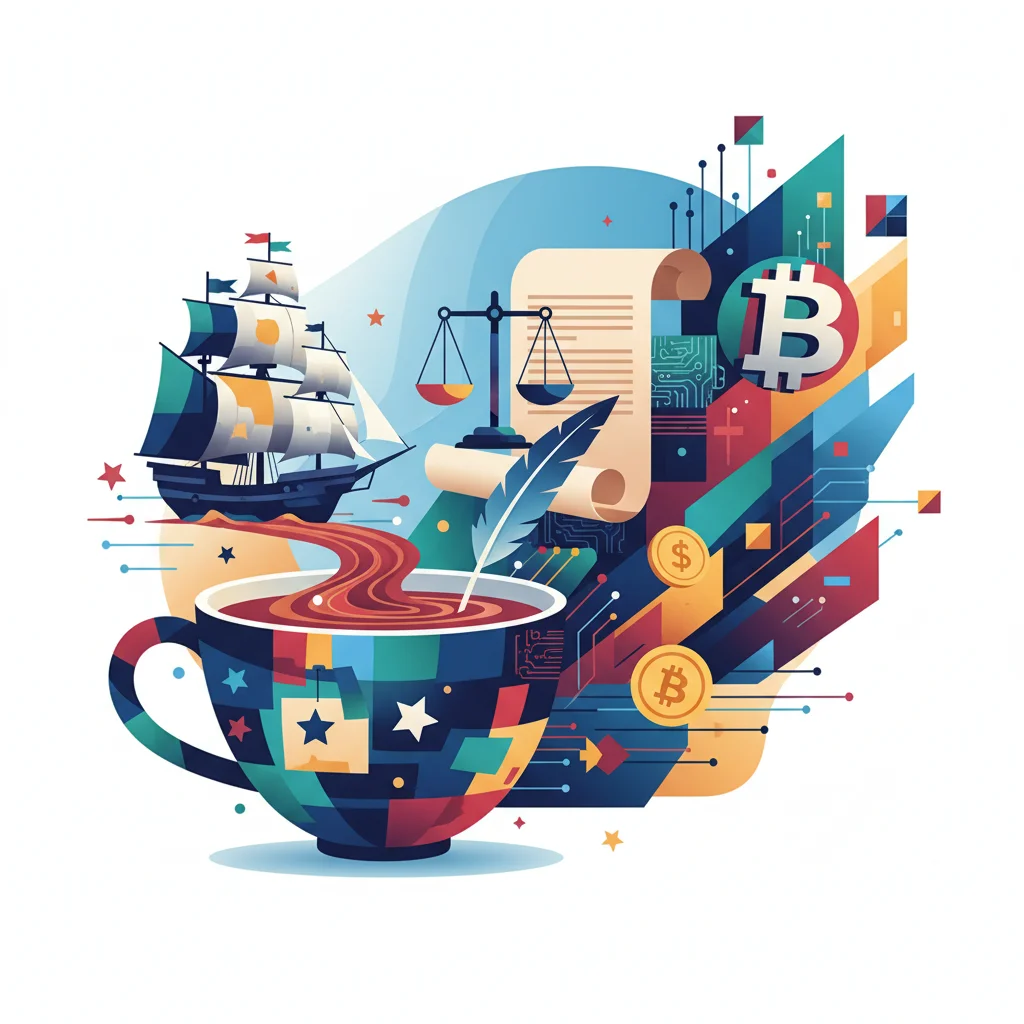
From Boston Tea to Bitcoin: Why the American Revolution’s Economic Lessons Still Drive Today’s Markets
History rarely repeats itself, but it often rhymes. In a pithy letter to the Financial Times, Emeritus Professor Albion M Urdank of UCLA highlighted a striking irony: the United Kingdom, a nation forged from an empire that once imposed taxes on its colonies from afar, now finds itself echoing the very same revolutionary cries of “no taxation without representation” in its post-Brexit relationship with Europe. This observation is more than a clever historical footnote; it’s a key that unlocks a deeper understanding of the fundamental tensions shaping our modern global economy, from corporate tax battles to the disruptive rise of financial technology.
The American Revolution was not just a political schism; it was the original great disruption—a violent, world-altering startup that spun out of its parent company, the British Empire. The grievances that led to this split were, at their core, economic. Today, the same principles of economic sovereignty, fair taxation, and freedom from centralized control are being fought anew, not with muskets on a battlefield, but in boardrooms, on parliamentary floors, and across digital ledgers. The spirit of 1776 is alive and well, animating everything from international trade disputes to the code that powers the blockchain.
For today’s investors, finance professionals, and business leaders, understanding these historical parallels is not an academic exercise. It’s a crucial framework for navigating the volatility of the modern stock market, anticipating regulatory shifts, and identifying the next wave of technological disruption.
The Original Disruption: Deconstructing the Economics of 1776
The popular narrative of the American Revolution often boils down to a simplistic protest over a tax on tea. But the reality was far more complex and deeply rooted in a restrictive economic system known as mercantilism. The British Empire viewed its colonies not as partners, but as captive sources of raw materials and guaranteed markets for its finished goods. This economic straitjacket was enforced through a series of laws that systematically stifled the colonies’ financial independence.
The Navigation Acts, for example, mandated that most colonial goods had to be shipped on English vessels and pass through English ports, adding costs and layers of control. Colonists were prohibited from developing certain industries, such as high-end textile manufacturing or iron production, that would compete with British factories. This system was designed to ensure wealth flowed in one direction: from the periphery to the imperial center in London.
The breaking point came after the Seven Years’ War (1756-1763). Though a victory for the British, it left the empire with staggering debt. To shore up its finance, London decided the American colonies should pay their share for the military protection they received. This led to a series of taxes—the Sugar Act, the Stamp Act, the Townshend Acts—imposed by a Parliament in which the colonists had no elected representatives. It was this act of imposing financial obligations without granting political voice that lit the fuse. The colonists’ cry was not simply “no taxes,” but “no taxation without representation.” They were demanding a say in their own economic destiny, a fundamental principle that continues to resonate today.
The Unwanted Gift Economy: A Financial Guide to Post-Holiday Asset Recovery
“No Taxation Without Representation” in the Digital Age
Fast forward nearly 250 years, and the same debate is playing out on a global stage. The actors and technologies have changed, but the core conflict between central authorities and those they govern remains. Consider the ongoing battles over global corporate and digital taxation.
For years, multinational corporations, particularly in the tech sector, have leveraged global loopholes to minimize their tax burdens, often booking profits in low-tax jurisdictions regardless of where their customers are. In response, the Organisation for Economic Co-operation and Development (OECD) has brokered a landmark deal to establish a 15% global minimum corporate tax. The goal, according to the OECD, is to ensure large multinational enterprises pay a fair share of tax wherever they operate. However, for some smaller nations or those with low-tax models, this feels like a rule imposed by a club of larger economies, a form of “taxation without adequate representation” in the rule-making process.
A more direct parallel can be seen in the rise of Digital Services Taxes (DSTs). Countries like France, Spain, and, ironically, the United Kingdom have implemented taxes targeting the revenue of large tech companies like Google, Amazon, and Meta. From their perspective, they are simply trying to tax economic activity happening within their borders. But from the perspective of the United States, where these companies are based, it’s seen as a discriminatory measure unfairly targeting American firms—a modern-day Stamp Act for the digital world.
To illustrate the scale of these financial debates, consider the historical versus modern context:
| Historical Grievance (c. 1770s) | Modern Parallel (c. 2020s) |
|---|---|
| The Stamp Act of 1765: A direct tax on printed materials in the colonies to raise revenue for Britain. Colonial contribution was estimated at around £60,000 annually (source). | Digital Services Tax (DST): A tax on the revenues of large digital companies. The UK’s DST, for example, is a 2% tax expected to raise around £500 million annually. |
| The Townshend Acts of 1767: Taxes on imported goods like glass, lead, paper, and tea, intended to fund colonial administration. | Global Minimum Corporate Tax: An OECD-led agreement for a 15% minimum tax rate, designed to stop a “race to the bottom” and projected to raise around $150 billion in additional global tax revenue annually. |
| Core Principle: A distant parliament imposing financial burdens without the consent or representation of the governed. | Core Principle: Supranational bodies and foreign governments imposing tax rules that impact corporations and national economies, sparking debates over fairness and sovereignty. |
From Mercantilist Chains to the Blockchain: Today’s Financial Revolution
The British mercantilist system was, in essence, a centralized and permissioned financial network. London sat at the center, dictating the terms of trade, controlling the flow of capital, and limiting the economic activities of the colonial “nodes.” To conduct meaningful international trading, the colonists had to operate within the rules and infrastructure set by the Crown. Breaking away meant building an entirely new financial system from scratch—a daunting task that involved issuing new currency, raising debt, and establishing new trade relationships.
This historical dynamic offers a powerful analogy for the disruption currently underway in the world of finance. For decades, the global financial system has been highly centralized. A handful of major central banks, commercial banking institutions, and payment networks like SWIFT have set the rules of the game. They act as gatekeepers, controlling the flow of money, verifying transactions, and granting (or denying) access to the global economy.
Enter Fintech, and more specifically, blockchain and decentralized finance (DeFi). At its core, blockchain is a technology of decentralization. It offers a way to maintain a secure, transparent, and immutable ledger of transactions without needing a central intermediary like a bank or government. This is a radical proposition. It’s a technological declaration of independence from the traditional financial system.
DeFi platforms built on blockchains like Ethereum allow users to lend, borrow, and trade assets in a peer-to-peer fashion, bypassing traditional financial institutions entirely. This movement is driven by a philosophy that mirrors the American revolutionaries: a belief that individuals should have more control over their own assets and economic lives, free from the fees, inefficiencies, and censorship potential of a centralized system. The rise of decentralized exchanges, where users can trade digital assets directly with one another, is a direct challenge to the centralized model of the New York Stock Market or the Nasdaq.
Beyond the Barricades: Why Boxing Day's Decline Signals a Seismic Shift in the UK Economy
Lessons for the Modern Investor and Business Leader
This collision of history, economics, and technology is not merely a topic for debate; it has profound, actionable implications for anyone involved in the global economy.
- Geopolitical Risk is Economic History in Motion: For those investing in the market, it’s critical to recognize that trade wars, tax disputes, and movements toward national sovereignty are not random noise. They are modern manifestations of the age-old tension between global integration and local control. These conflicts create real volatility and require a sophisticated understanding of political risk.
- The Future of Regulation is Unwritten: For business leaders, particularly in tech and finance, the landscape is in constant flux. The push for global tax harmonization will continue to clash with nations’ desires to set their own economic policies. Navigating this requires agility and foresight, as the rules governing digital commerce and cross-border finance are being rewritten before our eyes.
- Decentralization is a Secular Trend: While the future of specific cryptocurrencies is debatable, the underlying trend toward decentralization is undeniable. This technology represents a fundamental challenge to existing power structures in finance, media, and governance. Ignoring the rise of financial technology and DeFi is akin to a British merchant in 1770 dismissing the colonial grumblings as a temporary squabble over taxes.
Ethereum's Coiled Spring: Is a Major Price Breakout Looming Near the ,000 Mark?
The Enduring Echo of 1776
The irony that Professor Urdank identified in his letter is a powerful reminder that the core principles of the American Revolution were not just about political freedom, but economic self-determination. That revolutionary spirit—the desire to break free from centralized, arbitrary control—is a recurring force in human history.
Today, it echoes in debates over Brexit’s economic fallout, in global forums arguing over fair taxation, and most profoundly, in the burgeoning world of decentralized finance. The battlegrounds have shifted from colonial ports to digital platforms, and the weapons from muskets to cryptographic keys. But the fundamental struggle for control over one’s own economic destiny remains the same. Understanding this deep, historical current is essential for anyone seeking to navigate the turbulent but opportunity-rich waters of the 21st-century global economy.