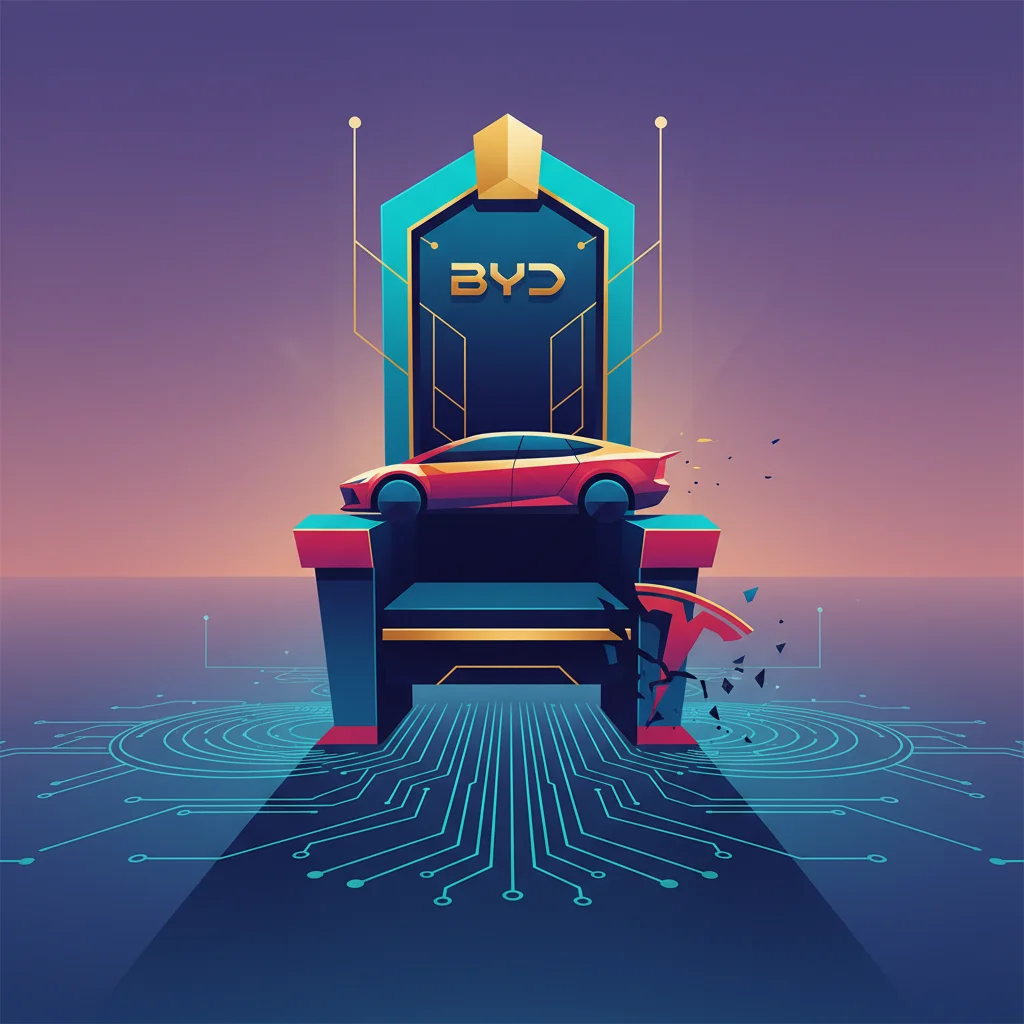
The EV Throne Has a New King: How BYD Dethroned Tesla and What It Means for Tech
For years, the electric vehicle landscape had a single, undisputed monarch: Tesla. The name was synonymous with EV innovation, market disruption, and a vision for a battery-powered future. But as 2023 drew to a close, the royal court was shaken. A new contender, China’s BYD (Build Your Dreams), quietly and decisively claimed the crown, overtaking Tesla as the world’s top seller of electric vehicles.
In the final quarter of 2023, BYD sold a staggering 526,409 fully electric vehicles, eclipsing Tesla’s 484,507 deliveries. This wasn’t just a statistical blip; it was the culmination of a meteoric rise and a masterclass in strategy, marking the first time the Chinese firm has outpaced its American rival in a quarterly sales race (source). While Tesla still held the lead for the full year in battery-only EVs, BYD’s total sales of “new energy vehicles” (including hybrids) topped 3 million, signaling a powerful shift in the global automotive and technology landscape.
But this story is about much more than just sales figures. It’s a tale of vertical integration, software-driven innovation, and the powerful fusion of manufacturing muscle with cutting-edge technology. For developers, entrepreneurs, and tech professionals, BYD’s ascent isn’t just car news—it’s a critical case study on how to build a resilient, tech-forward empire in the 21st century. Let’s pop the hood and see what’s really driving this change.
A Tale of Two Titans: The Numbers Behind the Headlines
To truly grasp the magnitude of this shift, it’s helpful to see the numbers side-by-side. The fourth quarter of 2023 was the turning point where momentum officially translated into market leadership for BYD in the pure EV space.
Here’s a snapshot of the Q4 2023 performance that changed the game:
| Metric | BYD | Tesla |
|---|---|---|
| Q4 2023 All-Electric (BEV) Sales | 526,409 | 484,507 |
| Full Year 2023 All-Electric (BEV) Sales | 1.57 million | 1.81 million |
| Full Year 2023 Total “New Energy Vehicle” Sales (incl. Hybrids) | 3.02 million | 1.81 million |
While Tesla maintained its lead in annual BEV sales, BYD’s trajectory and Q4 dominance are undeniable. This success wasn’t accidental; it was engineered through a series of strategic decisions that offer powerful lessons for any tech-focused business.
The Secret Sauce: Deconstructing BYD’s Winning Formula
How did a company that started as a battery manufacturer in 1995, and was once dismissed by Elon Musk, manage to overtake the pioneer of the modern EV revolution? The answer lies in a multi-layered strategy that brilliantly combines hardware control with software intelligence.
1. The Unfair Advantage of Vertical Integration
This is perhaps the most crucial element of BYD’s success. Unlike most automakers who rely on a complex web of third-party suppliers, BYD makes nearly everything in-house. They don’t just assemble cars; they manufacture their own batteries, semiconductors, electric motors, and even the plastic housings for components. This strategy, backed by a massive investment in **automation** and robotics, provides several formidable advantages:
- Cost Control: By owning the supply chain, BYD can aggressively manage costs, allowing it to offer a wide range of vehicles at highly competitive price points, from the sub-$15,000 Seagull to luxury sedans.
- Supply Chain Resilience: While other automakers faced crippling shortages of chips and batteries, BYD’s internal supply chain provided a buffer, ensuring production could continue unabated. For any **startup**, this is a lesson in de-risking your core operations.
- Rapid Innovation: Owning the tech stack allows for tighter integration and faster R&D cycles. Their proprietary “Blade Battery” is a prime example—a safer, more energy-dense LFP battery that they developed and scaled internally, giving them a distinct technological edge.
This level of control is a powerful moat, making it incredibly difficult for competitors to match them on price and scale simultaneously. Beyond Spreadsheets: The High-Stakes SaaS Boom in Tax-Tracking for the Rich
2. A Car for Everyone: The Power of a Diverse Portfolio
While Tesla has focused on a limited number of high-margin models (Model 3, Y, S, X), BYD has pursued a “flood the zone” strategy. They offer dozens of models across multiple sub-brands, including pure EVs and plug-in hybrids, at nearly every price point. This approach allows them to capture a much broader segment of the market, from first-time car buyers to luxury consumers. This strategic diversification minimizes risk and maximizes market penetration—a valuable lesson for **SaaS** companies considering their pricing tiers and product offerings.
The Tech Under the Hood: More Than Just Batteries
While vertical integration and market strategy are key, it’s the underlying technology that truly powers BYD’s engine. The modern car is a computer on wheels, and the winners of this race will be those who master the intersection of hardware, **software**, and data.
The Role of AI, Cloud, and Machine Learning
The EV is the ultimate IoT device, generating vast amounts of data. This is where cutting-edge tech comes into play:
- Intelligent Battery Management: The performance and longevity of an EV battery are governed by complex **software**. Carmakers like BYD use **AI** and **machine learning** algorithms to optimize charging cycles, predict battery degradation, and manage thermal performance in real-time, squeezing every last mile out of the hardware.
- Manufacturing Automation: BYD’s factories are showcases of modern **automation**. Machine learning models are used for predictive maintenance on robotic arms and for visual quality inspection, reducing defects and increasing throughput.
- Connected Car Platforms: Every vehicle is a node in a massive network. Data on driving habits, component performance, and environmental conditions are streamed to the **cloud**. This data is invaluable for R&D, allowing engineers to refine their **programming** and push over-the-air (OTA) updates that improve the car long after it’s sold. This is essentially an automotive **SaaS** model, creating recurring value from a hardware sale.
Cybersecurity: The Unseen Battlefield
As vehicles become more connected and software-defined, their attack surface expands dramatically. A security flaw is no longer a simple recall issue; it’s a potential threat that could allow malicious actors to control a vehicle remotely. This has made automotive **cybersecurity** one of the fastest-growing and most critical fields in the tech industry. Securing everything from the infotainment system to the CAN bus requires a deep understanding of embedded systems, network security, and secure **software** development practices. For developers and cybersecurity professionals, the automotive sector represents a new and complex frontier. The Great Tech Debate: Is the EU's "Regulation-First" Strategy a Bug or a Feature for Innovation?
What This Means for Tesla, the Industry, and You
The crowning of a new EV king has ripple effects that extend far beyond the two companies involved.
A Wake-Up Call for Tesla
Don’t count Tesla out. The company remains a powerhouse of **innovation**, profitability, and brand loyalty. However, BYD’s rise shatters the illusion of its invincibility. This intense competition will likely force Tesla to accelerate its roadmap for more affordable vehicles and potentially reconsider its supply chain strategies. Tesla’s primary focus on full self-driving (FSD) and its massive investments in **artificial intelligence**, including the Optimus robot, remain its key long-term differentiators. The battle is now a marathon, not a sprint.
A More Competitive Future
For consumers and the industry at large, this is fantastic news. Fierce competition drives down prices, accelerates technological advancement, and provides more choices. We can expect to see rapid **innovation** in battery technology, charging infrastructure, and in-car **software** as established automakers and new players fight for market share. Legacy automakers like Volkswagen and Ford are also investing billions, turning the EV market into a multi-polar battleground.
The Opportunity for Tech Professionals and Startups
The software-defined vehicle is the next great platform. Just as the iPhone created the app economy, the connected car is creating a new ecosystem of opportunities. There is a massive demand for:
- Developers with **programming** skills in C++, Python, and Rust for embedded systems.
- **AI** and **machine learning** engineers to develop autonomous driving and predictive maintenance systems.
- **Cloud** architects to build and manage the infrastructure for connected car data.
- **Cybersecurity** experts to protect vehicles from an ever-growing list of threats.
- Entrepreneurs and **startups** to build the next generation of in-car applications, fleet management **SaaS**, and charging solutions.
Beyond the Firewall: Why a Spy Chief’s Warning is a Wake-Up Call for Every Developer and Startup
The Race is Far From Over
BYD’s ascent to the top of the EV sales chart is a landmark moment, but it’s just one lap in a much longer race. It underscores a fundamental truth of the modern economy: success requires a masterful blend of physical manufacturing, supply chain genius, and a deep, intuitive understanding of **software** and **AI**. Tesla ignited the EV revolution, but BYD has proven that there are multiple paths to the throne. As the competition heats up, the ultimate winners will be the consumers and the innovators who continue to push the boundaries of what’s possible on four wheels.

Related Posts
The EV Throne Has a New Contender: How BYD’s Master Plan is Dethroning Tesla
The 2026 Crystal Ball: Decoding the Tech Trends, Power Plays, and Wild Cards Shaping Your Future