The Dunning-Kruger Effect in Your Portfolio: Why What You Don’t Know Can Cost You Everything
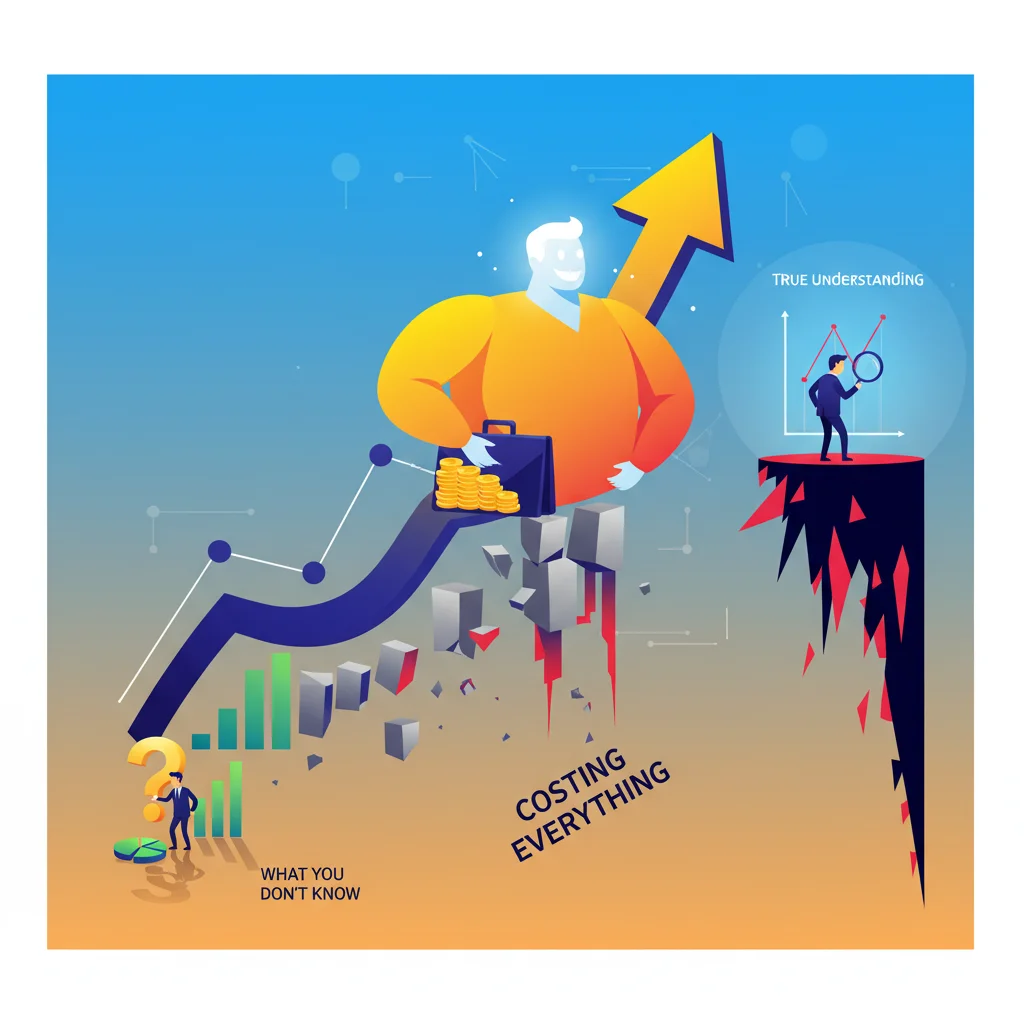
In the high-stakes world of finance and investing, confidence is often seen as a prerequisite for success. We celebrate the bold trader, the visionary CEO, the economist with the ironclad forecast. But what if the greatest risk to your financial well-being isn’t market volatility or a downturn in the economy, but the very confidence you carry? What if your biggest liability is, quite simply, not knowing what you don’t know?
This isn’t just a philosophical puzzle; it’s a cognitive reality. We are all susceptible to blind spots—gaps in our awareness that prevent us from seeing the world as it is. Instead, we see a version filtered through our own biases, experiences, and desires. This phenomenon is a powerful undercurrent in the financial markets, quietly shaping decisions in trading, banking, and even the development of complex financial technology.
Understanding these blind spots is the first step toward moving from a novice investor, swayed by emotion and overconfidence, to a seasoned professional who respects the unknown. This exploration is about more than just psychology; it’s about building a resilient and intelligent framework for navigating the complexities of the modern stock market and the broader financial landscape.
The Anatomy of a Blind Spot: Are You an Expert or Just Confident?
The term “unknown unknowns”—popularized by former US Secretary of Defense Donald Rumsfeld—perfectly captures the heart of the issue. These are the risks and realities we don’t even know exist, making them impossible to prepare for. In an insightful piece from the Financial Times, the author recounts a conference where an AI expert confidently declared that a computer would never beat a human at the complex game of Go. Just a few months later, Google’s AlphaGo did exactly that, rendering his expert prediction obsolete. His expertise created a blind spot; he was so certain of the current limitations that he couldn’t see the exponential progress happening right under his nose.
This is a classic manifestation of the Dunning-Kruger effect, a cognitive bias where individuals with low ability at a task overestimate their ability. In finance, this is a recipe for disaster. A beginner who makes a few lucky trades on the stock market might suddenly believe they’ve “cracked the code,” leading them to take on excessive risk. They are buoyed by a dangerous combination of limited knowledge and high confidence, a state of “unconscious incompetence.” They don’t just have the wrong answers; they aren’t even asking the right questions.
The Architecture of Alpha: Unlocking Portfolio Value in Forgotten Masterpieces
The High Price of Certainty in the Economy and Investing
History is littered with the financial wreckage of overconfidence. Think of the 2008 financial crisis. A vast ecosystem of bankers, ratings agencies, and regulators operated with the certainty that housing prices would never fall on a national scale and that complex derivatives had magically eliminated risk. The “unknown unknown” was the profound interconnectedness of the global banking system and how quickly a failure in one obscure corner of the market (subprime mortgages) could trigger a worldwide economic collapse.
This pattern repeats on smaller scales every day:
- In Investing: An investor becomes convinced a particular company is the next big thing. They fall victim to confirmation bias, exclusively seeking out news and data that supports their thesis while ignoring warning signs. Their blind spot is the possibility that their initial judgment was wrong.
- In Corporate Strategy: A legacy bank might dismiss the threat of a new financial technology startup, confident that their brand and scale are insurmountable moats. Their blind spot is the changing nature of customer expectations and the speed at which technology can disrupt entire industries.
– In Fintech and Blockchain: The crypto boom saw billions of dollars pour into projects based on little more than a whitepaper and a promise. Investors, caught in the hype, were certain they were on the ground floor of a new financial revolution. Many ignored the vast unknowns surrounding regulation, security, practical use cases, and the underlying economics of the tokens they were buying.
The Semmelweis Reflex: Why We Reject New Truths
Perhaps the most powerful historical lesson on cognitive blindness comes from outside of finance. In the 1840s, a Hungarian doctor named Ignaz Semmelweis discovered that he could drastically reduce mortality rates in maternity wards simply by having doctors wash their hands. His data was irrefutable. Yet, the medical establishment rejected his findings outright. It was an insult to the gentlemen doctors to suggest their own hands were unclean. His discovery contradicted their entire worldview.
This “Semmelweis Reflex”—the knee-jerk rejection of new evidence because it contradicts established norms—is rampant in the world of finance. The banking industry was initially dismissive of online banking, the brokerage industry scoffed at low-cost index funds, and many traditional finance experts were derisive of blockchain technology. As one analysis points out, this resistance is often not about the data, but about identity and ego (source). Admitting that a new paradigm is superior means admitting that your old way of doing things, the very foundation of your expertise, might be wrong.
Beyond the Bottom Line: How Ancient Rituals Drive Modern Finance and Investing
A Practical Toolkit for Seeing Around Corners
Acknowledging our blind spots is one thing; actively countering them is another. The antidote to overconfidence is not doubt, but intellectual humility. It’s an active, rigorous process of questioning your own beliefs and assumptions. For professionals in finance, economics, and business, this isn’t a “soft skill”—it’s a critical risk management tool.
Here’s a comparison of how these two mindsets approach common investing tasks:
| Financial Task | The Overconfident Mindset (Blind Spot Prone) | The Intellectually Humble Mindset (Blind Spot Aware) |
|---|---|---|
| Analyzing a Stock | “I’ve done my research, and I know this stock is a winner. I’ll find data to prove it.” | “My initial analysis is positive. Now, what are the strongest arguments against this investment?” |
| Experiencing a Market Downturn | “The market is wrong. I’ll double down because I know it will bounce back.” | “My thesis might be broken. Let me re-evaluate the fundamental conditions without emotion.” |
| Evaluating a New Technology (e.g., Fintech) | “This is just a fad. Our current business model has worked for decades.” | “What problem does this technology solve? Even if it seems small, could it grow to disrupt us?” |
| Making an Economic Forecast | “Based on my model, inflation will be 2% next year. I am certain.” | “My model suggests 2% inflation is the most likely outcome, but here are three key variables that could completely change that forecast.” |
How can you cultivate this humble mindset?
- Conduct a “Pre-Mortem”: Before making a significant investment or business decision, imagine it’s a year from now and it has failed spectacularly. Write down every possible reason for that failure. This forces you to consider threats and weaknesses you might otherwise ignore.
- Appoint a Devil’s Advocate: Formally assign someone on your team (or ask a trusted colleague) to argue passionately against your proposed course of action. Their job is to find every flaw in your logic.
- Track Your Decisions, Not Just Your Outcomes: Keep an “investment journal.” Write down why you made a decision at a specific time. Later, you can review whether your reasoning was sound, regardless of whether you made or lost money. A good process can have a bad outcome due to luck, and a bad process can get lucky. Focus on improving the process.
- Diversify Your Information Sources: Actively read and listen to experts and publications you disagree with. If you’re bullish on the economy, spend 30 minutes reading the most intelligent bearish arguments you can find.
Navigating the Future in an Age of AI-Driven Finance
The rise of advanced financial technology, machine learning, and AI in trading presents a new frontier for cognitive blind spots. These tools can analyze vast datasets and uncover patterns invisible to the human eye, potentially helping us overcome some of our innate biases. However, they also introduce new risks. An algorithm is only as good as the data it’s trained on and the assumptions of its creators. A biased model can create a high-tech echo chamber, reinforcing a flawed strategy with blinding speed and efficiency. As experts note, human oversight and critical thinking are becoming more, not less, important.
Beyond the Ticker: Why Investors Must Understand the 'Groyper' Phenomenon
The ultimate challenge is to use technology as a tool for illumination, not just confirmation. We must use it to ask better questions, to challenge our assumptions, and to model a wider range of potential outcomes. The future of smart investing and strategic leadership will belong to those who can pair the power of financial technology with the profound, and timeless, wisdom of intellectual humility.
In the end, the most profitable position you can hold in any market is a healthy awareness of your own ignorance. It is the one asset that never depreciates, the one hedge that protects against the greatest risk of all: yourself.