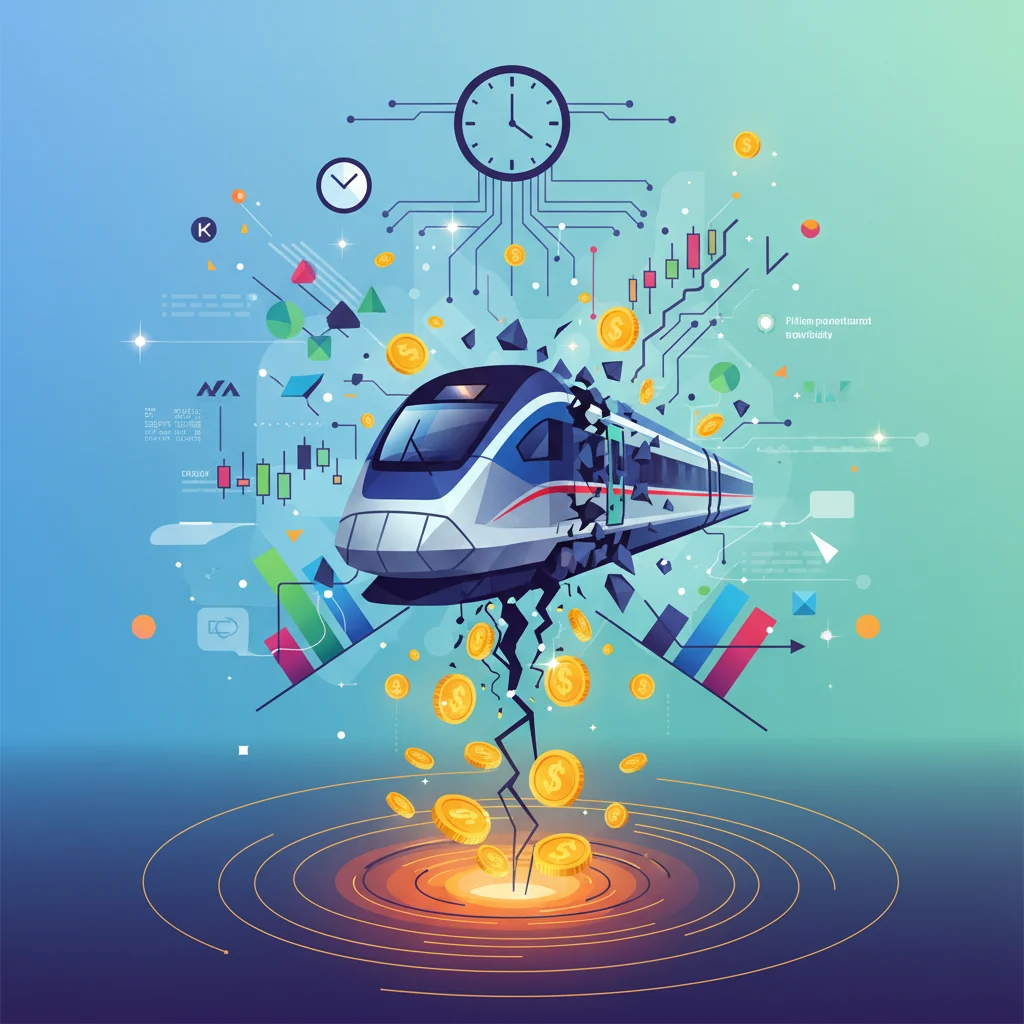
Beyond the Delay: The Hidden Financial Fallout of the Eurostar Shutdown and What Investors Must Learn
It began as a frustrating travel story. Hundreds of passengers, bound for continental Europe or London, found themselves trapped on Eurostar trains overnight, some for as long as seven hours. What was meant to be a swift journey through the Channel Tunnel devolved into a logistical nightmare, sparking a second day of delays and cancellations. While the headlines focused on the immediate human inconvenience, for business leaders, investors, and finance professionals, this incident is far more than a travel snag. It’s a stark and costly lesson in operational risk, a real-time case study revealing the fragile intersection of physical infrastructure, economic stability, and corporate value.
In our digitally-driven world, we often fixate on cyber threats and market volatility as the primary risks to business. Yet, the Eurostar shutdown serves as a powerful reminder that aging infrastructure, mechanical failures, and real-world logistical breakdowns can trigger financial shockwaves with surprising force. These events erode revenue, damage brand equity, and expose deep vulnerabilities that can spook the stock market. Understanding the multifaceted financial implications of such a failure is crucial for anyone involved in investing, economic analysis, or strategic business planning.
The Immediate Balance Sheet Impact: A Cascade of Direct Costs
The first wave of financial damage from a service disruption of this magnitude is direct and quantifiable. For Eurostar Group, the costs began mounting the moment the first train ground to a halt. The most obvious expense is passenger compensation. Under European Union regulations (EC No 1371/2007), passengers are entitled to significant refunds for long delays: a 25% refund for delays of 60 to 119 minutes and a 50% refund for delays of 120 minutes or more. For those stuck overnight, the costs escalate to include hotel accommodation, food, and alternative transport.
Let’s consider the scale. Eurostar can carry up to 900 passengers per train. If even five fully-booked trains were severely affected, that’s 4,500 passengers eligible for refunds, accommodation, and other expenses. This quickly translates into millions of euros in direct liabilities. Beyond passenger compensation, the company faces a host of other immediate costs:
- Operational Overtime: Engineers, ground staff, and customer service teams worked around the clock to resolve the issue and manage the fallout, leading to significant overtime pay.
- Repair and Maintenance: The cost of diagnosing and fixing the initial problem, whether it’s a power failure, track issue, or train malfunction, adds to the bill.
- Lost Revenue: Every cancelled service represents a complete loss of ticket revenue for that journey. With services disrupted for a second day, this figure becomes substantial, impacting the company’s quarterly earnings. According to a report from Getlink (the Channel Tunnel operator), over 10.7 million passengers used the service in the first nine months of 2023 (source), illustrating the high volume of daily traffic and the financial significance of even a partial shutdown.
These direct costs are what accountants will tally and report. However, for the savvy investor, they are merely the tip of the iceberg. The true, long-term damage to the economy and the company’s valuation lies in the less tangible, indirect consequences.
The Sovereignty Paradox: How a Flawed Economic Vision Shaped Brexit's Reality
The Ripple Effect: How One Train Delay Shakes the Broader Economy
The Eurostar is more than just a tourist train; it’s a vital economic artery connecting the UK with mainland Europe. Its failure sends ripples far beyond the company’s own finance department. The principles of economics teach us that disruptions to key infrastructure have far-reaching negative externalities.
First, consider the impact on business. High-level executives, consultants, and sales teams rely on the service for efficient, city-center-to-city-center travel. A missed meeting in Paris or a delayed contract signing in London carries an economic cost that is difficult to measure but undeniably real. This disruption to the flow of human capital can stall projects, delay investments, and sever valuable business opportunities.
Second, the disruption hits the tourism and hospitality sectors. Tourists stranded on either side of the Channel cancel hotel rooms, restaurant reservations, and theatre tickets. This creates a domino effect, where the train’s failure translates into lost revenue for countless other businesses. The travel and tourism sector is a cornerstone of both the UK and French economies, and its fragility was brutally exposed during the pandemic. Incidents like this, while smaller in scale, chip away at the sector’s recovery and stability.
Finally, there is the long-term damage to brand equity and investor confidence. A brand like Eurostar sells not just speed, but reliability. When that reliability is shattered so spectacularly, it creates hesitation. Will a business traveler risk booking for a critical meeting? Will a family trust the service for their holiday? This erosion of trust can lead to a sustained dip in demand, forcing the company to compete more aggressively on price, thereby squeezing profit margins. For investors in parent companies like Getlink, this is a major red flag, potentially impacting stock market performance as the market prices in a higher risk profile for the company’s future earnings.
Operational Risk in Focus: An Investor’s Guide
The Eurostar incident is a textbook example of operational risk—the risk of loss resulting from inadequate or failed internal processes, people, and systems, or from external events. For those in finance and banking, this is a familiar concept, but it’s one that investors across all sectors must understand. It is distinct from market risk (changes in stock prices) or credit risk (defaults on loans).
To better understand the landscape of these threats, here is a breakdown of common operational risk categories, using the Eurostar case as a reference.
| Risk Category | Description | Example in the Eurostar Context |
|---|---|---|
| Systems Failure | Breakdown of physical assets, technology infrastructure, or core systems. | The initial cause of the delay, such as a power line failure, signal malfunction, or a mechanical issue with the train itself. |
| Process Failure | Weaknesses in procedures, controls, or crisis management protocols. | Inadequate contingency plans for evacuating passengers, poor communication with those onboard, or slow deployment of recovery teams. |
| Human Error | Mistakes made by employees, whether in maintenance, operations, or management. | Could be a contributing factor, such as improper maintenance checks or a driver error (though not suggested in this specific case). |
| External Events | Events outside the company’s control, such as extreme weather, security threats, or third-party supplier failures. | While not the cause here, events like heavy snow or security alerts have previously shut down the service, highlighting this constant vulnerability. |
For investors, analyzing a company’s exposure to and management of these risks is paramount. A company that underinvests in maintenance, lacks robust crisis plans, or has a history of system failures presents a much higher risk profile, which should be reflected in its valuation and in trading decisions.
XRP at a Crossroads: Decoding the Post-Rally Unwind and a Critical Support Test
The Path Forward: Can Technology Mitigate Old-World Failures?
While the problem is one of physical infrastructure, the most promising solutions may lie in the world of financial technology and data science. The proactive mitigation of operational risk is becoming a major focus for forward-thinking companies, moving from a reactive to a predictive model.
One of the most exciting frontiers is the use of AI and the Internet of Things (IoT) for predictive maintenance. By embedding thousands of sensors in trains, tunnels, and tracks, companies can collect real-time data on everything from vibration and temperature to energy consumption. AI algorithms can then analyze this data to detect microscopic anomalies that predict a future failure, allowing engineers to intervene *before* a breakdown occurs. This approach, a cornerstone of modern `fintech` philosophy applied to physical assets, can dramatically reduce downtime and save millions in emergency repair costs and lost revenue.
Furthermore, could `blockchain` technology play a role? While often associated with cryptocurrency, the core concept of a transparent, immutable ledger has powerful applications. Imagine a scenario where passenger compensation is handled via smart contracts on a blockchain. The moment a train is officially delayed by over 120 minutes—a fact immutably recorded on the chain—a smart contract could automatically trigger refund payments to the digital wallets of affected passengers. This would slash administrative overhead, eliminate disputes, and transform a negative customer experience into a demonstration of hyper-efficient, transparent service. This is `financial technology` directly addressing a real-world service failure, rebuilding trust through automation.
The principles of decentralization, borrowed from the world of `blockchain` and fintech, could also inspire more resilient command-and-control systems, reducing single points of failure within the operational network. While these technological solutions require significant upfront investment, the long-term ROI, measured in both dollars and brand reputation, could be immense.
BP's Billion Gambit: Why Selling a Crown Jewel Like Castrol is a Masterstroke in Disguise
Actionable Takeaways for Leaders and Investors
The Eurostar saga is more than a fleeting news story; it’s a call to action. For business leaders, it underscores the non-negotiable importance of investing in infrastructure resilience and developing ironclad crisis management plans. For finance professionals and those engaged in the `stock market`, it highlights the critical need to look beyond the financial statements and scrutinize a company’s operational health.
When evaluating an investment, especially in asset-heavy industries like transport, energy, or manufacturing, ask these questions:
- What is the company’s capital expenditure on maintenance vs. expansion? A company prioritizing growth over the upkeep of core assets is a ticking time bomb.
- How transparent is the company about its operational risks in its annual reports? Look for detailed disclosures, not just boilerplate language.
- What is the company’s track record with service reliability and customer satisfaction? Past performance can be an indicator of future risk.
- Is the company embracing technology like predictive analytics to manage its physical assets? A lack of investment in modern `financial technology` for asset management is a significant red flag.
Ultimately, the global economy runs on a complex web of physical and digital infrastructure. As the Eurostar incident shows, a single snapped cable or failed part can have consequences that ripple through the entire system. By understanding these risks, we can make more informed `investing` decisions, build more resilient companies, and contribute to a more stable and reliable global `economy`.