The Two-Speed Europe Dilemma: A Radical Blueprint for Economic and Geopolitical Power?
In the grand theater of global power, Europe often appears as a formidable economic giant that speaks with a whisper. While possessing a collective economy rivaling the United States, its geopolitical influence has struggled to match its financial weight. Plagued by internal divisions and decision-making processes that move at a glacial pace, the European Union finds itself at a critical juncture. As the US and China dictate the technological and geopolitical narrative, a provocative question emerges: Must Europe fundamentally restructure itself to survive and thrive?
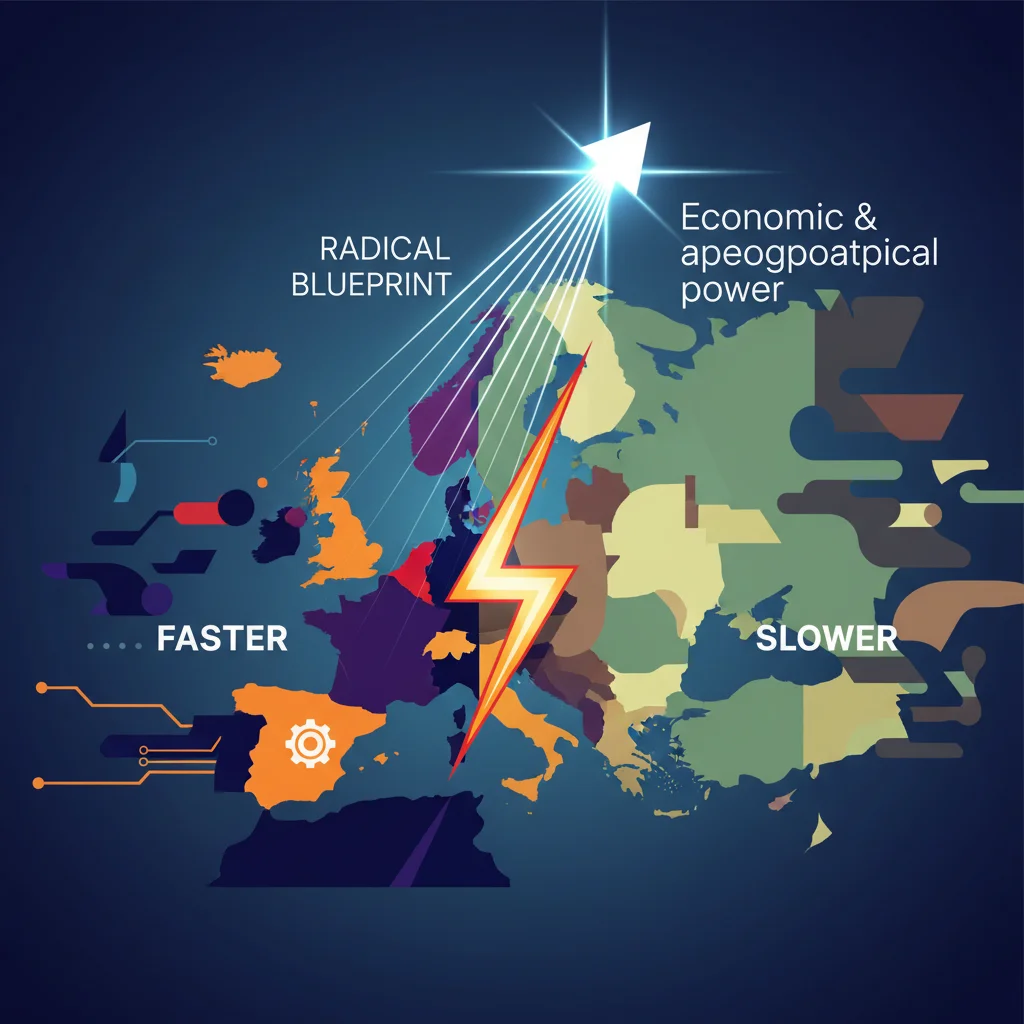
A recent letter to the Financial Times by Brillo DeLuca articulated a controversial yet increasingly debated solution: a “two-speed Europe.” The idea, while not new, is gaining fresh currency in a world defined by rapid change and strategic competition. It proposes a Europe of concentric circles—an integrated, fast-moving federal core committed to deeper union, and an outer ring of members participating primarily in the single market. This isn’t just a political reshuffle; it’s a blueprint with profound implications for the global economy, international finance, and investment strategies for decades to come.
This post will dissect the concept of a two-speed Europe, moving beyond the theoretical to explore its tangible impact on capital markets, the banking sector, and the future of financial technology. Is this the pragmatic shock therapy Europe needs to assert its relevance, or is it a recipe for irreversible fragmentation?
The Unanimity Trap: Why Europe’s Current Model is Faltering
To understand the appeal of a two-speed model, one must first diagnose the ailment of the current system. The EU’s foundational principle of consensus, particularly in foreign policy and taxation, often leads to paralysis. Major initiatives can be vetoed by a single member state, resulting in watered-down compromises or complete inaction. This “unanimity trap” has significant economic consequences.
For years, the EU has championed the Capital Markets Union (CMU), an ambitious project to create a single market for capital across the bloc. The goal is to unlock trillions of euros in private funding for businesses, reduce reliance on traditional bank lending, and create a deeper, more liquid stock market. Yet, progress has been painfully slow. According to the European Commission, EU capital markets remain fragmented and underdeveloped compared to the US, where they are about twice as large relative to GDP (source). This disparity starves innovative European companies of growth capital, pushing promising startups to seek funding—and often relocate—to the United States.
This structural weakness is a critical drag on the European economy. While the US leverages its unified market to spawn tech giants and dominate the future of fintech and AI, Europe struggles to create continental champions. A two-speed approach, its proponents argue, could break this deadlock.
The Murdoch Succession: A New King, a Divided Kingdom, and the Future of a Media Empire
Anatomy of a Two-Speed Europe: A Tale of Two Tiers
What would a two-speed Europe look like in practice? It would involve a formal differentiation of membership, creating an “inner core” and an “outer tier” with distinct rights and obligations. While the exact composition is speculative, the structure could be based on a commitment to deeper integration.
Below is a potential breakdown of how these two tiers might function, impacting everything from fiscal policy to financial regulation.
| Feature | Inner Core (e.g., Germany, France, Italy, Benelux) | Outer Tier (e.g., Poland, Hungary, Sweden, Denmark) |
|---|---|---|
| Fiscal Integration | Common debt issuance (Eurobonds), a significant central budget, harmonized corporate taxes. | National control over budgets and taxation, adherence to basic fiscal rules. |
| Financial System | Fully completed Banking Union and Capital Markets Union, unified market supervision. | Participation in the single market for financial services but with national regulatory oversight. |
| Defense & Foreign Policy | Integrated command structure, common procurement, majority voting on foreign policy. | National sovereignty over defense, policy co-operation on a case-by-case basis. |
| Technology & Innovation | Pooled funding for strategic projects (e.g., AI, blockchain, semiconductors). | Access to EU research programs but without direct participation in core strategic funds. |
This structure would allow a smaller, more politically aligned group of nations to accelerate integration in critical areas. For the world of finance, the completion of the CMU and Banking Union within this core would be a game-changer. It could create a genuine Euro-denominated safe asset, deepen liquidity for trading, and establish a regulatory environment conducive to scaling up fintech innovations across a market of hundreds of millions.
The Bull Case: Unleashing Europe’s Economic Potential
For investors and business leaders, the primary appeal of a federal core is its potential to unlock staggering economic value. A truly unified capital market in the core could, according to some estimates, mobilize over €2 trillion in additional funding for European companies (source). This infusion of capital would have several cascading effects:
- A Revitalized Stock Market: Deeper, more liquid markets would attract global capital, potentially leading to a re-rating of European equities. It would also make it easier for companies to list on European exchanges rather than the NASDAQ.
- A Fintech Revolution: A single set of rules for financial technology and a unified digital identity system across the core would allow fintech firms to scale rapidly, creating genuine European competitors to American and Asian giants. Innovations in payments, lending, and even decentralized finance using blockchain could flourish.
- Strategic Autonomy: With the ability to issue common debt, the core could fund massive, long-term investments in areas where Europe lags, such as artificial intelligence, battery production, and defense technology. This fiscal firepower is essential for geopolitical relevance, a point Brillo DeLuca’s letter implicitly makes.
In this scenario, investing in Europe would shift from a tactical play on global recovery to a strategic allocation based on the continent’s renewed dynamism. The core’s economy would become a powerhouse of innovation and stable growth.
XRP at a Crossroads: Decoding the Post-Rally Unwind and a Critical Support Test
The Bear Case: The Perils of a Great Divide
However, the path to a two-speed Europe is fraught with peril. Critics argue that it would formalize a division that currently exists informally, creating deep and lasting resentment. The risks are substantial and could destabilize the entire continent.
- Economic Divergence and Instability: The outer tier could suffer from capital flight as investment flows to the more dynamic core. This could widen the economic gap, leading to lower growth, higher unemployment, and potential financial crises on the EU’s periphery. The single market’s integrity could be threatened as regulatory and economic philosophies diverge.
- Political Fragmentation: Countries in the outer tier may feel disenfranchised, leading to a surge in anti-EU sentiment. Russia and other geopolitical rivals would likely exploit these divisions, weakening the continent’s overall security. Instead of a stronger Europe, the result could be a weaker core and a hostile periphery.
- Market Chaos and Complexity: The transition period would create massive uncertainty for the markets. How would rating agencies assess the debt of the two tiers? Would the Euro remain the currency for all, and if so, how would the ECB manage its mandate? This would introduce a new layer of sovereign risk and complexity to trading and investment analysis. A recent report from the Bruegel think tank highlights the immense legal and political hurdles to any treaty change required for such a move (source).
Implications for the Modern Investor
For those in finance, navigating a two-speed Europe would require a radical rethinking of strategy. The continent would no longer be a single investment thesis.
- Asset Allocation: Investors would need to differentiate clearly between the “core” and the “periphery.” The core might be treated as a stable, developed market with strong growth prospects in tech and finance. The periphery could become a higher-risk, higher-reward emerging market play, sensitive to political shifts and economic divergence.
- Sector Focus: In the core, sectors like financial technology, green energy, and advanced manufacturing would likely benefit from strategic investment and a unified market. In the outer tier, opportunities might lie in areas benefiting from lower costs or specific national strengths.
- Currency and Debt: The value of the Euro and the pricing of sovereign debt would become highly complex. Bonds issued by the federal core would likely trade at a premium, becoming a new global safe-haven asset, while the debt of outer-tier nations would carry a higher risk premium.
The Harambe Effect: Why a 1914 Warning Haunts Today's Global Economy
Conclusion: Evolution or Irrelevance?
The concept of a two-speed Europe is a direct response to the continent’s growing sense of geopolitical and economic anxiety. It is a radical, high-risk, high-reward strategy. The current model of slow, consensus-driven integration appears insufficient to meet the challenges of the 21st century. The inertia is costing Europe its competitive edge in key areas of the global economy, from capital markets to cutting-edge technology.
While the dream of a fully united continent remains a powerful ideal, the pragmatic reality may demand a more flexible and differentiated approach. The debate is no longer about whether all members will reach the same destination at the same time, but whether they are even heading in the same direction. For investors, business leaders, and policymakers, the coming years will be defined by this fundamental choice: embrace a bold, potentially divisive restructuring to reclaim global influence, or risk a slow, managed decline into geopolitical irrelevance.