The Hidden Bull Market: Why UK Entrepreneurs Are Ignoring the Economic Gloom
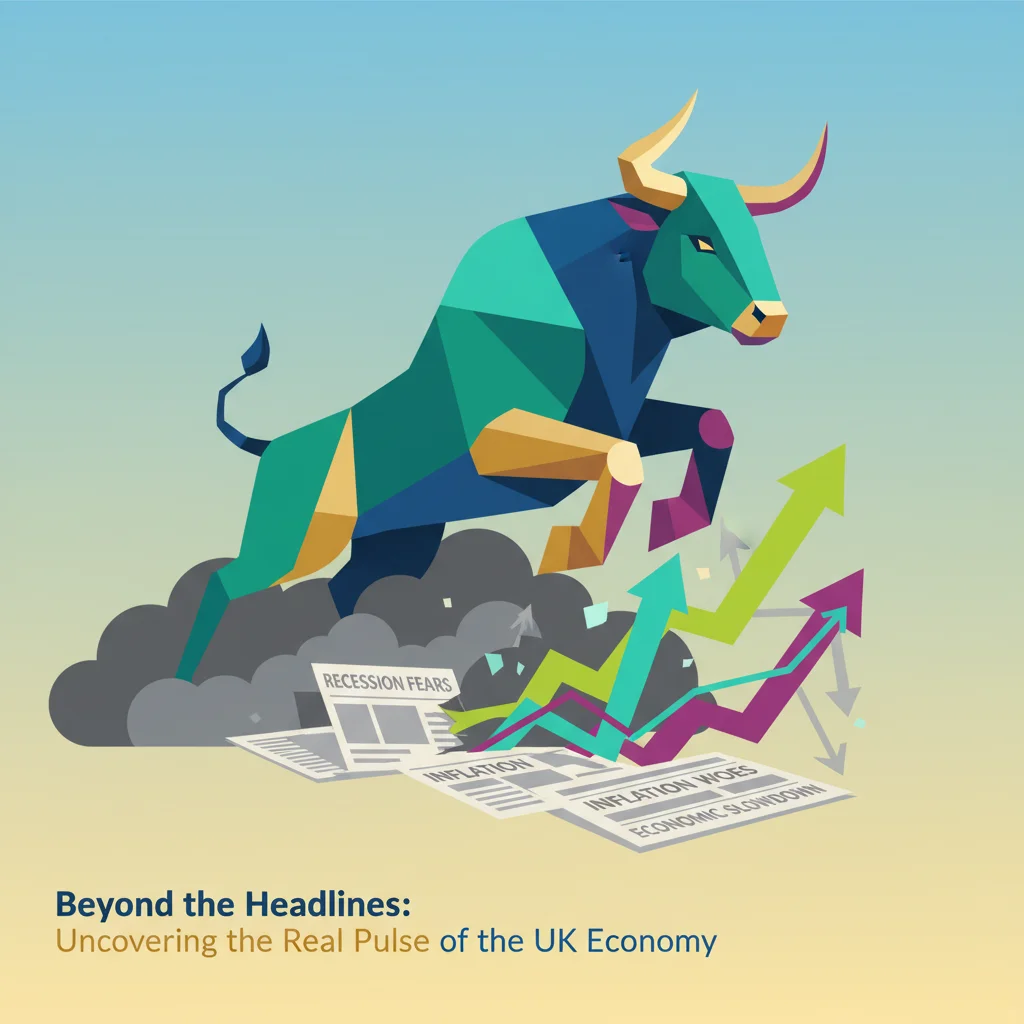
Beyond the Headlines: Uncovering the Real Pulse of the UK Economy
Turn on the news or scroll through your financial news feed, and you’ll be met with a familiar, somber narrative about the UK economy. Headlines are dominated by persistent inflation, the high cost of capital, political uncertainty, and predictions of sluggish growth. The general sentiment, from the stock market floor to the household kitchen table, seems to be one of cautious pessimism. It’s a story of headwinds and hurdles, a narrative that suggests battening down the hatches is the only sensible strategy.
But what if this is only half the story? What if, away from the macroeconomic noise, in the engine room of the economy, a completely different narrative is unfolding? A growing body of evidence, and the voices of those on the front lines of innovation, suggest a powerful undercurrent of optimism. The UK’s entrepreneurs—the founders, the builders, the risk-takers—are not just weathering the storm; many are hoisting their sails, convinced of brighter horizons ahead. This profound disconnect between the prevailing gloom and on-the-ground entrepreneurial grit presents a fascinating puzzle for investors, business leaders, and anyone interested in the future of British finance.
This article delves into that disconnect. We will explore why the creators of future value are more bullish than the commentators, dissect the specific sectors driving this confidence, and analyze what this hidden optimism means for the future of investing and economic growth in the United Kingdom.
A Tale of Two Economies: The Pessimist’s View vs. The Founder’s Vision
To understand the current landscape, it’s crucial to acknowledge the two parallel realities co-existing in the UK’s economic discourse. On one hand, we have the widely reported macroeconomic challenges. On the other, we have the microeconomic reality experienced by agile, innovative businesses.
The pessimistic narrative is well-documented. Stubborn inflation has forced the Bank of England into a cycle of interest rate hikes, making borrowing for both businesses and consumers more expensive. This directly impacts everything from corporate expansion plans to the housing market. Add to this the lingering economic friction from Brexit and a volatile global political climate, and the case for caution seems compelling. The public markets often reflect this sentiment, with the London stock market facing challenges in attracting new IPOs and retaining its largest companies.
However, the view from the startup garage and the venture capital boardroom is starkly different. A recent survey from The Entrepreneurs’ Network (TEN) revealed a striking statistic: 45% of founders expect their revenues to grow by 50% or more this year. This isn’t just wishful thinking; it’s a confidence rooted in tangible opportunities and a fundamentally different perspective on the economics of value creation.
This dichotomy can be best understood by comparing the two viewpoints side-by-side:
| Prevailing Macro Narrative (The Gloom) | Entrepreneurial Micro Reality (The Opportunity) |
|---|---|
| High interest rates stifle investment and growth. | Focus on capital efficiency and building sustainable business models. |
| Sluggish GDP growth and recession fears dominate headlines. | Targeting high-growth niche markets and global customer bases. |
| Political instability creates an uncertain business environment. | Regulatory advantages in key sectors like fintech create a competitive edge. |
| Weak IPO market signals a lack of investor confidence. | Venture capital “dry powder” remains significant for promising early-stage companies. |
| Focus on established industries and legacy challenges. | Disrupting old models with new technology (AI, blockchain, life sciences). |
This table illustrates that entrepreneurs aren’t blind to the challenges; they simply interpret them differently. For them, economic friction creates problems that are ripe for innovative solutions. A legacy banking system struggling with cross-border payments gives rise to a Wise. Inefficient consumer finance creates an opening for a Revolut. High energy costs accelerate the demand for green tech. This is the essence of creative destruction, and it thrives in times of change. The Buzz Aldrin Principle: What a Secret Spacesuit Patch Teaches Us About Financial "Tells"
The UK’s Innovation Strongholds: Why Fintech and Deep Tech Lead the Charge
The optimism isn’t evenly distributed; it’s concentrated in sectors where the UK has a genuine, world-class competitive advantage. Chief among these is financial technology, or fintech. London, for years, has cultivated an ecosystem that is rivaled only by Silicon Valley. This is no accident.
It’s the product of a perfect storm: a deep talent pool from the traditional finance and banking sectors, a progressive regulatory environment (such as the Financial Conduct Authority’s “regulatory sandbox” which allows startups to test new products safely), and a concentration of venture capital. This has allowed companies to scale rapidly and attack global markets from a UK base. The success of firms like the aforementioned Wise and Revolut, which have fundamentally changed how people manage and move money, are not outliers; they are proof of the ecosystem’s strength. According to one founder quoted in the FT, these companies have created a “flywheel effect,” spinning off experienced talent who then go on to create the next wave of startups (source).
Beyond fintech, the UK is a powerhouse in “deep tech” fields like artificial intelligence, life sciences, and quantum computing. These are not sectors that are easily swayed by short-term economic cycles. Their development horizons are measured in years, not quarters, and they are backed by patient capital that understands the long game. The UK’s world-renowned universities, such as Oxford, Cambridge, and Imperial College London, act as incubators for groundbreaking research that is then spun out into commercial ventures. This creates a resilient, high-value-add layer to the economy that is often missed in broad-based analyses. While the headlines focus on retail sales, these companies are quietly filing patents that will define industries for the next decade. Less Trade, Fewer Jobs: The Simple Grammar Rule Unpacking the Complex Reality of Tariffs for Investors
What This Means for Investors: A Guide to Contrarian Thinking
For the savvy investor, this divergence between perception and reality is a significant opportunity. While public market trading may be choppy, the private markets are telling a different story about long-term value creation. Here’s how different types of investors can interpret this landscape:
- Venture Capital & Private Equity: The current environment may be the best time in years to be deploying capital. Valuations have become more reasonable compared to the frothy peaks of 2021, and the economic pressures are forcing startups to be more disciplined, focusing on strong unit economics and sustainable growth. The abundance of talent and innovative ideas, particularly in fintech and deep tech, means there is no shortage of high-potential deals.
- Public Market Investors: The pessimism of the stock market can be an advantage. It’s time to look beyond the index-level performance and identify publicly-listed companies that possess the same innovative, resilient DNA as the startups driving optimism. These are businesses with strong balance sheets, clear technological advantages, and management teams focused on long-term market share gains, not just quarterly earnings. When the broader sentiment eventually catches up to the underlying innovation, these stocks are likely to outperform.
- Business Leaders: The message is clear: don’t let the macroeconomic narrative dictate your strategic planning. This is the time to invest in R&D, embrace new technologies, and focus on solving fundamental customer problems. As one entrepreneur notes, a downturn is precisely the moment to “build a war chest” and prepare to capture market share from less agile competitors.
Of course, this is not to say the risks aren’t real. Access to growth capital remains a hurdle, and a prolonged economic downturn will inevitably lead to failures. The path from a startup to a successful IPO is more challenging than it has been in years. But the key takeaway is that the spirit of innovation is not just alive; it is thriving. High-Stakes on the High Seas: The Economic Fallout of the Latest US-Venezuela Tanker Seizure
Conclusion: Betting on the Builders
The story of the UK economy in the 2020s is one of profound contradiction. The headlines paint a picture of stagnation and gloom, yet the entrepreneurs building the future see a landscape rich with opportunity. They see the UK’s deep-rooted strengths in finance, technology, and science not as relics of the past, but as the foundation for the next wave of global champions.
For investors, policymakers, and business leaders, the critical task is to look past the noise and listen to the signals coming from the engine room. The optimism of a nation’s entrepreneurs is one of the most powerful leading indicators of its future economic health. While the challenges are undeniable, the evidence suggests that British business, driven by its most innovative minds, has a clear opportunity to defy the gloom and build a prosperous future. The smart money will be betting on them.

Related Posts

The Exchange That Never Sleeps: How a Fintech Upstart is Revolutionizing South Korea’s Stock Market

Beyond the Square Flag: Decoding the Swiss Model for Finance and Investing