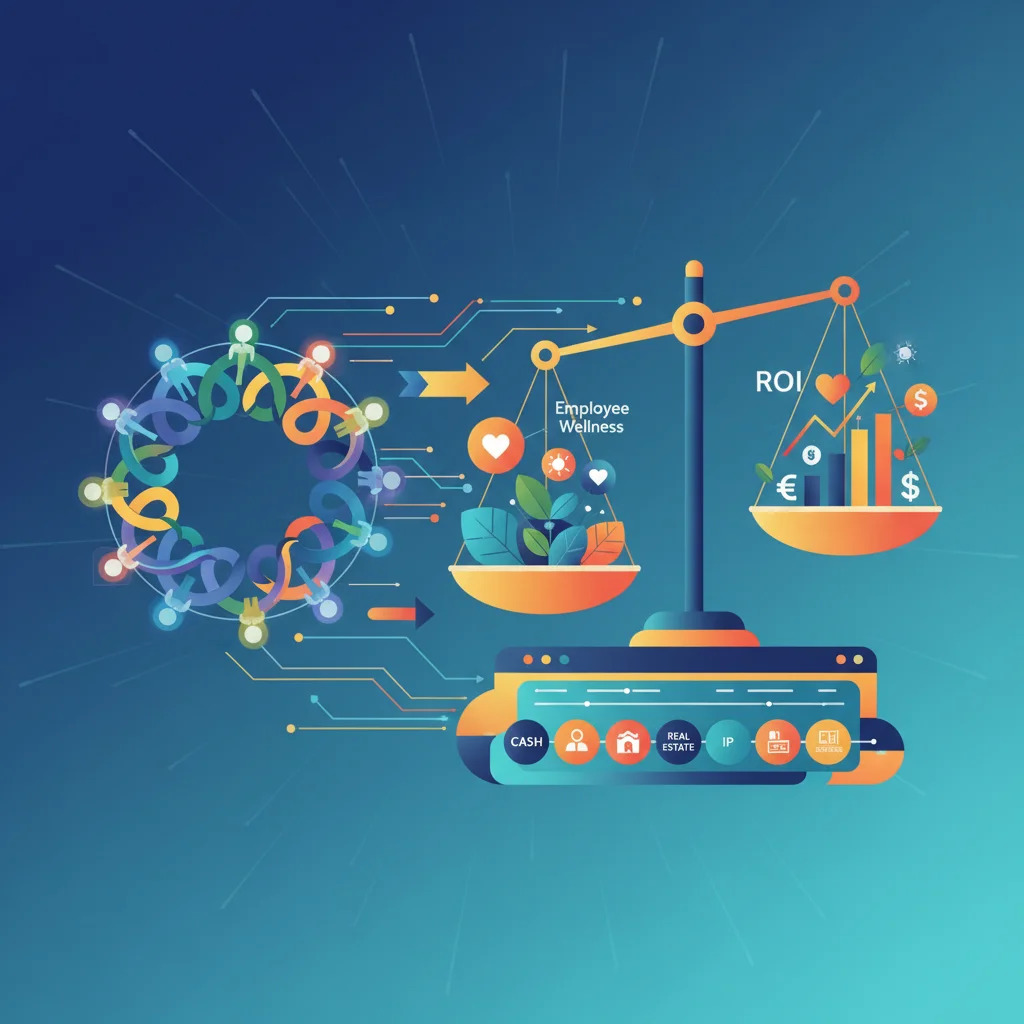
The Friendship Portfolio: Deconstructing the ROI of Sweden’s Radical Bet on Employee Wellness
In the world of corporate finance and investing, the most scrutinized assets typically appear on a balance sheet: cash reserves, real estate, intellectual property, and market securities. We build complex models to value them, trade them on the stock market, and leverage them for growth. Yet, one of the most critical assets determining long-term success remains largely invisible to traditional accounting: the social and mental well-being of a company’s workforce. Now, a groundbreaking experiment in Sweden is forcing business leaders and investors to confront this intangible asset head-on, suggesting that the next frontier of corporate value creation might lie not in complex financial instruments, but in fostering simple human connection.
A pilot project, first reported by the BBC, is offering Swedish workers a paid “friendship hour” each week, complete with a stipend to fund social activities. On the surface, it sounds like a utopian perk. But a deeper analysis reveals a shrewd strategic investment in human capital, one with profound implications for productivity, corporate finance, and the broader economy. This isn’t just about being nice; it’s about building a more resilient, innovative, and profitable enterprise from the inside out.
The Silent Liability: Quantifying the Economic Cost of Loneliness
Before analyzing the Swedish solution, we must first understand the problem’s scale. The “loneliness epidemic” is not merely a social issue; it is a significant economic drag. In a post-pandemic world characterized by remote work and digital communication, workplace isolation has surged, creating a silent liability on corporate income statements. The costs manifest in several key areas:
- Reduced Productivity: Socially disconnected employees are less engaged and motivated. A Gallup analysis has repeatedly shown that teams with high levels of engagement are significantly more productive and profitable. Loneliness is a direct antagonist to engagement.
- Increased Employee Turnover: A lack of social bonds at work is a major driver of attrition. The cost to replace an employee—including recruitment, hiring, and training—can range from one-half to two times their annual salary.
- Higher Healthcare Costs: Chronic loneliness has been linked to a host of physical and mental health issues, from depression to cardiovascular disease. This translates directly to higher insurance premiums and more sick days, impacting the bottom line. Research published by Cigna found that loneliness has the same impact on mortality as smoking 15 cigarettes a day (source).
When viewed through this lens, loneliness is not a soft HR issue but a hard financial risk. It erodes human capital, stifles innovation, and directly impacts shareholder value. Any initiative that can mitigate this risk deserves serious consideration from a financial and strategic perspective.
Primate Principles: What Chimpanzees Can Teach Us About a Smarter Financial Future
A Financial Deep Dive: Calculating the ROI of the “Friendship Hour”
The Swedish model proposes a radical intervention: directly investing company time and money into employees’ social lives. Let’s break this down not as an expense, but as a capital expenditure in workforce stability and productivity. The investment consists of two parts: the cost of one hour of wages per employee per week, and a small stipend (around £45 or $55) for activities.
To understand the potential return on this investment (ROI), we can construct a hypothetical model. While the exact figures will vary by company and industry, the framework for analysis remains constant. The table below outlines the potential costs against the quantifiable financial benefits.
Hypothetical Cost-Benefit Analysis of a “Friendship Hour” Program (Per Employee, Annually)
| Metric | Estimated Annual Cost/Benefit | Financial Rationale |
|---|---|---|
| Cost: Lost Labor Hour | (~£2,080) | Based on a £40/hour loaded labor cost for 52 weeks. This is the primary direct expense. |
| Cost: Activity Stipend | (~£2,340) | Based on a £45 weekly stipend for 52 weeks. This cost could be variable. |
| Potential Benefit: Productivity Gain | +£4,000 | A modest 5% productivity increase on an £80,000 annual salary equivalent. Engaged employees are often far more productive. |
| Potential Benefit: Reduced Turnover Costs | +£2,500 | Amortized cost of preventing one employee turnover (at £50k replacement cost) across a 20-person team. |
| Potential Benefit: Reduced Absenteeism | +£640 | Preventing just two additional sick days per year at a daily cost of £320. |
| Net Annual ROI (Per Employee) | +£2,720 | (Benefits £7,140) – (Costs £4,420). A potential positive return on investment. |
This simplified model demonstrates that a “friendship hour,” when viewed as a strategic tool to enhance productivity and retention, can plausibly generate a positive financial return. The economics of the situation suggest that paying an employee to build social capital can be more profitable than paying them for one more hour of isolated work.
ESG Investing and the “Social” Scorecard
The conversation around the “friendship hour” extends far beyond internal corporate finance and into the domain of public markets and investing. For years, investors have been increasingly incorporating Environmental, Social, and Governance (ESG) criteria into their analysis. The “S” in ESG, which covers everything from labor practices to community relations, has often been the most difficult to quantify. Initiatives like this provide a tangible, measurable way for a company to demonstrate its commitment to social principles.
For a fund manager or analyst evaluating a company, a program like the “friendship hour” can serve as a powerful leading indicator of:
- Progressive Management: It signals a leadership team that understands the modern drivers of talent acquisition and retention.
- Workforce Resilience: A socially connected workforce is better equipped to handle stress, collaborate on complex problems, and adapt to change.
- Reduced Risk: Companies with high employee satisfaction and low turnover are less prone to reputational damage, labor disputes, and operational disruptions.
A strong social score can lower a company’s perceived risk profile, potentially making its cost of capital cheaper and its stock market valuation more attractive. In an economy where talent is the ultimate competitive advantage, a company that actively invests in its employees’ well-being is making a strong case for its long-term viability.
Less Trade, Fewer Jobs: The Simple Grammar Rule Unpacking the Complex Reality of Tariffs for Investors
Macroeconomic Ripple Effects and the Role of Banking
If this concept were to move from a niche experiment to a widespread corporate practice, the macroeconomic implications would be substantial. It represents a fundamental shift in how capital is allocated within the economy—from purely physical or technological assets toward human and social capital.
Consider the ripple effects. A weekly stipend, multiplied across millions of workers, would inject a significant and consistent stream of capital into the leisure and hospitality sectors of the local economy. This is a form of decentralized, grassroots economic stimulus, funded by the private sector. The corporate banking sector would also play a crucial role. Banks would need to develop new products and services to help companies manage these programs, from specialized payroll processing to integrated financial technology platforms for administering stipends and tracking engagement metrics.
This approach challenges the foundations of traditional economics, which has often treated labor as a simple input cost to be minimized. The Swedish model reframes it as an asset to be nurtured. It moves beyond the simple trading of hours for currency and toward a more sophisticated understanding of value creation.
High-Stakes on the High Seas: The Economic Fallout of the Latest US-Venezuela Tanker Seizure
The Future of Work: A Paradigm Shift in Value
Ultimately, the “friendship hour” is a powerful symbol of a larger paradigm shift. For decades, the employer-employee relationship has been largely transactional. The new model emerging is relational, built on mutual investment and shared success. This requires a new vocabulary for business leaders and investors, one that includes concepts like psychological safety, social capital, and well-being alongside EBITDA and P/E ratios.
The lesson from this small Swedish experiment is profound. In an increasingly complex and uncertain world, the most resilient and successful organizations will be those that recognize that their greatest asset walks out the door every evening. Investing in that asset’s health, happiness, and connection is not a charitable act; it is the most astute financial decision a company can make. The future of the stock market and the broader economy may depend less on the algorithms we write and more on the human relationships we build.