Beyond Infinite Growth: Why Planetary Limits Are the New Frontier for Finance and Investing
The Uncomfortable Truth at the Heart of Modern Economics
In the fast-paced world of finance, the mantra has always been simple: growth. Quarter over quarter, year over year, the expectation embedded in every stock market valuation, every economic forecast, and every corporate strategy is one of perpetual expansion. But a recent letter to the Financial Times by David Jodrey posed a question that challenges the very foundation of our financial system: What happens when an economic model demanding infinite growth collides with a planet of finite resources? As Jodrey succinctly put it, “the earth’s regenerative capacity is finite” (source). This isn’t an environmentalist’s plea; it’s a fundamental risk assessment that every investor, banker, and business leader must now confront.
For decades, traditional economics has treated the natural world as an externality—a limitless provider of resources and a bottomless sink for waste. This oversight is no longer tenable. The consequences of exceeding our planet’s budget are manifesting as tangible financial risks: volatile commodity prices, disrupted supply chains, and a wave of climate-related regulations. The paradigm is shifting. Understanding Earth’s regenerative limits is no longer a niche concern; it is the next frontier of sophisticated financial analysis, risk management, and long-term value creation in our global economy.
Earth Overshoot Day: When Our Global Account Goes into Deficit
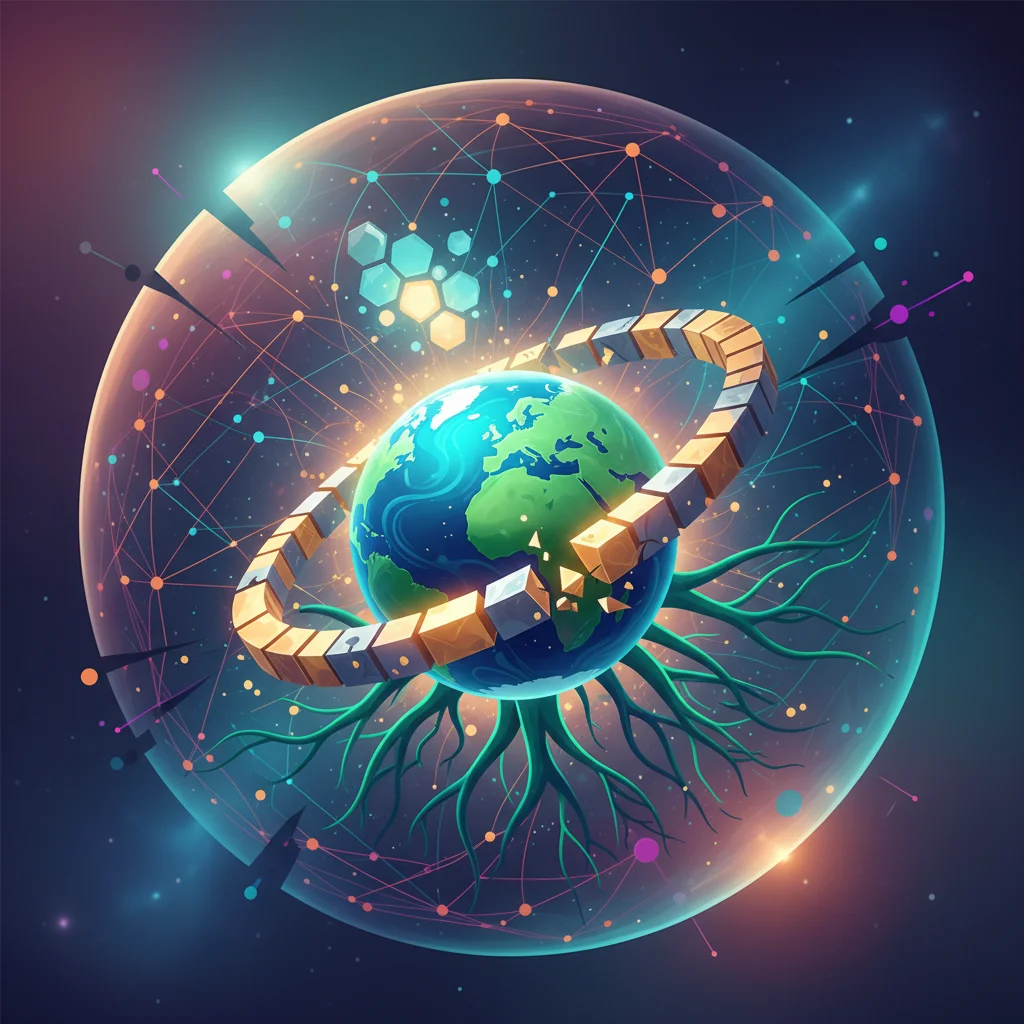
Imagine a bank account that contains all the natural resources the Earth can regenerate in one year. For the first half of human history, we lived well within this annual budget. Today, we burn through it at an alarming rate. The day we exhaust our annual budget is called Earth Overshoot Day, and it’s arriving earlier every year. In 2023, that day fell on August 2nd, according to the Global Footprint Network. From that day forward, for the rest of the year, we were operating in an ecological deficit, liquidating the planet’s natural capital to sustain our economic activity.
This isn’t just an ecological metric; it’s a stark indicator of systemic economic risk. Operating in deficit means we are eroding the very asset base our economy depends on. This translates directly into financial liabilities:
- Stranded Assets: Fossil fuel reserves that can never be burned, agricultural land rendered useless by desertification, and coastal real estate threatened by rising sea levels.
– Supply Chain Volatility: Scarcity of water, minerals, and other raw materials creates production bottlenecks and price shocks that ripple through the stock market.
– Regulatory Risk: Governments are increasingly implementing carbon taxes, emissions trading schemes, and environmental protections that directly impact corporate profitability.
– Insurance Crises: The rising frequency and intensity of extreme weather events are pushing the insurance and reinsurance industries to their breaking point, with profound implications for banking and real estate.
Ignoring these realities is like a company ignoring its depleting inventory while continuing to book record sales. The numbers look good for a while, but the collapse is inevitable. The most astute players in finance and investing are realizing that the next great alpha will be found not by ignoring these limits, but by understanding and pricing them correctly.
Gold's Glimmering Ascent: Decoding the Record-Breaking Surge Above ,400
The New Financial Toolkit: Pricing Nature and Investing in Regeneration
Acknowledging the problem is the first step; building a financial system that addresses it is the next. A revolution is underway in finance, driven by a new set of tools, technologies, and economic philosophies designed for a resource-constrained world. This is where innovation in banking, fintech, and trading is creating powerful new opportunities.
From ESG to Natural Capital Accounting
Environmental, Social, and Governance (ESG) investing was the first major attempt to integrate sustainability into financial decision-making. While a crucial first step, it has often been criticized for inconsistent data and “greenwashing.” The next evolution is Natural Capital Accounting, which attempts to place a direct economic value on the resources and services the environment provides—clean air, water, pollination, and a stable climate.
Below is a simplified comparison of key metrics for two hypothetical companies, one operating a traditional linear model and the other a circular, regenerative model. This illustrates how a natural capital lens can reveal underlying risks and strengths not visible in standard financial reports.
| Metric | Company A (Linear Model) | Company B (Circular/Regenerative Model) |
|---|---|---|
| Resource Input | 100% virgin materials | 75% recycled/regenerated materials |
| Water Usage/Product | High (unaccounted cost) | Low (closed-loop system) |
| Carbon Footprint | High (significant carbon tax liability) | Net-zero or carbon-negative |
| End-of-Life Liability | High (waste disposal costs) | Low (product-as-a-service, take-back programs) |
| Traditional P/E Ratio | 15x | 20x |
| Risk-Adjusted Valuation | Lowered due to climate and resource risk | Increased due to resilience and market leadership |
As this table shows, while Company A might look solid on a traditional P/E basis, a deeper analysis reveals significant, unpriced liabilities. Company B, despite a higher initial valuation, is fundamentally more resilient and better positioned for the future economy.
Bitcoin's K Tightrope: Navigating the Perils of Peak Leverage and Unprecedented Demand
The Role of Fintech and Blockchain
This new era of economics requires a new generation of financial technology. Fintech platforms are at the forefront, developing sophisticated algorithms to scrape and analyze unstructured ESG data, helping investors see through corporate spin. AI is being used to model complex climate scenarios and their impact on asset classes from municipal bonds to agricultural commodities.
Blockchain technology, often associated with cryptocurrencies, has a powerful role to play here. Its immutable ledger is the perfect tool for creating transparent and trustworthy systems for:
- Supply Chain Verification: Tracking raw materials from source to shelf, proving claims of sustainable or deforestation-free sourcing.
- Carbon Credit Trading: Creating liquid, transparent markets for carbon offsets, ensuring that each credit is unique, verified, and permanently retired. This is a critical piece of infrastructure for a functioning green economy.
- Tokenization of Natural Assets: Exploring ways to create financial instruments that represent a stake in a protected forest or a restored wetland, channeling private capital directly into conservation efforts.
Beyond Growth: The Rise of Alternative Economic Models
The ultimate challenge is to rethink our obsession with GDP growth as the sole measure of progress. Visionary economists are already building the frameworks for what comes next. Kate Raworth’s “Doughnut Economics” model, for example, proposes a new goal for our economy: meeting the needs of all people within the means of the living planet. As described in her work, this creates a “safe and just space for humanity,” with a social foundation below which no one should fall and an ecological ceiling which we should not overshoot (source).
This isn’t about ending progress; it’s about redefining it. It’s about shifting from a quantitative, extractive economy to a qualitative, regenerative one. This means investing in efficiency, circularity, and well-being. The business models of the future will be those that decouple revenue from resource consumption—think software-as-a-service, product-as-a-service, and platforms that enable the sharing economy.
The £100 Billion Question: Is Post-Brexit Trade Holding Back the UK Economy?
A Call to Action for the Financial World
The message from our planet is clear, and voices like David Jodrey’s are translating it into the language of economic reason. The Earth’s regenerative capacity is not a soft, environmental issue; it is the hardest, most non-negotiable boundary condition for the entire global economy. For too long, our financial models have been built on a fantasy of limitlessness.
The transition to an economy that respects planetary boundaries will be the single greatest source of disruption and opportunity in the 21st century. It will create new market leaders and leave behind those who fail to adapt. For investors, it means looking beyond the next quarter’s earnings to assess long-term resilience. For the banking sector, it means re-evaluating loan books for climate and ecological risk. For fintech innovators, it presents a clear challenge: to build the tools that will guide capital toward a truly sustainable future. The clock is ticking, and the smart money is already moving.

Related Posts

Caught in the Crossfire: A Survival Guide for Investing in Europe’s New Geopolitical Reality
Decoding the Crystal Ball: Are House Price Predictions a Fool’s Errand or an Investor’s Edge?