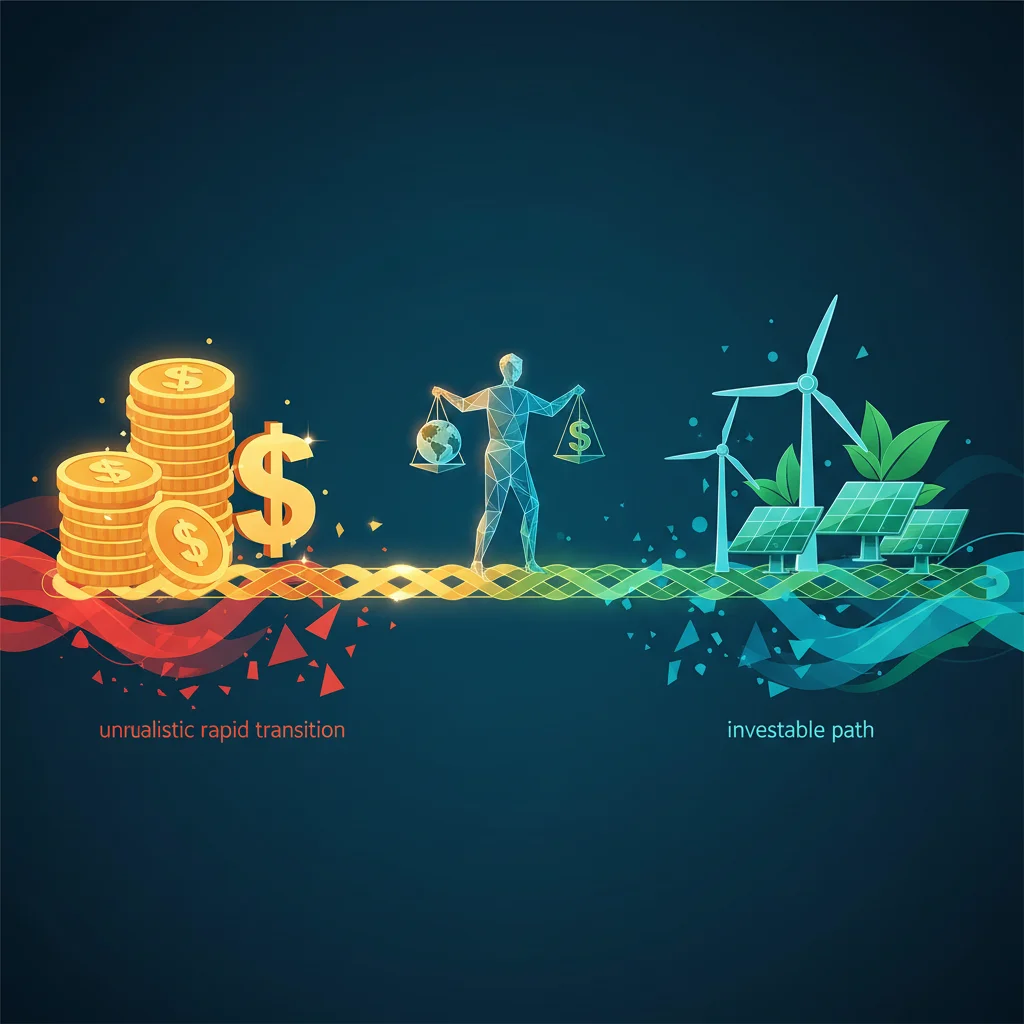
The Trillion-Dollar Tightrope: Why a Realistic Climate Transition is the Only Investable Path
The global conversation around climate change is dominated by a sense of urgency, and rightly so. The calls for a rapid, sweeping energy transition are growing louder, backed by ambitious targets and passionate advocacy. Yet, as we stand at the precipice of the largest economic transformation in human history, a critical question emerges: Are our ideals outpacing our reality? A recent letter in the Financial Times by Professor Nirbhay Rana highlights a crucial, often overlooked, point: true climate leadership requires a realistic, pragmatic, and economically viable approach to the transition.
For investors, finance professionals, and business leaders, this isn’t just an academic debate. It’s the central challenge that will define the next several decades of capital allocation, risk management, and economic growth. An unrealistic, poorly planned transition risks not only failing to meet climate goals but also triggering significant financial instability, stranding trillions in assets, and exacerbating global inequalities. Conversely, a pragmatic, well-engineered transition represents the single greatest investment opportunity of our generation. This article explores why a grounded, realistic approach is not a compromise on ambition but the only sustainable path forward for our planet and our economy.
The Grand Canyon Between Ambition and Reality
The Paris Agreement set the world on a course to limit global warming, a goal that necessitates a monumental shift in our global energy and industrial systems. The ambition is clear: transition away from fossil fuels towards a net-zero economy. However, the path from A to B is fraught with complexities that idealistic timelines often ignore.
The concept of a “just transition” is central to this challenge. It acknowledges that the shift to a green economy must be equitable, ensuring that the benefits are broadly shared and that those who stand to lose—such as workers in fossil fuel industries and communities in developing nations—are supported. According to the International Labour Organization, while the green economy could create 24 million new jobs globally by 2030, 6 million jobs will be lost in sectors like coal and oil production. Without a realistic plan, this dislocation could create profound social and economic instability, undermining the very transition we seek to achieve.
Furthermore, the financial scale is staggering. The International Energy Agency (IEA) estimates that to reach net-zero emissions by 2050, annual clean energy investment worldwide will need to more than triple to around $4 trillion by 2030. This level of capital cannot be mobilized by governments alone; it requires a robust, confident private sector. For the world of finance and investing, this means creating conditions where green projects are not just environmentally sound but also financially attractive and predictable.
Charting a Pragmatic Course: Idealism vs. Realism in the Green Transition
A realistic approach doesn’t mean abandoning our climate goals. It means designing a smarter, more resilient path to achieve them. This involves acknowledging technological limitations, economic dependencies, and geopolitical realities. The following table contrasts the common idealistic viewpoints with more pragmatic, investable pathways.
| Challenge Area | The Idealistic Approach | The Realistic & Investable Pathway |
|---|---|---|
| Energy Sourcing & Divestment | Immediate and complete divestment from all fossil fuels. Mandate 100% renewable energy sources within a decade. | A phased transition recognizing natural gas as a crucial bridge fuel. A technology-neutral strategy that includes renewables, nuclear power, hydrogen, and carbon capture to ensure grid stability and energy security. |
| Industrial & Economic Policy | Impose sweeping carbon taxes and regulations that force rapid industrial change, regardless of economic impact. | Implement stable, long-term carbon pricing mechanisms and green industrial policies that incentivize innovation and de-risk private investment in new technologies, creating a predictable environment for the stock market. |
| Finance & Investing | Rely primarily on public funds and development banking to finance the transition, often with below-market returns. | Foster blended finance models where public capital is used to catalyze and secure much larger pools of private capital. Develop new financial instruments and clear metrics that make green investing profitable and scalable. |
| Global Equity (Just Transition) | Demand that developing nations adopt the same aggressive transition timelines as developed nations, often without sufficient financial support. | Acknowledge differentiated responsibilities. Create dedicated financial mechanisms, as discussed at events like COP, to fund technology transfer and infrastructure development in emerging economies, turning a potential liability into a massive growth market. |
This pragmatic approach transforms the climate challenge from a purely cost-based problem into an economic opportunity. By creating stable policy and recognizing the need for a multi-decade, multi-technology approach, we create an environment where the banking sector can lend with confidence, investors can model long-term returns, and the global economy can adapt without collapsing.
The Swedish Christmas Portfolio: Building Financial Resilience in a Volatile World
The Engine of Transition: The Role of Financial Technology and Innovation
Bridging the gap between our climate ambitions and economic reality requires more than just political will; it demands unprecedented innovation, particularly in the realm of finance. This is where **financial technology (fintech)** becomes a critical enabler of the green transition.
Modern **fintech** platforms are democratizing green **investing**, allowing retail and institutional investors to directly fund solar farms, reforestation projects, and clean-tech startups. AI-powered analytics are helping funds better assess climate risk in their portfolios, moving beyond simplistic ESG scores to genuine, data-driven insights. This enhances decision-making across the **stock market** and private equity.
Furthermore, emerging technologies like **blockchain** offer revolutionary potential. Imagine a global, transparent, and fraud-proof carbon credit **trading** market built on a distributed ledger. Blockchain can be used to track and verify the provenance of green energy, the impact of a green bond, or the entire supply chain of a sustainable product. This level of transparency builds trust, a non-negotiable currency in a market that needs to mobilize trillions of dollars. A study by the World Economic Forum outlines over 65 existing and emerging use-cases for blockchain in tackling the climate crisis, showcasing its vast potential.
This wave of innovation is fundamentally reshaping the **economics** of the transition. It’s reducing friction, lowering transaction costs, and creating new markets that can efficiently channel capital towards the most impactful solutions. The traditional **banking** system is also adapting, integrating these new technologies to create more sophisticated green financing products.
Actionable Strategies for a New Economic Era
Navigating this complex landscape requires a clear-eyed strategy from all stakeholders.
- For Investors: Look beyond the headlines. Scrutinize corporate transition plans for their realism. A company with a credible, phased plan to decarbonize its operations using a mix of technologies is often a better long-term bet than one with an impossibly ambitious 2030 target and no clear roadmap. Diversify across transition technologies—from battery storage and green hydrogen to carbon capture and advanced nuclear.
- For Business Leaders: Embed a realistic transition strategy into your core business model. This is no longer a CSR initiative; it’s a central pillar of long-term value creation. Engage with policymakers to advocate for stable, predictable regulations that support long-term investment. Proactively manage the risks and opportunities of the transition, from supply chain resilience to new market entry.
- For Policymakers: Create the sandbox for innovation to flourish. Your role is not to pick technological winners but to set clear, consistent rules of the game that unleash private capital. This means long-term carbon pricing signals, streamlined permitting for green infrastructure, and targeted support for the research and development of breakthrough technologies.
The Growth Paradox: Is Poverty a Cause or a Consequence of Economic Stagnation?
Conclusion: The Pragmatic Path to a Prosperous, Sustainable Future
The transition to a net-zero economy is an unavoidable reality. The choice we face is not whether to transition, but how. An approach based on pure idealism, while well-intentioned, is a recipe for economic disruption and, ultimately, climate failure. As Professor Rana’s letter suggests, true leadership lies in embracing complexity and charting a realistic course.
By grounding our ambitions in the principles of sound **economics** and strategic **finance**, we can build a transition that is not only effective but also equitable and prosperous. This pragmatic path acknowledges the essential role of the market, the power of technological innovation, and the necessity of a just transition for all. For those in the world of **investing**, **banking**, and business, the message is clear: the greatest economic opportunity in history will not be seized by wishful thinking, but by a clear-eyed, realistic, and strategic approach to building the sustainable economy of tomorrow.

Related Posts

The Arnault Gambit: Why a €200M Real Estate Spree in a Sluggish Paris Signals a Masterclass in Contrarian Investing

The Diamond Standard: How Flawed Gems Are Forging the Future of Finance and Technology
