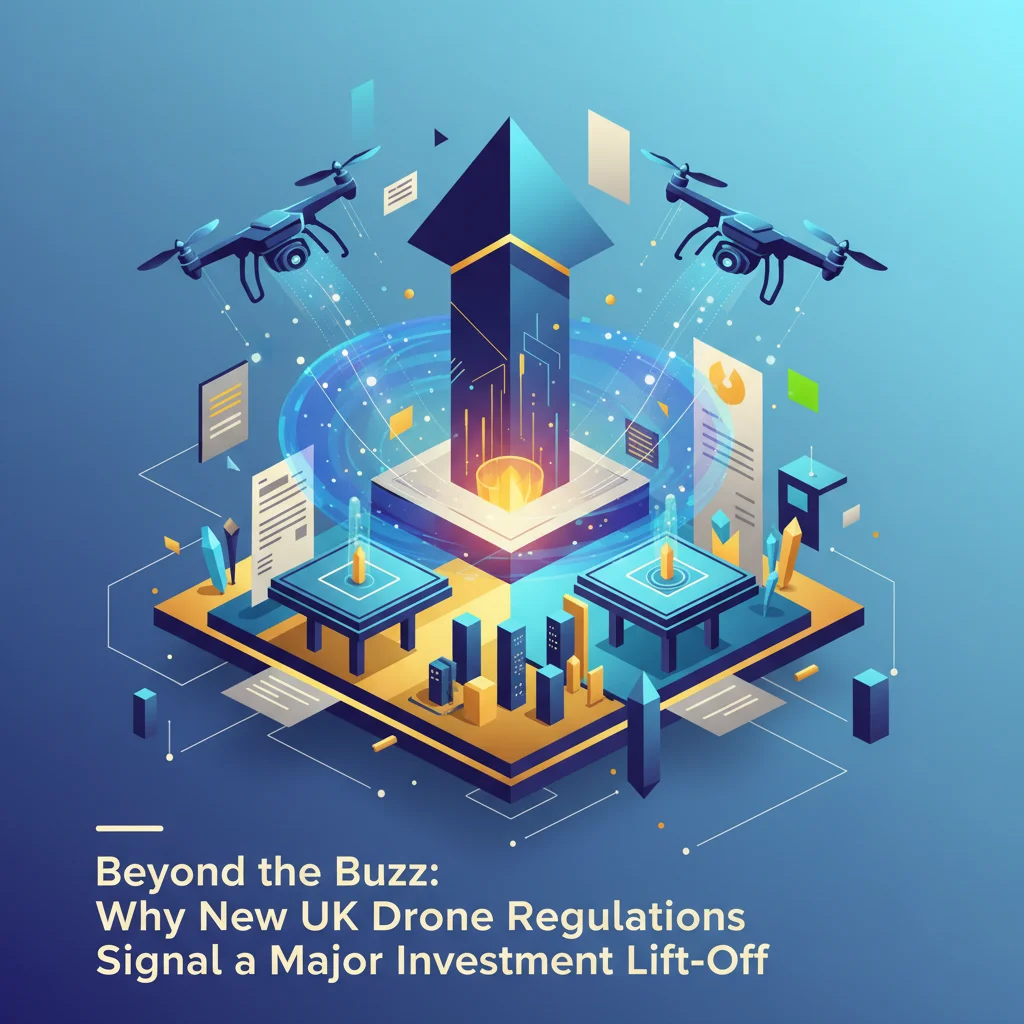
Beyond the Buzz: Why New UK Drone Regulations Signal a Major Investment Lift-Off
In the world of finance and investing, the most potent signals are often not found in stock market tickers or quarterly earnings reports, but in the seemingly dry pages of regulatory updates. A recent announcement from the UK’s Civil Aviation Authority (CAA) is a case in point. On the surface, the news that many new drone users must now pass a theory test seems like a minor bureaucratic hurdle. However, for astute investors, finance professionals, and business leaders, this development is anything but trivial. It represents the formalization of a burgeoning high-tech sector, creating a stable, predictable environment ripe for significant economic expansion and investment.
The CAA estimates that its new requirements could impact up to half a million people in the UK. While many of these are hobbyists, the underlying message is clear: the era of drones as mere toys is over. We are entering a phase of regulated, professional, and commercially integrated unmanned aerial vehicle (UAV) operations. This regulatory maturity is the bedrock upon which the future of the drone economy will be built, unlocking opportunities across logistics, agriculture, infrastructure, and the financial technology that will power it all.
Decoding the New Regulatory Framework
Before diving into the economic implications, it’s crucial to understand the substance of these changes. The CAA’s updated rules are designed to enhance safety and accountability, moving the drone industry from a “wild west” frontier to a structured and insurable market. This shift is fundamental for any industry seeking institutional capital and widespread commercial adoption.
Here is a simplified breakdown of the key regulatory shifts for drone operators in the UK:
| Regulatory Aspect | Previous State (Simplified) | New Requirements | Impact on the Market |
|---|---|---|---|
| Operator Registration | Required for drones over 250g. | Registration remains mandatory, but enforcement and awareness are heightened. All but the lightest drones require an Operator ID. | Increases accountability and traceability, reducing operational risk for commercial services. |
| Pilot Competency | A free online test was required for a Flyer ID. | A more formal theory test is now required for flying most new drones, ensuring a higher baseline of knowledge on safety and aviation rules. | Professionalizes the operator base, creating a more skilled workforce and improving safety records—a key factor for insurers and investors. |
| Drone Classification | Legacy-based system. | Introduction of new class marks (C0-C4) on drones, which dictate where they can be flown and by whom. | Standardizes the hardware landscape, making it easier for businesses to procure compliant technology and for regulators to manage airspace. |
This structured approach, while adding a layer of administration, is a profoundly bullish signal. It mirrors the regulatory evolution seen in other transformative industries, from automobiles to the internet. Regulation creates barriers to entry that filter out casual or reckless participants, paving the way for serious, well-capitalized companies to build scalable and sustainable business models. For the world of finance, this predictability is paramount.
Universal's UK Gambit: A Multi-Billion Dollar Bet on Britain's Economy
The Multi-Billion Pound Drone Economy: An Investment Thesis
The true significance of these regulations lies in the economic activity they unlock. The drone industry is not a niche market; it is a foundational technology that will revolutionize multiple sectors of the global economy. Investors who understand this can position themselves to capitalize on the immense growth ahead. According to a 2022 report from PwC, the drone economy could boost the UK’s GDP by £45 billion by 2030. These new regulations are a critical step toward realizing that potential.
1. Logistics and E-commerce
Companies like Amazon and Alphabet’s Wing are already investing billions in drone delivery. The primary obstacle has not been technology, but regulation. A clear, nationwide framework for operator competency and vehicle classification is essential for scaling these services. As these networks expand, they will dramatically impact the stock market valuations of retail and logistics giants, creating new opportunities for trading and long-term investing. The efficiency gains—reduced delivery times, lower carbon emissions, and decreased road congestion—represent a powerful economic incentive.
2. Infrastructure and Energy
The inspection of critical infrastructure like wind turbines, power lines, railways, and oil pipelines is dangerous, expensive, and time-consuming. Drones equipped with high-resolution cameras and thermal sensors can perform these tasks faster, safer, and more cheaply. This “drones-as-a-service” (DaaS) model is a high-growth area. A stable regulatory environment allows energy and utility companies to confidently integrate drone fleets into their standard operating procedures, driving massive contracts for specialized drone service providers.
3. Agriculture (AgriTech)
Precision agriculture is another explosive growth sector. Drones provide invaluable data on crop health, soil conditions, and hydration levels, enabling farmers to optimize the use of water, fertilizer, and pesticides. This not only increases yields but also promotes sustainability. The economics are compelling, and with clear operational rules, AgriTech companies can more easily sell and deploy their drone-based solutions across the country.
The Convergence with Financial Technology (Fintech)
Perhaps the most overlooked aspect of the drone revolution is its deep connection to the world of banking and financial technology. An autonomous economy requires autonomous financial infrastructure. Drones are not just flying hardware; they are mobile, data-generating economic agents that will require a new suite of fintech solutions.
Insurtech and Risk Management
Insuring a single drone is simple. Insuring a fleet of thousands of autonomous delivery vehicles is a complex challenge that legacy insurance models are ill-equipped to handle. This creates a massive opportunity for Insurtech innovators to develop new products based on real-time flight data, pilot history, and AI-driven risk assessment. The CAA’s registration and testing requirements provide the foundational data needed to accurately price these novel insurance policies.
Blockchain for Security and Transparency
A drone delivering a high-value medical package or capturing sensitive infrastructure data is a prime target for cyber-attacks. Blockchain technology offers a powerful solution for securing this ecosystem. A distributed ledger can create an immutable record of a drone’s flight path, maintenance history, and data transmissions. This is not just a security feature; it’s a financial and regulatory tool. Imagine a supply chain where a product’s journey is tracked via drone and recorded on a blockchain, triggering an automatic payment upon verified delivery. This enhances trust, streamlines audits, and reduces fraud—core principles of modern economics and finance.
Automated Payments and Banking
As drones become autonomous economic actors, they will need to transact independently. This could involve paying landing fees at “vertiports,” purchasing data from weather services, or receiving payment for a completed job. This machine-to-machine (M2M) economy will require sophisticated financial technology, including embedded banking services and instant, low-cost payment rails. This is a new frontier for fintech companies and a challenge to traditional banking models.
The £150 Glitch: How a Single Postcode Error Reveals Systemic Risk in the Global Economy
Risks and a Balanced Outlook for Investors
No investment thesis is complete without a sober assessment of the risks. While the new regulations are a net positive, they do not eliminate the challenges facing the drone industry. Investors and business leaders must remain aware of several key factors:
- Regulatory Evolution: Regulations can and will change. Future rules regarding beyond-visual-line-of-sight (BVLOS) operations and autonomous flight will be complex and could create new hurdles.
- Public Perception: Privacy and noise concerns remain significant public issues. Widespread acceptance is not guaranteed and could impact the speed of adoption for services like urban deliveries. A single high-profile incident could set the industry back years.
- Technological Hurdles: Challenges like battery life, payload capacity, and vulnerability to GPS spoofing or hacking are still being addressed. Continued R&D investment is critical. A recent report highlighted the growing concern around cybersecurity for UAVs, which could impact investor confidence (source).
- Economic Headwinds: Like any capital-intensive industry, the drone sector is sensitive to the broader economy. A downturn could slow investment in new fleets and infrastructure.
The Unstable Foundation: How Britain's Housing Crisis Became a Ticking Bomb for the Economy
Conclusion: The Flight Plan for Future Growth
The UK Civil Aviation Authority’s new drone regulations are far more than a simple update for hobbyists. They are a landmark development that signals the maturation of a transformative industry. By establishing a clear, safe, and professional framework, these rules de-risk the sector for commercial operators and, crucially, for the financial markets that will fund its growth.
For investors, business leaders, and finance professionals, the message is to look beyond the headlines about theory tests and see the bigger picture. This is the starting gun for a new phase of economic activity, creating a ripple effect that will touch logistics, agriculture, energy, and banking. The convergence of autonomous aviation with cutting-edge financial technology like blockchain and Insurtech will create entirely new markets and investment opportunities. The sky is no longer the limit; it’s the new frontier of economic development.

Related Posts
From Battlefields to Balance Sheets: Europe’s Defense Giants Unleash a $5 Billion Windfall for Investors

The Ozempic Economy: How Weight-Loss Drugs Are Reshaping Corporate Finance and Productivity