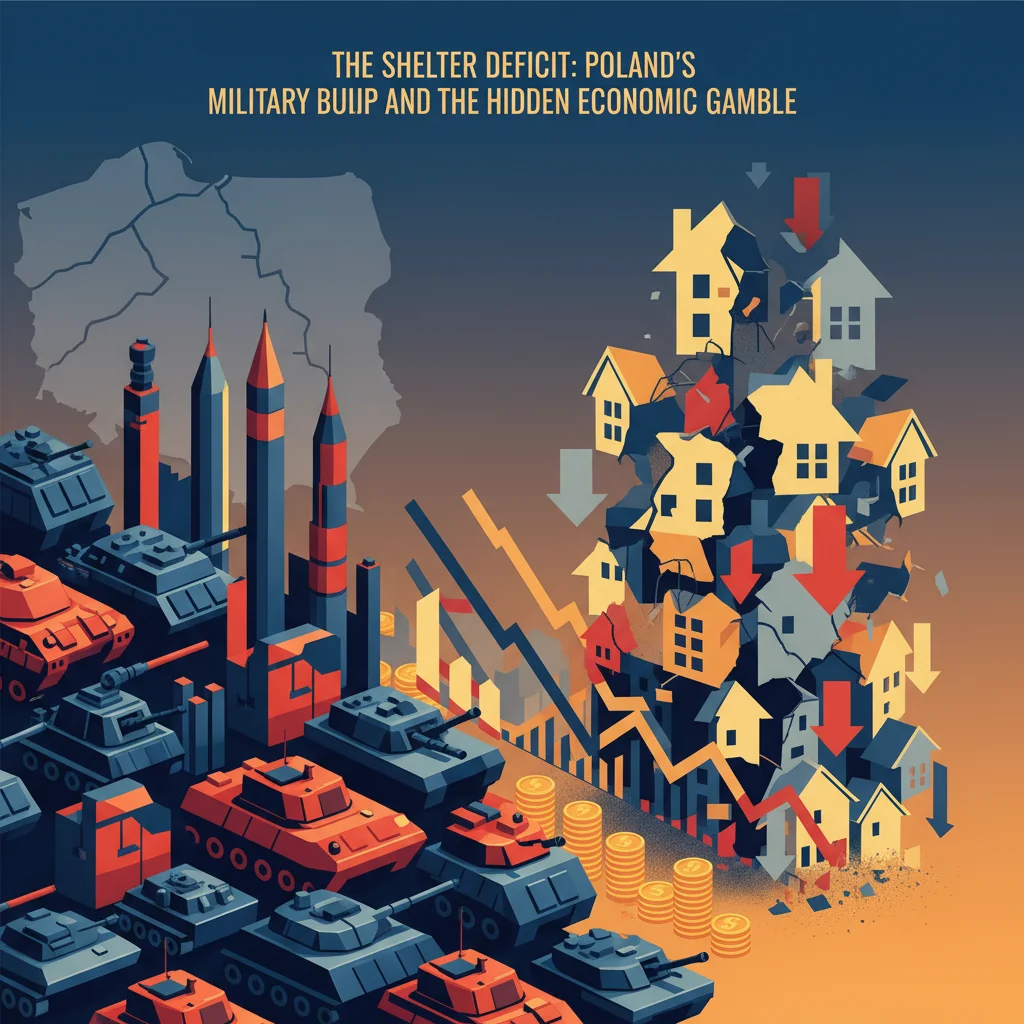
The Shelter Deficit: Poland’s Military Buildup and the Hidden Economic Gamble
The Paradox of Power: A Nation Armed for War, A People Unprepared
In the high-stakes theatre of European geopolitics, Poland has emerged as a formidable military power. As a frontline NATO state sharing a border with both Ukraine and the Russian exclave of Kaliningrad, its commitment to defense is anything but symbolic. Warsaw is dedicating more than 4% of its GDP to military spending, the highest proportion in the entire NATO alliance. This investment is materializing in a formidable arsenal of advanced tanks, jets, and artillery. Yet, a glaring paradox lies beneath this shield of military hardware: the nation’s civilian population remains critically exposed. While the state invests billions in its ability to wage war, it has profoundly underinvested in its ability to protect its citizens.
This isn’t merely a matter of public safety; it’s a critical issue with deep implications for Poland’s long-term **economy**, the stability of its **public finance**, and the overall **investment** climate. The race to build bomb shelters, now gaining frantic momentum, reveals a fundamental gap in national strategy. It forces us to ask a crucial question: What is the true cost of security, and can a nation be considered truly secure if its economic engine—its people—is left vulnerable? For investors, business leaders, and financial professionals, understanding this “shelter deficit” is key to assessing the real-world risk and resilience of a major European economy.
A Tale of Two Budgets: Tanks vs. Tunnels
The disparity between Poland’s military and civil defense preparations is stark. The post-Cold War era fostered a sense of security, leading to the neglect and decay of a once-robust network of public shelters. A recent government audit delivered a sobering verdict: existing shelters can accommodate, at best, a mere 4% of the population. Some officials believe the true figure for proper, fully-equipped shelters is less than 1%. While the Polish military is being modernized for 21st-century conflict, its civil defense infrastructure remains a relic of a bygone era.
This imbalance is not unique to Poland, but its position on NATO’s eastern flank makes the situation particularly acute. The strategic focus has been on deterrence through military strength, a logical but incomplete approach. The modern understanding of national security, however, encompasses societal resilience. To put this in perspective, consider the preparedness levels of other European nations with a long history of strategic defense planning.
The table below offers a simplified comparison of national defense philosophies, highlighting the divergence in prioritizing civilian protection.
| Country | Military Spending (% of GDP) | Civilian Shelter Capacity (% of Population) | Underlying Philosophy |
|---|---|---|---|
| Poland | ~4.2% (2023) | <4% (Official estimate) | Focus on military deterrence and frontline combat capability. |
| Finland | ~2.3% (2023) | ~80-90% | “Comprehensive Security” – military and societal resilience are inseparable. |
| Switzerland | ~0.8% (2023) | >100% (By law) | Armed neutrality and total population defense. |
| Germany | ~1.6% (2023) | <1% | Post-Cold War dismantling of civil defense, now being reassessed. |
Note: Figures are estimates and can vary based on sources and definitions of “shelter.” The table illustrates strategic priorities rather than exact, audited numbers.
This data reveals a critical divergence in risk management. While nations like Finland and Switzerland have long integrated civilian protection into their core national identity and legal frameworks, others are now scrambling to reverse decades of neglect. For Poland, the challenge is immense, involving not just construction but a fundamental shift in the **economics** of national security.
Europe's Trillion-Dollar Battery Dilemma: Why Local Content is the New Gold Standard
The Economics of Resilience: A New Investment Frontier
The Polish government is finally taking action, drafting a new civil defense bill and allocating initial funds to assess and upgrade potential shelter locations. But the scale of the task is staggering. The estimated cost runs into the billions, posing a significant challenge to a national budget already strained by record military expenditures. This is where the worlds of **finance**, **banking**, and public policy must intersect.
Several key economic and financial dimensions are at play:
- Public Finance and Funding Models: How will Poland pay for this? The answer will likely involve a mix of central government funding, municipal bonds, and, crucially, public-private partnerships (PPPs). This opens up a new avenue for infrastructure **investing**, where private capital can be mobilized to build dual-use facilities like reinforced underground parking garages, subway stations, and shopping centers. These projects offer a tangible return on investment while simultaneously enhancing national security.
- A Burgeoning Private Market: As public initiatives slowly ramp up, a private market for personal and corporate shelters is booming. This has created a new niche industry for construction companies, security firms, and manufacturers of specialized equipment like air filtration systems. This is a direct, if grim, reflection of market forces responding to a perceived failure of the state. For private equity and venture capital, this emerging sector presents unique growth opportunities.
- The Role of Financial Technology: The management and allocation of vast public funds for a nationwide infrastructure project is a prime use case for **financial technology**. **Fintech** solutions could be deployed to ensure transparent and efficient distribution of grants to municipalities. Furthermore, some theorists suggest that a national registry of available shelter spaces—both public and private—could be managed on a secure ledger system, potentially using **blockchain** technology to ensure data integrity and rapid access during a crisis.
– **Impact on Real Estate and Insurance:** The designation (or lack thereof) of a building’s basement as a potential shelter will inevitably influence property values. This introduces a new factor for real estate investors and developers. Similarly, the insurance industry will need to recalibrate risk models for business continuity and property damage in a region with varying levels of civilian protection.
The Polish government’s approach, leaning towards cost-effective dual-use structures, is a pragmatic compromise. As one official noted, it’s about creating spaces that serve the community in peacetime and protect it in crisis (source). This strategy minimizes the “dead capital” of single-purpose bunkers and integrates resilience into the fabric of the urban **economy**.
The Paycheck Rebellion: Why Fidelity's War on Executive Pay Is a Game-Changer for Every Investor
A Systemic Risk for the European Economy
Poland’s situation is not an isolated case but a harbinger of a broader European reassessment of security. From Germany auditing its remaining shelters to the Baltic states issuing civil defense guides, the continent is waking up to a new reality. The “peace dividend” that followed the Cold War, which saw widespread decommissioning of civil defense infrastructure, is now being paid back with interest.
This collective scramble has significant implications for the wider European **economy**. A major conflict on NATO’s eastern flank would not be contained by borders. The economic shockwaves—from supply chain disruptions and energy market volatility to refugee crises and investor flight—would be felt across the continent. Therefore, bolstering the resilience of frontline states like Poland is a matter of collective economic security for the entire European Union.
The challenge highlights the need for a coordinated approach, potentially through EU or NATO funding mechanisms, to standardize and support civil defense initiatives. Just as the alliance has a 2% military spending target, perhaps a new conversation is needed around resilience benchmarks. Investing in the protection of the human capital that drives the European **stock market** and economy is arguably as critical as investing in military hardware.
Economic Titans Clash: Wolf and Krugman on Power, Plutocracy, and the Future of Your Portfolio
Conclusion: Redefining the Balance Sheet of National Security
Poland’s urgent race to build bomb shelters is a powerful symbol of our turbulent times. It illustrates the profound economic and strategic consequences of neglecting one half of the security equation. A nation’s strength cannot be measured by its arsenal alone, but by its ability to protect its people and preserve its economic vitality under duress.
For the financial world, this is a pivotal moment. It demands a more nuanced understanding of sovereign risk, one that looks beyond traditional economic indicators and military budgets to assess the underlying resilience of a society. The “shelter deficit” is creating new challenges for public **finance**, but it is also generating new opportunities for **investing**, innovation in **financial technology**, and a re-energized construction sector. Ultimately, Poland’s story is a lesson in the modern **economics** of defense: true security is a balanced portfolio of military deterrence and civilian resilience. The nations that master this balance will be the ones best prepared to navigate the uncertain decades ahead.