The Trillion-Dollar Text: Why Elon Musk’s Vision for Self-Driving Teslas is a Bellwether for the Global Economy
The Tweet Heard ‘Round the Financial World
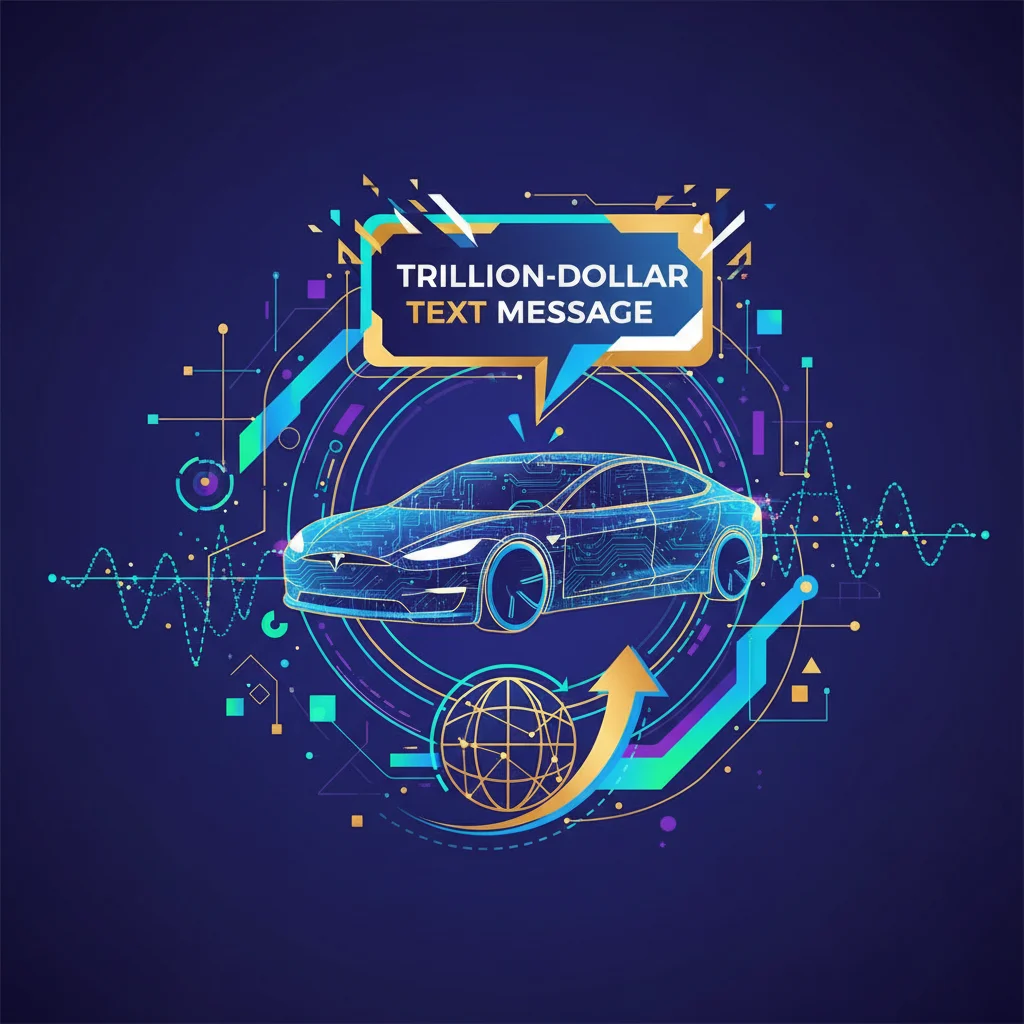
It started, as it often does, with a simple yet provocative statement. Elon Musk suggested that Tesla’s advanced automated software would soon be capable enough to allow drivers to text behind the wheel under certain conditions. On the surface, this might sound like a minor feature update or, to the more skeptical, a reckless promise. However, for those in finance, investing, and business leadership, this statement is anything but trivial. It’s a signal, a condensed summary of a multi-trillion-dollar economic transformation simmering just beneath the surface of our current transportation paradigm. The real question isn’t whether texting in a self-driving car is crazy; it’s whether your investment portfolio is prepared for the world where it’s commonplace.
This single idea—the liberation of the driver—is the cornerstone of Tesla’s astronomical valuation and the central thesis for investors betting on a future dominated by artificial intelligence. It represents the final leap from human-assisted driving to true machine autonomy, a shift that carries profound implications for the global economy, the stock market, and the very fabric of industries from insurance and logistics to real estate and urban planning.
Deconstructing Autonomy: From Cruise Control to Robotaxis
To grasp the financial significance of Musk’s claim, one must first understand that “self-driving” is not a monolithic concept. The Society of Automotive Engineers (SAE) has defined six levels of driving automation, a critical framework for investors and regulators alike. Most modern vehicles with features like adaptive cruise control or lane-keeping assist operate at Level 1 or 2. The promise of texting while the car handles everything requires, at a minimum, Level 4.
Here’s a breakdown of what these levels mean and where Tesla’s Full Self-Driving (FSD) Beta currently stands:
| SAE Level | System Capability | Human Driver’s Role | Current Industry Status |
|---|---|---|---|
| Level 0-1 | No automation or basic driver assist (e.g., cruise control). | Full and constant control. | Standard on most vehicles. |
| Level 2 | Partial Driving Automation. System can control steering and speed simultaneously. | Must remain fully engaged, monitor the environment, and be ready to take over instantly. | This is the category for Tesla’s FSD, GM’s Super Cruise, and Ford’s BlueCruise. |
| Level 3 | Conditional Driving Automation. The car can manage most aspects of driving in specific conditions. | Can disengage but must be prepared to intervene when requested by the system. | Highly limited and legally restricted. Mercedes-Benz has received approval in some regions. A significant regulatory and technical jump from Level 2. |
| Level 4 | High Driving Automation. The vehicle can operate itself without human intervention within a limited area or set of conditions (a “geofence”). | Not required to intervene within the system’s operational design domain. This is the level for “robotaxis.” | Operational in limited commercial services (e.g., Waymo in Phoenix). |
| Level 5 | Full Driving Automation. The vehicle can operate itself on any road and in any condition a human could. | A passenger only. Steering wheels and pedals are optional. | Purely theoretical at this stage; no production systems exist. |
Tesla’s FSD, despite its name, is a Level 2 system. This is a crucial distinction for anyone involved in investing or trading Tesla stock (TSLA). The valuation of the company is not based on its current status as a successful electric vehicle manufacturer; it is based on the market’s belief in its ability to solve the technological and regulatory chasm between Level 2 and Level 4/5. Achieving this would unlock the “robotaxi” network, a decentralized fleet of autonomous vehicles that could generate recurring revenue on a scale that would dwarf traditional car sales.
The Dragon Takes a Breath: Why China's Stock Market Rally Is Facing a Harsh Economic Reality
The Investment Thesis: Pricing a Paradigm Shift
Why does Wall Street assign a tech-like valuation to a company that, for now, primarily sells hardware? The answer lies in the potential Total Addressable Market (TAM) of autonomous mobility. According to a study by Intel, the autonomous vehicle industry could create a “Passenger Economy” worth $7 trillion by 2050. This is the prize that investors are focused on.
The core financial arguments for this bullish outlook include:
- Recurring Revenue: Instead of a one-time car sale, Tesla envisions a future where every vehicle sold can operate as a revenue-generating asset on its network, taking a cut of every fare. This transforms a manufacturing business into a high-margin software and service platform.
- Data as a Moat: Tesla’s fleet of over 5 million vehicles equipped with FSD hardware acts as a massive data collection network. Every mile driven provides valuable data to train its neural networks, creating a competitive advantage that is difficult for rivals to replicate. This data-centric approach is a hallmark of modern financial technology platforms.
- Drastic Cost Reduction: Autonomous vehicles promise to dramatically lower the cost-per-mile of transportation by removing the driver—the single largest expense in taxi and freight services. This deflationary pressure could reshape the entire logistics and transportation sector of the economy.
However, the path is fraught with risk. Regulatory approval is a monumental, unpredictable hurdle. Public trust remains fragile, as high-profile accidents can set back progress by years. And competitors, from Google’s Waymo to a host of startups and legacy automakers, are pouring billions into their own solutions. For investors, this is a high-stakes bet on technological execution and regulatory navigation.
The Economic Shockwave: Reshaping Banking, Insurance, and Beyond
Should Tesla or a competitor solve autonomy, the ripple effects will extend far beyond the auto industry. Entire sectors of the global economy will be fundamentally reshaped.
Consider the insurance industry. The U.S. auto insurance market alone is worth over $300 billion annually. This industry is built on the statistical reality of human error, which is responsible for over 90% of traffic accidents. If autonomous systems can reduce crash rates by an order of magnitude, the traditional risk-pooling model of consumer auto insurance could become obsolete. Liability will shift from individual drivers to software manufacturers and fleet operators. This is a massive challenge and opportunity for the fintech and “insurtech” sectors, which will need to develop entirely new models for underwriting risk based on algorithms and software updates rather than driver behavior.
The "Merry Christmas Baby" Portfolio: Timeless Lessons on Investing, Economics, and Enduring Value
The banking and asset financing landscape will also transform. The concept of individual car ownership may wane in urban centers, replaced by subscription-based “transportation-as-a-service.” This changes the nature of auto loans and creates new opportunities for financing massive commercial fleets. Furthermore, the security and transaction layer for such a vast, decentralized network could become a major application for technologies like blockchain, ensuring secure vehicle-to-vehicle communication and transparent, automated payment for services rendered.
Finally, the productivity gains could be immense. The average American spends nearly an hour commuting each day. Reclaiming that time for work, leisure, or communication—like texting—represents a significant injection of productive hours back into the economy. This is the ultimate promise behind Musk’s seemingly simple statement: turning trillions of hours of wasted commute time into economic and personal value.
Conclusion: Investing in the Inevitable, Timing the Impossible
Elon Musk’s assertion that Tesla drivers will one day be able to text safely is not just a feature announcement. It is a condensed, forward-looking statement on the future of mobility, AI, and labor. It encapsulates a vision that underpins one of the most debated and dynamic stocks on the market and serves as a proxy for the entire disruptive technology sector.
For investors, business leaders, and finance professionals, the takeaway is clear. The transition to autonomous transportation is one of the most significant economic events of our lifetime. It presents a confluence of opportunities and threats across nearly every industry. While the exact timeline remains uncertain, the direction of travel is not. The debate over texting in a Tesla today is a precursor to the far more complex economic, regulatory, and ethical questions we will all face tomorrow. The challenge is not to predict the future with certainty, but to understand the forces shaping it and to position our strategies, portfolios, and businesses to be on the right side of history when it arrives.
The Paycheck Rebellion: Why Fidelity's War on Executive Pay Is a Game-Changer for Every Investor