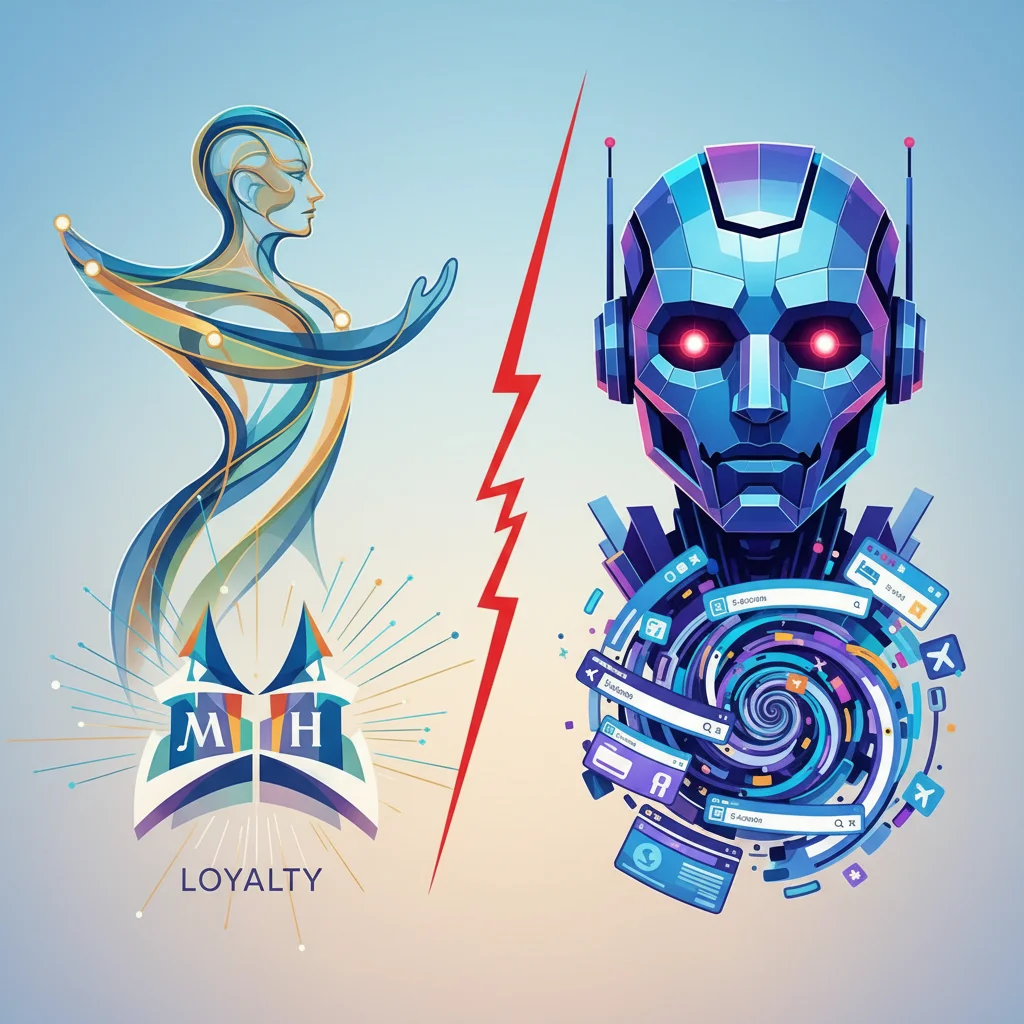
Human vs. Machine: Why Marriott and Hilton are Betting on Loyalty to Beat the AI Travel Agent
Ever found yourself lost in a labyrinth of browser tabs, trying to book a hotel? You’re cross-referencing Kayak, Expedia, the hotel’s own website, and a dozen travel blogs, all in a desperate hunt for the best deal. It’s a familiar digital ritual. But behind this seemingly simple search lies a high-stakes, multi-billion dollar war for your business. And the battle lines are being redrawn.
For years, the main conflict was between global hotel giants like Marriott and Hilton and the powerful Online Travel Agents (OTAs) like Booking.com and Expedia. Now, a new, formidable player has entered the arena: artificial intelligence. As generative AI-powered travel planners become more sophisticated, they threaten to become the ultimate gatekeepers, potentially turning hotel brands into commoditized afterthoughts.
Faced with this two-front war, the hotel industry isn’t just building better apps or offering flashy discounts. They’re doubling down on one of the oldest strategies in the book, supercharged with modern technology: customer loyalty. This isn’t just about earning points anymore; it’s a sophisticated data-driven strategy to build a defensive moat that even the smartest algorithm can’t easily cross.
The Old War: The Costly Convenience of OTAs
To understand the future, we have to look at the recent past. The rise of OTAs in the early 2000s was a classic case of digital disruption. They offered travelers a one-stop-shop to compare prices and availability across thousands of properties, a service that hotels couldn’t provide on their own. For hotels, listing on these platforms provided immense visibility and a steady stream of customers they might never have reached otherwise.
But this convenience came at a steep price. OTAs typically charge commissions of 15% to 25% on every booking. That’s a massive slice of revenue that hotels would much rather keep. More importantly, when a customer books through an OTA, the hotel loses a direct relationship with them. The OTA “owns” the customer data and the primary communication channel, making it difficult for hotels to build brand loyalty or encourage repeat business.
This is why you see the “Book Direct for the Best Rate” banners plastered all over hotel websites. A direct booking is pure gold—it’s more profitable, and it gives the hotel direct access to a customer’s data and preferences, forming the foundation of a long-term relationship.
The TikTok Deal: How a Geopolitical Showdown Redefined Cloud, AI, and Cybersecurity
The New Challenger: The Rise of the AI Travel Concierge
Just as hotels were getting a handle on their OTA strategy, generative AI crashed the party. Tools integrated into Google’s Search Generative Experience, Kayak, and a wave of new startups are promising to revolutionize travel planning. Instead of you sifting through listings, you’ll simply tell an AI:
“Plan a 5-day family-friendly trip to Lisbon in July. Find me a 4-star hotel with a pool and free breakfast near the city center, under $300 a night, with good reviews for cleanliness.”
The AI will not only find options but could also build an entire itinerary, book flights, and make restaurant reservations. This level of automation and personalization is a game-changer. For hotels, however, it’s a terrifying prospect. If the AI becomes the trusted advisor, the hotel brand becomes secondary. The customer’s loyalty shifts from Hilton or Marriott to the AI assistant that makes their life easier. The hotel is just a line item, a commodity selected by an algorithm.
This is where the fight gets interesting. How do you compete with a seemingly objective, hyper-efficient machine? You lean into the one thing the machine doesn’t have: a real, data-rich, human relationship.
The Counter-Offensive: Weaponizing Loyalty with Data and Perks
This is the core of the hotel industry’s strategy. Their loyalty programs are no longer just punch cards for free nights; they are massive data ecosystems. Marriott Bonvoy has over 200 million members, and Hilton Honors boasts 180 million. This isn’t just a mailing list; it’s one of the largest first-party datasets in the consumer world.
This data—your past stays, your room preferences, what you order from room service, whether you use the spa—is fed into sophisticated machine learning models running on powerful cloud infrastructure. The goal is to create a profile so detailed that they can anticipate your needs and offer a level of personalization that a generic AI, scraping public data, can’t match.
Their strategy has two main pillars:
1. Creating an Unbeatable Value Proposition for Members
Hotels are creating a clear two-tiered system. The best experience is reserved exclusively for loyalty members who book directly. This goes far beyond a slightly lower price.
Here’s a breakdown of how booking direct through a loyalty program stacks up against using an OTA or an AI agent:
| Feature | Booking Direct (as a Loyalty Member) | Booking via OTA / AI Agent |
|---|---|---|
| Pricing | Access to member-exclusive rates, often the lowest available. | Competitive, but may not include special member discounts. |
| Room Selection & Upgrades | Higher priority for complimentary upgrades; ability to select specific rooms. | Often assigned “run-of-the-house” rooms; upgrades are rare or paid. |
| Earning Rewards | Earn points for every dollar spent, redeemable for free nights, flights, etc. | Typically do not earn hotel loyalty points. |
| Personalized Perks | Free Wi-Fi, late check-out, welcome amenities based on status and history. | Standard amenities only; no personalization. |
| Customer Service | Direct line to the hotel for changes or issues; dedicated support for elite members. | Must go through the third-party’s customer service, which can be slow and disconnected from the hotel. |
2. Turning the Hotel App into a “Super App”
The second part of the strategy is to make their own digital platforms—the website and mobile app—the central hub for a member’s entire travel journey. They are integrating features that go far beyond booking, like mobile check-in, keyless room entry, messaging the front desk, and booking on-site amenities. By making the app indispensable during the stay, they reinforce the value of the direct relationship and gather even more data on guest behavior and preferences.
The Tech Stack Behind the Loyalty War
For the developers, entrepreneurs, and tech professionals in the audience, it’s crucial to appreciate the sheer scale of the technology powering this strategy. This isn’t just a marketing campaign; it’s a massive endeavor in software engineering and data science.
- Cloud Infrastructure: Running a loyalty program for 200 million global members requires a robust, scalable, and secure cloud backbone. We’re talking petabytes of data, real-time transaction processing, and global content delivery networks to ensure their apps are fast and responsive everywhere.
- SaaS and APIs: The modern hotel tech stack is a complex ecosystem of specialized SaaS (Software as a Service) platforms. They use different vendors for property management (PMS), customer relationship management (CRM), revenue management, and more. The magic lies in using programming and APIs to stitch all these systems together, creating a unified view of the guest.
- AI and Machine Learning: This is where the real innovation is happening. Hotels use ML for dynamic pricing, personalized marketing campaigns (sending you a spa offer if you’ve booked a spa treatment before), and even fraud detection within their points systems.
Decoding the Matrix: What Blackstone, AI Risk, and Crypto Politics Reveal About Our Future
What This Means for the Future of Travel
This evolving battlefield has significant implications for everyone involved in the travel ecosystem.
For Travelers: The message is clear. If you tend to stay with a particular hotel family (Marriott, Hilton, Hyatt, etc.), joining their free loyalty program and booking direct is almost always the superior choice. You’ll get better service, more perks, and often a better price. The age of brand agnosticism might be waning for savvy travelers.
For Developers and Tech Professionals: The hospitality industry is a fascinating and complex vertical that is ripe for technological disruption. There are immense opportunities to build better personalization engines, more secure data platforms, and seamless user experiences that bridge the digital and physical worlds.
For Entrepreneurs and Startups: While the giants battle it out, they create opportunities in their wake. Can you build a SaaS tool that helps independent hotels compete? Or a new AI-driven service that respects brand loyalty while still offering discovery? The game is far from over.
Conclusion: A Bet on Human Connection, Powered by Tech
The war for the future of travel booking is not a simple story of man versus machine. It’s a complex clash of business models, data strategies, and customer experiences. The hotel giants are making a calculated bet that a deep, data-informed relationship, rewarded with tangible perks and a human touch, can build a bond that is stronger than the cold convenience of an algorithm.
They are using the very tools of their disruptors—artificial intelligence, massive datasets, and sophisticated software—to reinforce a very old-fashioned idea: loyalty. The winner in this new era of travel won’t be the entity with the smartest AI, but the one that best combines powerful technology with a genuine understanding of what makes hospitality, well, hospitable.