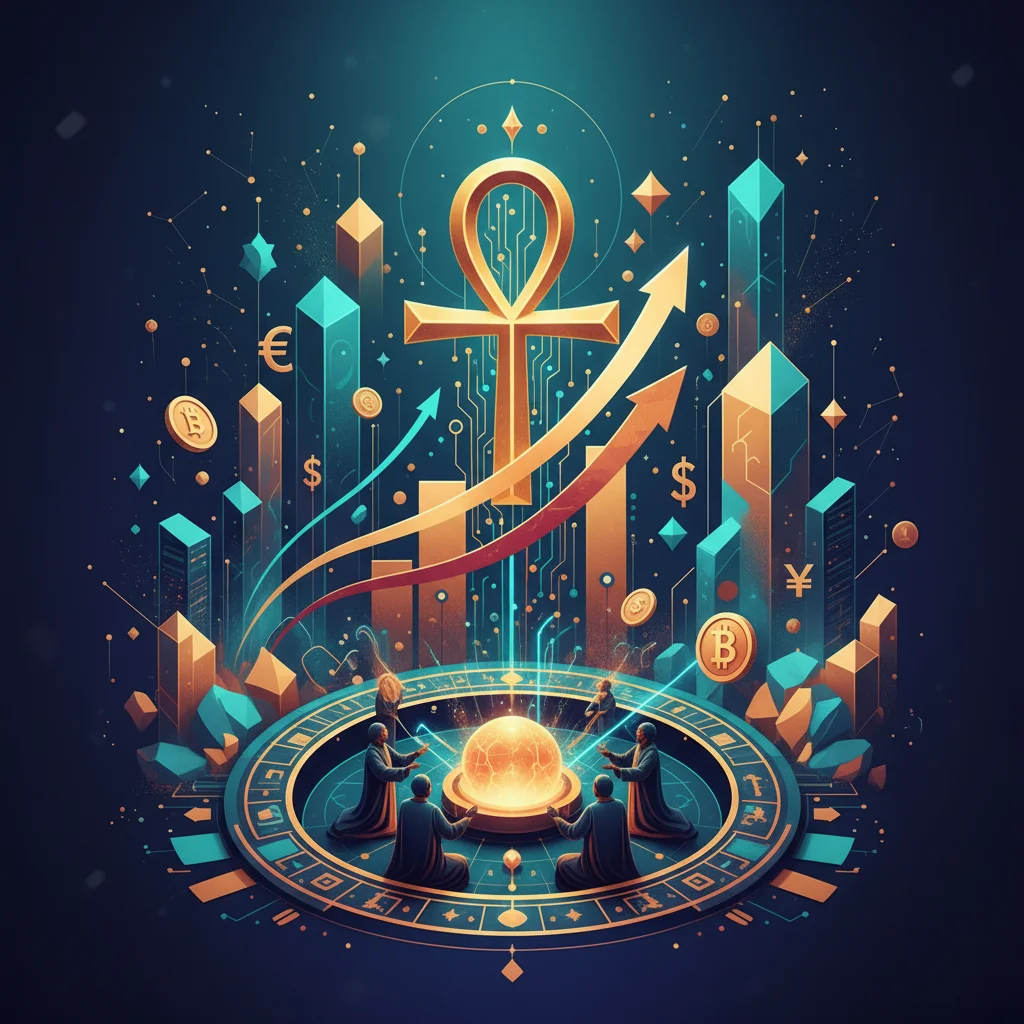
Beyond the Bottom Line: How Ancient Rituals Drive Modern Finance and Investing
In the gleaming, data-driven corridors of modern finance, we pride ourselves on rationality. Decisions are meant to be forged in the crucible of quantitative analysis, market trends, and economic modeling. From high-frequency trading algorithms to complex derivatives, the world of investing and banking appears to be the ultimate domain of logic over emotion. Yet, if you look closely, beneath the surface of spreadsheets and stock tickers, an ancient and profoundly human force is at work: ritual.
In an era where traditional religious observance is reportedly on the decline in many Western nations, our innate need for structure, meaning, and control hasn’t vanished. Instead, it has migrated. It finds new homes in our offices, on our trading floors, and even in the code of our financial technology. These modern rituals, from the daily stand-up meeting to the pre-market routine of a seasoned trader, serve the same fundamental purpose they have for millennia: to manage anxiety and create a sense of order in a world of overwhelming uncertainty. And nowhere is uncertainty more palpable than in the global economy.
The Primal Power of Predictability in an Unpredictable Market
At its core, a ritual is a sequence of actions performed in a prescribed order, imbued with symbolic meaning. Anthropologists and psychologists have long understood that rituals are powerful tools for alleviating anxiety. When faced with high-stakes, high-stress situations where the outcome is uncertain—like hunting a mammoth, praying for rain, or shorting a volatile stock—humans instinctively turn to structured, repetitive behaviors. These actions provide a psychological anchor, creating an island of predictability in a sea of chaos.
Consider the immense pressure of the stock market. Fortunes are made and lost in moments. Geopolitical events, unexpected economic data, or a single tweet can send markets into a tailspin. In this environment, the human brain craves control. While a trader cannot control the market itself, they can control their personal environment and process. This is why so many elite performers in finance and trading are creatures of habit. Their rituals might include:
- Arranging their monitors in a precise configuration each morning.
- Reading the same sequence of news sources before the opening bell.
- Performing a specific pre-trade mental checklist.
- Wearing a “lucky” tie on days when the Federal Reserve makes an announcement.
These actions are not mere superstitions; they are cognitive tools. They reduce the mental load by automating routine decisions, freeing up cognitive resources to tackle complex market dynamics. They trigger a state of focus and readiness, much like an athlete’s pre-game routine. By performing a familiar sequence of actions, the brain is reassured that, despite the external chaos, “we’ve been here before, we have a process, and we are in control of our response.”
The Green Paradox: Why the West's ESG Retreat is Ceding the Future to China
From Sacred Rites to Corporate Ceremonies
This phenomenon extends far beyond the individual trader’s desk. The entire corporate world, especially in high-stakes sectors like finance and tech, is saturated with its own secular rituals. These ceremonies serve to build group cohesion, reinforce cultural values, and create a shared sense of purpose and identity—functions once exclusively held by religious institutions.
To illustrate this parallel, consider the underlying functions of traditional sacred rituals versus their modern corporate counterparts.
| Traditional Sacred Ritual | Modern Corporate/Financial Ritual | Shared Psychological Function |
|---|---|---|
| Communal Prayer for a Good Harvest | Quarterly All-Hands Earnings Call | Alleviating collective anxiety about the future and reaffirming shared goals. |
| Initiation Rite for a New Member | New-Hire Onboarding & Welcome Lunch | Integrating an individual into the group and transmitting cultural norms. |
| Sacrificial Offering to Appease the Gods | Painful Restructuring or Layoffs for “Shareholder Value” | Making a difficult sacrifice in the present for a perceived better future. |
| Ringing of Church Bells | Ringing the Opening/Closing Bell at the NYSE | Marking a transition, creating a focal point for the community, and signaling a call to action. |
| Chanting a Sacred Mantra | Reciting the Company’s Mission Statement | Reinforcing core beliefs and creating a sense of unified identity. |
As the table shows, the context changes, but the human need remains. A study on the effects of rituals on grief found that the structured actions provided a restorative sense of control after a chaotic loss (source). Similarly, a quarterly earnings call, with its predictable structure of CEO statements, CFO data presentations, and a Q&A session, provides a ritualized forum to process potentially chaotic financial results and restore a sense of forward-looking control for investors and employees.
The Investor’s Dilemma: Ritual vs. Compulsion
For the individual investor, establishing healthy rituals can be the difference between disciplined wealth creation and emotional ruin. A structured investment plan, for example, is a powerful ritual. The practice of dollar-cost averaging—investing a fixed amount of money at regular intervals, regardless of market fluctuations—is a classic example. This ritual accomplishes several things:
- Reduces Decision Fatigue: It automates the “when” and “how much” of investing.
- Mitigates Emotional Responses: It prevents panic selling during downturns and irrational exuberance during bubbles.
- Fosters a Long-Term Mindset: The repetitive, steady action reinforces the goal of long-term growth over short-term gains.
However, there is a fine line between a healthy ritual and a value-destroying compulsion. Constantly checking stock prices, a behavior exacerbated by modern trading apps, is a compulsive loop that feeds anxiety rather than calming it. It transforms a tool for information into a source of stress, often leading to impulsive, short-sighted decisions. The key distinction, as experts in behavioral psychology note, is whether the action serves to ground you in a rational process or trap you in an emotional reaction.
The End of an Era: Why the Bank of Japan's Historic Rate Hike Will Ripple Across the Globe
Leadership in an Age of Anxiety: The Ritual-Maker
For business leaders, understanding the power of ritual is a critical and often overlooked leadership tool. In times of economic uncertainty, mergers, or technological disruption, employees crave stability and meaning. A leader who can consciously design and implement positive rituals can build a resilient and focused organizational culture.
This doesn’t have to be complex. It can be as simple as:
- The Monday Morning Kick-off: A predictable, high-energy meeting to set the tone for the week.
- The Friday Wins-Sharing: A ritual to celebrate successes and foster a sense of collective achievement before the weekend.
- The Project Post-Mortem: A structured, blameless review of what went right and wrong, turning failure into a learning ritual.
These structured interactions create psychological safety. They signal to the team that, no matter how turbulent the external environment, there is an internal process, a shared rhythm, and a stable culture they can rely on. In the grand scheme of a company’s financial health, this cultural stability is a powerful, if intangible, asset.
The £800m Pension Puzzle: Why Are UK MPs Avoiding the Stock Market?
Conclusion: The Enduring Need for Order
The worlds of finance, investing, and business may be more technologically advanced than ever, but the human brain operating within them is the same one that evolved over millennia. Our deep-seated need for ritual to manage anxiety, create meaning, and foster community has not been coded out of us. It has simply put on a business suit.
From the symbolic ringing of a bell on the stock market floor to the quiet, personal routine of an investor reviewing their long-term goals, rituals are the invisible architecture supporting our modern economy. They are the human response to an inhuman amount of data and uncertainty. Recognizing and harnessing the power of these rituals—both personal and organizational—is not a retreat from rationality. It is the ultimate acknowledgment of the human element that will always be at the heart of any market, and a key to navigating its inevitable storms with focus, discipline, and resilience.

Related Posts
The Sleepless Leader: Why ‘Hustle Culture’ is a High-Risk Investment in Today’s Economy
The Watermelon Heist of 1987: Unpacking a Forgotten Lesson in Market Psychology and Modern Finance