Beyond Procedural Generation: How AI ‘World Models’ Are About to Revolutionize the $190 Billion Gaming Industry
Picture your favorite open-world video game. The sprawling cities, the dense forests, the vast deserts. Every single tree, building, and rock was painstakingly crafted by teams of artists and developers over thousands of hours. It’s an incredible feat of human creativity and labor. But what if I told you that the next generation of epic game worlds won’t be built, but grown? What if an AI could generate a unique, dynamic, and logically consistent 3D world from a simple text prompt or a single image?
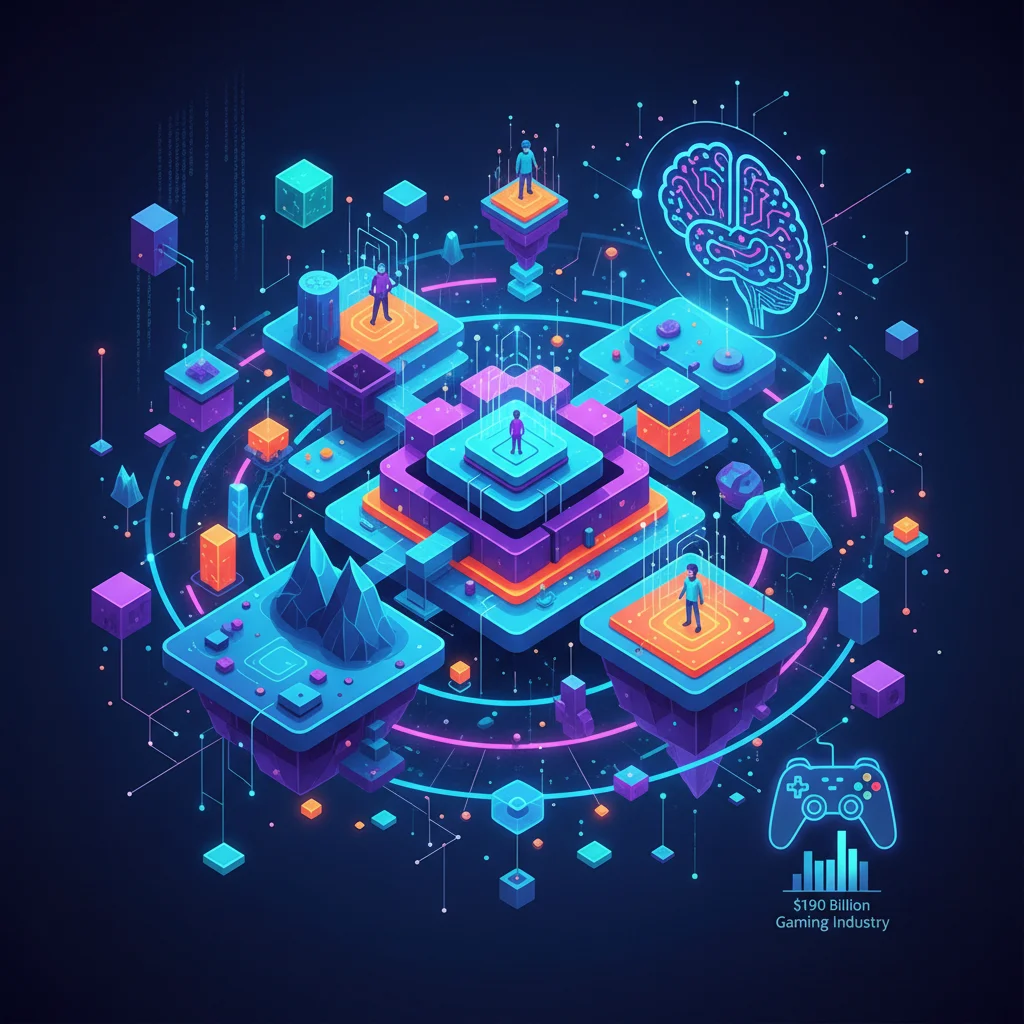
This isn’t science fiction. This is the bleeding edge of artificial intelligence, and it’s poised to completely reshape the $190 billion video games industry. We’re talking about a technological leap so significant it makes current methods look like hand-cranked machinery in the age of automation. At the heart of this revolution are “world models,” a sophisticated new class of AI being developed by giants like Google DeepMind and visionary AI pioneers like Fei-Fei Li. These models promise to do for 3D environments what technologies like GPT-4 did for text and DALL-E did for 2D images—and the implications are staggering.
Forget simply generating assets. World models are about understanding and simulating the very physics and logic of a reality. This is the next frontier of innovation, and it will redefine what it means to create and experience interactive entertainment.
What Are “World Models” and Why Are They a Game-Changer?
For years, game developers have used a technique called procedural generation to create large-scale environments. Think of the infinite planets in No Man’s Sky or the dungeons in Diablo. Procedural generation uses algorithms and rule-based systems to create content. It’s powerful, but it’s fundamentally mathematical and can often feel repetitive or random. It follows rules; it doesn’t understand.
AI world models are a different beast entirely. Instead of following a rigid set of pre-programmed rules, these machine learning systems learn the underlying principles of a world from vast amounts of data—videos, images, text, and physics simulations. They build an internal “understanding” of how objects interact, how light behaves, and how environments are structured.
The result? The ability to generate novel 3D spaces that are not just visually complex, but also coherent and interactive. Imagine typing: “Generate a dense, misty redwood forest at dawn, with a babbling brook and ancient, moss-covered ruins.” A world model could, in theory, create that entire playable environment, understanding that water should flow downhill, mist should cling to the ground, and ruins should look weathered by time.
This leap from rule-based generation to learning-based simulation is the core of this disruption. It represents a fundamental shift in creative software, moving from direct manipulation to collaborative creation with an intelligent system.
The Great AI Debate: Is Big Tech Unbeatable or Is History Repeating Itself?
The Titans of AI Enter the Gaming Arena
This groundbreaking technology isn’t just a theoretical concept in a research paper. Some of the biggest names in artificial intelligence are actively building these systems, with a clear focus on gaming and other interactive simulations.
On one side, you have Google DeepMind, the legendary AI lab behind AlphaGo. For years, they’ve used games as a crucible to test and train their AIs. Now, they’re flipping the script. Instead of creating AIs that can play games, they’re building AIs that can create them. Their involvement signals a massive investment and a belief that this is a commercially viable and technologically achievable goal.
On the other side, we have a formidable new player: World Labs. This new venture was co-founded by Dr. Fei-Fei Li, a titan in the AI world and a former director of the Stanford Artificial Intelligence Laboratory. Her entry into this space lends it immense credibility and signals a convergence of top-tier academic research with entrepreneurial ambition. According to the Financial Times, her lab is developing “AI technology to generate 3D worlds from text, images or video,” with the goal of building a “powerful ‘world engine’ for video games and other industrial simulations.” (source)
While both are targeting a similar outcome, their approaches and ultimate goals may differ. Here’s a quick look at how these two powerhouses might be positioned:
| Entity | Potential Strengths & Focus | Implications for the Industry |
|---|---|---|
| Google DeepMind | Leveraging massive cloud infrastructure (Google Cloud), vast datasets, and deep experience in reinforcement learning. Likely focused on creating a scalable, powerful foundation model for world generation. | Could become a foundational SaaS platform for game developers, similar to how major game engines like Unreal and Unity operate today. Integration with Google’s ecosystem is a major advantage. |
| World Labs (Dr. Fei-Fei Li) | Rooted in cutting-edge academic research with a focus on computer vision and spatial intelligence. Potentially more agile and focused on building a specific “world engine” product. | As one of the most promising new AI startups, it could introduce disruptive new models and tools, pushing the entire industry forward through competition and specialized innovation. |
A Paradigm Shift for Developers, Players, and the Business of Games
The impact of this technology will ripple through every corner of the gaming world. For developers, particularly smaller indie studios, this is a potential golden age. The astronomical cost and time required to build a triple-A quality world has been a massive barrier to entry. World models could democratize content creation, allowing a small team to generate a world that would currently require a studio of hundreds.
This is automation on a scale never before seen in creative industries. It will free up developers to focus on what truly matters: gameplay, story, and creating unique experiences. The technical artist of tomorrow might spend less time modeling individual rocks and more time refining AI prompts to achieve a specific aesthetic vision.
For players, the promise is nothing short of infinite novelty. Imagine games where the world is different every time you play, where environments react and evolve based on your actions in a way that isn’t pre-scripted. The concept of “replayability” would be redefined. The global video games market is already a behemoth, with consumers spending an estimated $188 billion on games and in-game content last year alone; technologies that promise endless content could push that figure into the stratosphere.
AI's New Power Grid: Why Malaysia and Arizona are Quietly Reshaping Global Tech
The Inevitable Hurdles: From Technical Debt to Artistic Integrity
Of course, this utopian vision of AI-powered game development isn’t without its challenges. The computational power required to train and run these world models is immense, demanding significant investment in cloud computing infrastructure. Ensuring that the generated worlds are not just visually plausible but also bug-free, optimized, and—most importantly—fun is a monumental task.
Then there are the human and ethical questions. What happens to the thousands of 3D artists and environment designers currently employed in the industry? While new roles will emerge, a painful transition is likely. There are also thorny issues of copyright. What data are these models trained on? If a model is trained on a billion images from the internet, who owns the resulting output?
Perhaps the greatest challenge is artistic. How do we ensure these tools are used to enhance human creativity rather than replace it? The fear is a future flooded with soulless, algorithmically generated games that all feel the same. The solution lies in building these systems as collaborative tools, designed to augment, not supplant, the vision of a human creator.
The Next Level Is Loading
The development of AI world models is more than just an incremental update for the gaming industry; it’s the start of a new chapter. This is a foundational technology that will not only change how games are made but also what kind of games are possible. The convergence of artificial intelligence, creative software, and interactive entertainment is creating a fertile ground for startups and established players alike.
The road ahead is long and filled with both technical and philosophical challenges. But one thing is clear: the worlds of tomorrow are being coded today. The developers, entrepreneurs, and creators who understand and embrace this shift won’t just be playing the game—they’ll be building the very reality it takes place in.
From Drill Rigs to Data Racks: How Big Oil's Titans Are Powering the AI Revolution