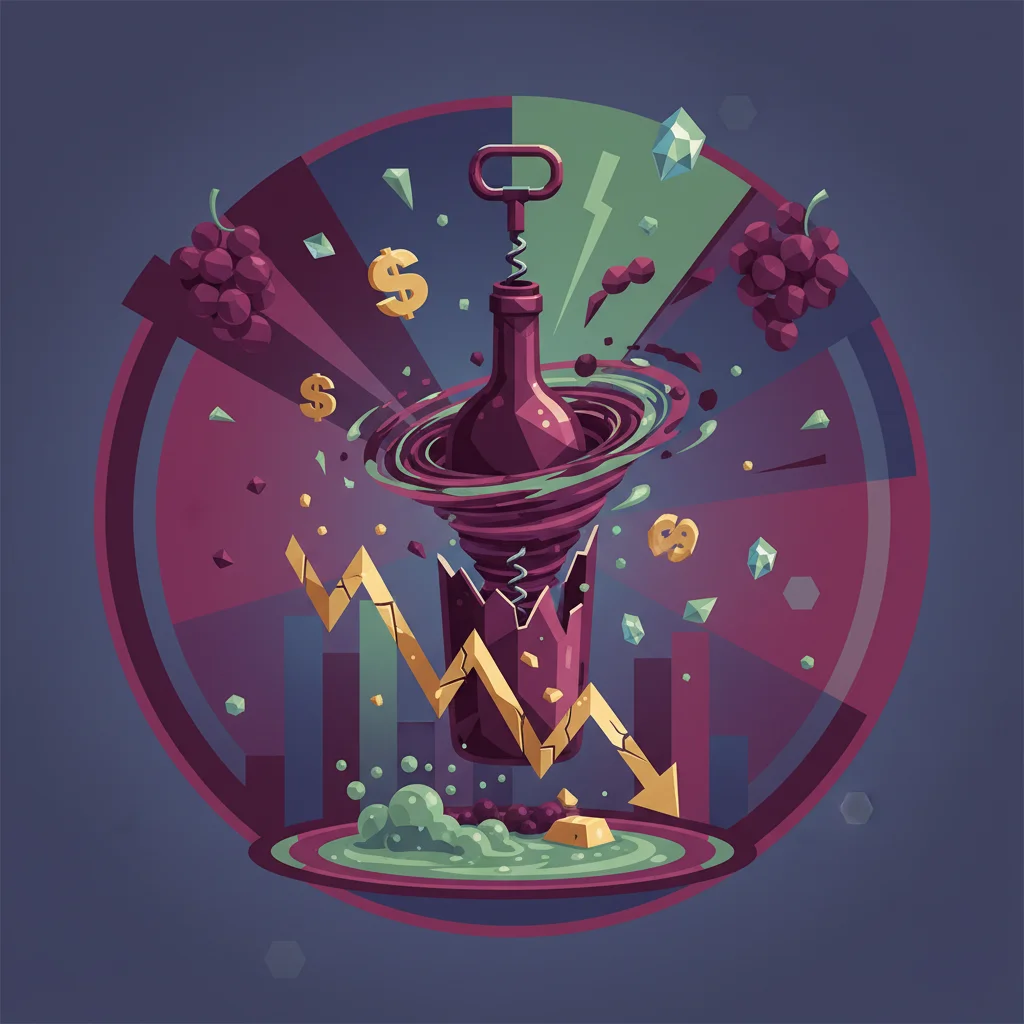
Uncorking the Downturn: Why the Fine Wine Investment Market is Leaving a Sour Taste
The Allure and Agony of Fine Wine Investing
For decades, fine wine has been more than just a connoisseur’s delight; it has been a celebrated alternative asset, a liquid luxury promising to mature in both complexity and value. Investors have often turned to cases of rare Bordeaux and Burgundy as a hedge against inflation and a diversification tool away from the volatility of the traditional stock market. The narrative was simple: as the finest wines become rarer with age, their value inevitably climbs. However, the past three years have soured this story, leaving many investors with a portfolio that’s proving hard to swallow.
The fine wine market is currently navigating a significant and prolonged downturn, challenging long-held assumptions about its stability. A confluence of geopolitical tensions, macroeconomic pressures, and shifting consumer preferences has uncorked a period of price correction. This isn’t just a minor dip; it’s a fundamental test of the market’s resilience. For finance professionals, seasoned investors, and even those just curious about the world of alternative investing, understanding the dynamics behind this slump is crucial for navigating the path forward.
A Market Decanted: The Sobering Statistics
The numbers paint a clear picture of the current market climate. The Liv-ex Fine Wine 100, a leading industry benchmark often called the “FTSE 100 of fine wine,” has been on a downward trajectory. This index tracks the price movements of the 100 most sought-after fine wines, providing a critical snapshot of market health.
According to data from the London International Vintners Exchange, the market has experienced its third consecutive year of declines. The Liv-ex 100 index fell by 14% last year, a significant drop that has erased many of the gains seen during the pandemic-era boom (source). The pain is not isolated to the top tier; the broader Liv-ex 1000 index, which tracks a wider range of wines, also saw a similar decline.
To put this into perspective, let’s look at the performance of key sub-indices, which reveals where the pressure is most acute.
| Region/Index | Key Characteristics | Recent Performance Trend |
|---|---|---|
| Bordeaux 500 | Represents the most heavily traded fine wines, traditionally the market’s backbone. | Significant declines as buyers pull back on blue-chip investments. |
| Burgundy 150 | Previously a star performer with meteoric price rises, now facing a sharp correction. | Among the hardest hit, as sky-high valuations prove unsustainable in the current economy. |
| Champagne 50 | Enjoyed a post-pandemic surge but has since lost its fizz, falling sharply. | Correction after a period of speculative buying and over-excitement. |
| Rhône 100 | Often seen as a value-oriented region, but not immune to the broader market downturn. | Negative performance, though historically less volatile than Burgundy. |
This widespread decline indicates that the issue is not isolated to a single region but is a systemic market correction. The question for every investor is: what are the driving forces behind this prolonged hangover?
Cracks in the Foundation: Private Equity's Lending Crisis and Fintech's Growing Pains
The Bitter Taste of Tariffs and Geopolitics
One of the most significant factors corking market growth has been international trading disputes. The 25% tariffs imposed by the Trump administration on certain European wines, including French still wines under 14% alcohol, dealt a heavy blow (source). While these tariffs were later suspended, their chilling effect lingers. They effectively slammed the brakes on demand from the United States, which has historically been one of the largest and most influential markets for fine wine.
This geopolitical friction created uncertainty and made it significantly more expensive for American collectors and investors to acquire top European vintages. As a result, merchants reported a sharp drop in US buying activity, which removed a crucial pillar of support for prices, particularly for Bordeaux and Burgundy. The
economics of the situation shifted, forcing sellers to look for buyers elsewhere in a market that was already beginning to cool.
Macroeconomic Headwinds: Interest Rates and Economic Uncertainty
Beyond tariffs, the global macroeconomic environment has been decidedly unfriendly to alternative assets. Central banks, particularly the Federal Reserve and the European Central Bank, have aggressively raised interest rates to combat inflation. This has profound implications for an asset like wine, which offers no yield.
When investors can get a risk-free return of 4-5% from government bonds or high-yield savings accounts, the appeal of holding a non-income-producing physical asset diminishes. The opportunity cost of tying up capital in cases of wine stored in a warehouse becomes much higher. This environment encourages a “flight to safety” and a preference for liquid, yielding assets, placing downward pressure on the prices of collectibles. The general uncertainty in the global economy also dampens speculative appetite, which had previously fueled parts of the wine market.
Looking ahead, I predict we’ll see a significant push towards the tokenization of wine assets using blockchain technology. Imagine being able to buy and sell fractional shares of a case of 1982 Lafite Rothschild with the same ease as trading a stock. This would democratize access, dramatically improve liquidity, and create a more transparent pricing mechanism. Companies are already exploring this, and while it’s still a nascent field, this downturn could be the catalyst that accelerates the adoption of fintech solutions. The old world of banking and asset management is colliding with digital innovation, and the fine wine market is a perfect, if challenging, candidate for transformation. The next bull run in wine may not be driven by ratings and reviews alone, but by the technology that underpins its trading.
The Broader Context: How Wine Stacks Up
To truly understand the current state of fine wine, it’s helpful to compare its performance against other asset classes. While a 14% drop is painful, context is key for any diversified investor. The pandemic era saw a boom in almost all alternative assets, and many are now experiencing a similar reality check.
This table offers a simplified comparative view over the recent period of market stress:
| Asset Class | Recent Performance Trend | Key Drivers |
|---|---|---|
| Fine Wine (Liv-ex 100) | ▼ Negative | High interest rates, tariff impacts, market correction after a boom. |
| Global Equities (e.g., S&P 500) | ▲ Positive / Volatile | Corporate earnings, central bank policy, tech sector strength. |
| Gold | ▲ Positive | Geopolitical uncertainty, central bank buying, safe-haven demand. |
| Cryptocurrency (e.g., Bitcoin) | ▲ Highly Volatile / Positive | Regulatory developments, institutional adoption, market sentiment. |
This comparison highlights that while wine has underperformed the stock market and safe havens like gold recently, its downturn is part of a broader re-evaluation of non-traditional assets in a new interest rate paradigm. The speculative froth that lifted many boats during 2020 and 2021 is now receding across the board.
London's Big Bet: Why the UK is Overhauling Financial Benchmark Rules
An Investor’s Crossroads: Time to Buy, Hold, or Fold?
With prices falling, the inevitable question arises: is this a buying opportunity or a warning sign to stay away? There is no simple answer, and the right strategy depends entirely on an investor’s time horizon, risk tolerance, and understanding of the market’s unique characteristics.
- The Contrarian Case (Buy): Proponents of this view will argue that the best time to invest is when there’s “blood in the streets.” With prices for top Bordeaux and Burgundy down significantly from their peaks, this could be an attractive entry point for long-term investors. The fundamental supply-demand dynamic—that great wines become rarer over time—hasn’t changed. A patient investor could acquire blue-chip assets at a discount, poised to benefit from the next market upswing.
- The Cautious Case (Hold): For those already invested, selling into a falling market can lock in losses. Many experts advise that fine wine should be viewed as a 10+ year investment. If the initial investing thesis remains intact, holding through the cycle may be the most prudent course of action. The key is to ensure the wine is stored professionally to preserve its condition and value.
- The Risk-Averse Case (Sell/Avoid): Critics will point to the market’s inherent risks: a lack of liquidity (it can be difficult to sell quickly at a fair price), high storage and insurance costs, and issues of provenance and fraud. The current downturn serves as a stark reminder that fine wine is not a one-way bet and is susceptible to the same economic forces as any other asset class. For those with low risk tolerance, the volatility and carrying costs may be too high a price to pay.
Ultimately, any decision should be based on thorough research and a clear understanding of wine’s role within a diversified portfolio. As one merchant noted, the market has transitioned from being emotionally driven to being “much more financially driven,” meaning fundamentals and value are once again paramount (source).
The 0 Billion Treasure Hiding in Japan's Closets: A New Frontier for its Economy?
Conclusion: A Maturing Market?
The fine wine investment market is at a pivotal moment. The hangover from the post-pandemic party is real, and the combination of geopolitical friction and a challenging macroeconomic landscape has forced a painful but perhaps necessary correction. The era of easy gains appears to be over, replaced by a more discerning and value-conscious environment.
For investors, this period offers valuable lessons in due diligence, diversification, and the importance of a long-term perspective. While the allure of a tangible, appreciating asset remains, the risks are now more apparent than ever. The future of the market will likely depend on a recovery in global economic confidence, a stabilization of international trade relations, and potentially, the integration of new financial technology to improve transparency and liquidity. For now, investors would be wise to proceed with caution, a clear strategy, and perhaps, a glass of something good to drink rather than to trade.

Related Posts
2025 and Beyond: Navigating the Economic Tremors of a Potential Trump 2.0

The Perfect Storm: How Putin, Trump, and Xi Are Forcing a New Reality on the Global Economy