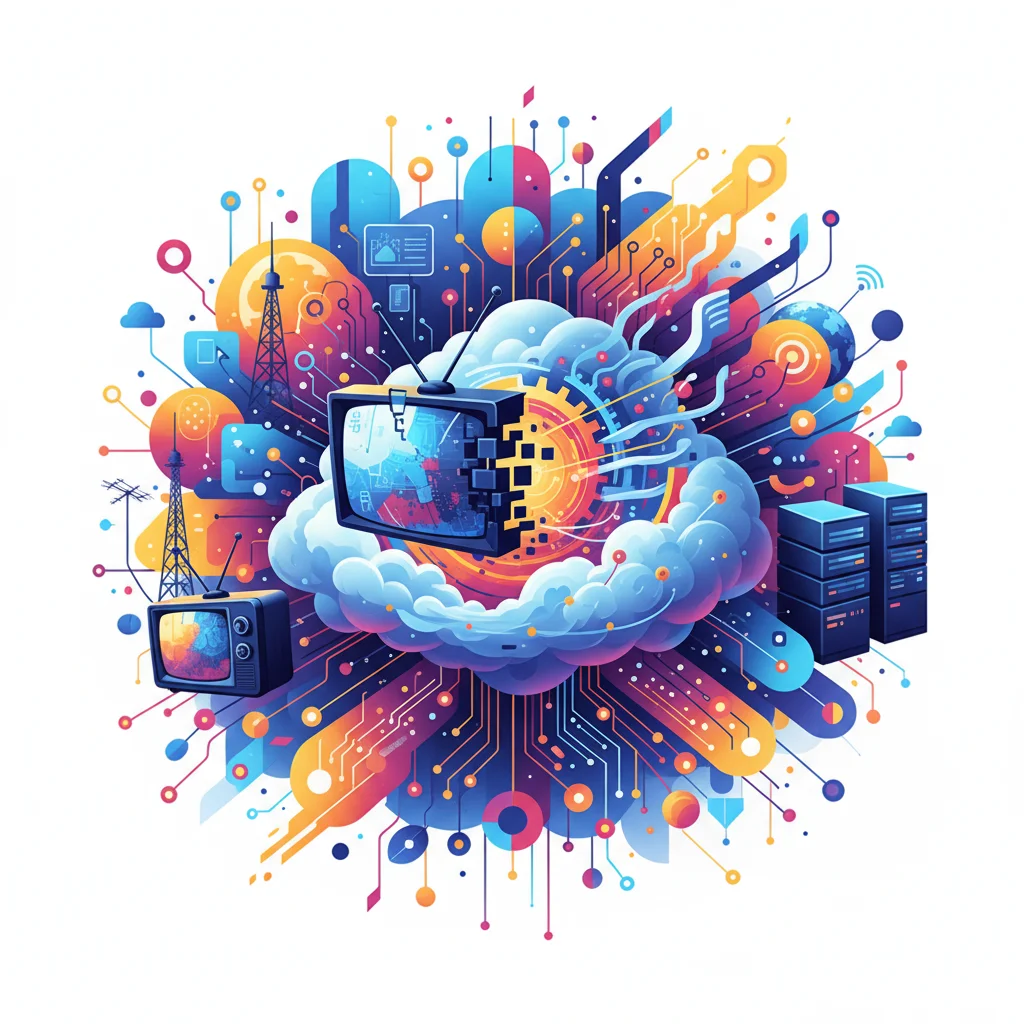
The Final Episode: How AI and Cloud Tech Are Writing the End of Broadcast TV
Remember gathering around the TV for the big Christmas special? For decades, that shared experience was a cultural cornerstone, a time when a whole nation watched the same story unfold at the same time. It was a ritual powered by a handful of broadcast channels that dictated not just what we watched, but when we watched it. Today, that ritual feels like a relic from a bygone era. The once-mighty broadcast schedule is being replaced by the infinite, on-demand scroll of streaming platforms.
The decline of traditional television isn’t just a shift in viewing habits; it’s a textbook case of digital disruption, a story of how legacy systems are being systematically dismantled by superior technology. While the original story might seem to be about media, the real protagonists are software, cloud computing, and artificial intelligence. For developers, entrepreneurs, and tech leaders, the slow fade of broadcast TV offers a masterclass in how technology can fundamentally reshape a multi-billion dollar industry. Let’s deconstruct the code behind this transformation.
The Fading Signal: A Story Told in Data
The change isn’t gradual; it’s a seismic shift, particularly among younger demographics who have grown up as digital natives. The concept of waiting for a specific time to watch a show is as foreign to them as a dial-up modem. The numbers paint a stark picture of this generational divide.
According to a detailed analysis by the Financial Times, the average broadcast TV viewing for people aged 16 to 24 has plummeted to just 53 minutes a day. This is a staggering drop from nearly three hours a day just a decade ago. In contrast, older viewers remain more loyal to the traditional format, but even their habits are slowly changing. This isn’t just a trend; it’s a fundamental rewiring of media consumption.
To put this in perspective, here’s a look at how viewing habits have diverged, creating two distinct media worlds co-existing in the same households.
| Metric | Younger Audience (16-24) | Older Audience (65+) |
|---|---|---|
| Avg. Daily Broadcast TV Viewing | Under 1 hour (source) | Nearly 6 hours |
| Primary Content Source | On-demand streaming (Netflix, YouTube, TikTok) | Scheduled broadcast channels (BBC, ITV) |
| Content Discovery Model | Algorithmic (AI-driven recommendations) | Curated (Channel schedules, TV guides) |
| Business Model Alignment | Subscription (SaaS) / Creator-led | License Fee / Advertising |
This data highlights a critical disconnect. Broadcasters are producing content for an audience that is increasingly tuning out, while a new generation of media giants, built on entirely different technological foundations, captures their attention and loyalty.
The Tech Stack That Toppled an Empire
The success of Netflix, Disney+, and their peers isn’t magic. It’s the result of a superior technology stack that delivers a fundamentally better user experience. Traditional broadcasters, with their massive terrestrial transmitters and rigid schedules, are like legacy mainframes competing against the agile, scalable power of the cloud.
From Prime Time to Your Time: The SaaS Revolution in Media
At its core, streaming is a Software-as-a-Service (SaaS) model applied to entertainment. Instead of a one-time purchase (like a DVD) or a rigid, ad-supported service (broadcast), users pay a recurring fee for access to a constantly updated library of content. This model offers several profound advantages:
- On-Demand Access: The most obvious benefit. Users are no longer beholden to a schedule. This freedom is the primary driver of the behavioral shift.
- Predictable Revenue: Subscription models provide stable, recurring revenue, allowing for massive investments in original content—a virtuous cycle that legacy broadcasters struggle to match.
- Direct Customer Relationship: Netflix knows what you watch, when you pause, and what you skip. This direct data line is something traditional broadcasters, who have an anonymous relationship with viewers, could only dream of.
This shift to a SaaS model has transformed viewers from a passive audience into active users, creating a more engaging and sticky product experience. Hacking the BBC: Why the Future of Broadcasting is a Software Problem
The AI Director: Personalization and Automation at Scale
If the SaaS model is the engine, then artificial intelligence is the fuel. The single biggest technological advantage streaming services have is their use of machine learning for personalization. The homepage of your Netflix account is completely different from anyone else’s, a feat of engineering that traditional TV cannot replicate.
This goes far beyond simple recommendations. AI and data analysis influence every stage of the content lifecycle:
- Content Acquisition: Netflix famously greenlit House of Cards based on data showing that users who liked the original British version also liked movies starring Kevin Spacey and directed by David Fincher. This is data-driven innovation in action.
- Personalized Curation: Sophisticated algorithms analyze thousands of data points to predict what you’ll want to watch next, maximizing engagement and reducing churn. This is a form of intelligent automation that keeps users hooked.
- Dynamic Artwork: The platform even uses AI to test and select the most effective thumbnail artwork for a show based on your viewing history. If you watch a lot of rom-coms, you might see a promotional image of the romantic leads; if you prefer thrillers, you might see a more action-oriented image for the exact same show.
This level of personalization creates a powerful feedback loop. The more you watch, the better the recommendations become, making the service more valuable and harder to leave. It’s a stark contrast to the one-size-fits-all approach of a broadcast channel. AI's Next Frontier Isn't Language, It's Space: Why Fei-Fei Li is Building Virtual Worlds
Broadcasting from the Cloud
Underpinning this entire revolution is the cloud. Traditional broadcasting is hardware-intensive, geographically limited, and expensive to scale. Streaming services are built on global, elastic cloud infrastructure (like AWS), which provides:
- Global Reach: A show can be launched simultaneously in over 190 countries with the push of a button.
- Infinite Scalability: When a blockbuster like Stranger Things drops, the infrastructure can instantly scale to handle tens of millions of concurrent streams without crashing.
- Cost-Efficiency: By using a pay-as-you-go model for computing and storage, these services avoid the massive capital expenditure of building and maintaining a physical broadcast network.
The very architecture of modern media is now based on flexible, scalable software, not rigid, expensive hardware.
The Incumbents’ Dilemma: Innovate or Fade to Black?
Legacy broadcasters like the BBC and ITV are not standing still. They have launched their own streaming services, BBC iPlayer and ITVX, which have gained considerable traction. However, they face a classic innovator’s dilemma. Their core business model and organizational structure were built for a different era, creating significant hurdles.
They must simultaneously maintain their profitable (but declining) legacy broadcast operations while trying to compete with tech-native startups that have no such baggage. Furthermore, the public service remit of an organization like the BBC, which aims to serve everyone, is philosophically at odds with the hyper-personalized, niche-driven world of algorithmic media. The security challenges also multiply; protecting a vast digital library and millions of user accounts from cyber threats requires a level of cybersecurity expertise that is more common in tech companies than in traditional media houses. As one expert noted, “The BBC has to cater for an eight-year-old in Glasgow and an 80-year-old in Glasgow,” a task that is becoming increasingly difficult in a fragmented media landscape (source).
Their challenge is not just about building an app; it’s about a complete cultural and technological transformation, from content creation and programming to distribution and monetization. Waymo's 0 Billion Gambit: Is the Robotaxi Revolution Finally Hitting the Streets?
Conclusion: The Future of the Screen is Written in Code
The slow death of Britain’s TV channels is more than a nostalgic headline. It is a real-time demonstration of how superior technology—powered by AI, delivered via the cloud, and packaged in a SaaS model—can methodically dismantle a century-old industry. The principles at play are universal and serve as a blueprint for disruption in any field.
The future of the screen will be more personalized, more interactive, and more data-driven than ever before. For the entrepreneurs, developers, and innovators building this future, the lesson is clear: don’t just build a better product, build a better system. The companies that win won’t be the ones that just create the best content, but the ones that master the underlying technology of discovery, personalization, and delivery. The final credits may be rolling for broadcast television as we knew it, but for tech-driven media, the show is just getting started.

Related Posts
The Ellison Playbook: Can a Brutal 20-Year-Old Software Takeover Strategy Conquer Hollywood?
Hacking the BBC: Why the Future of Broadcasting is a Software Problem