The Social Capital Dividend: What a Yorkshire Town Can Teach Wall Street About Real Investment
The Unseen Asset on the Balance Sheet
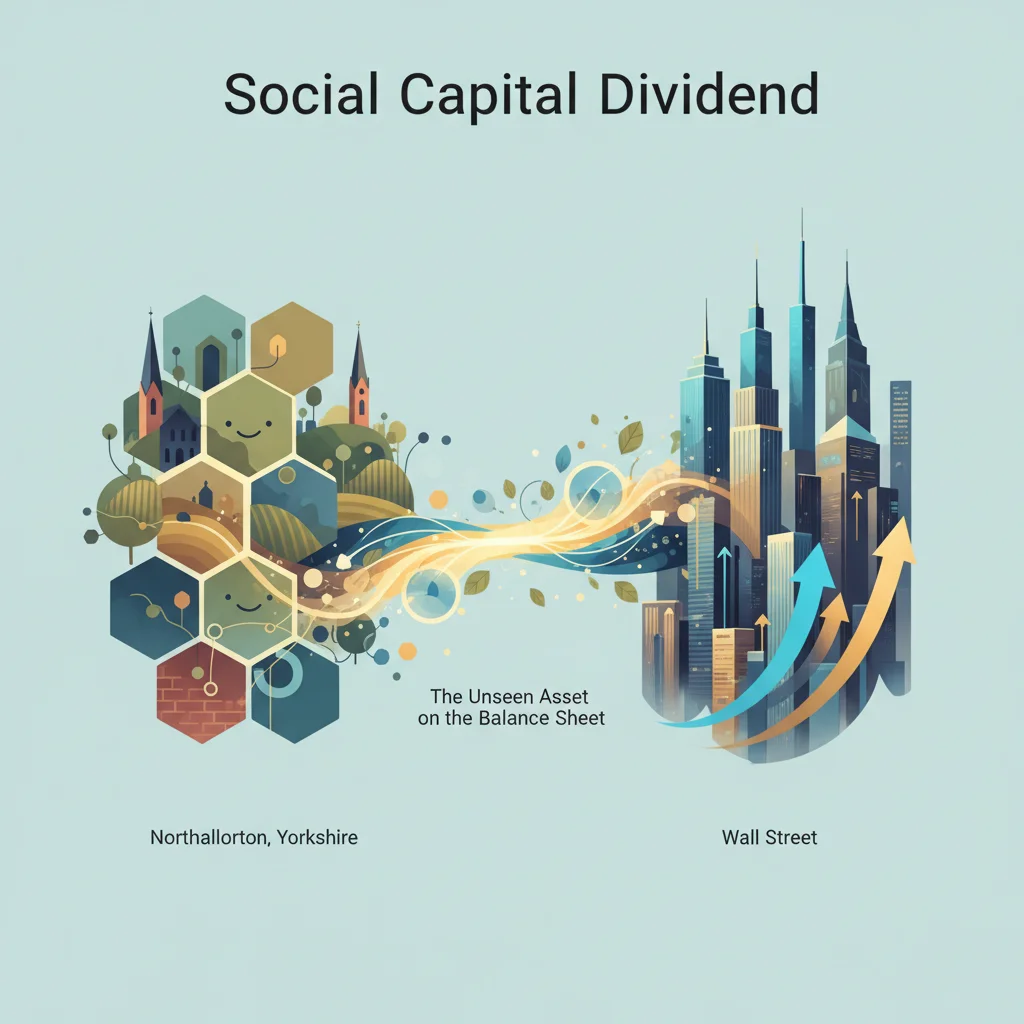
In the market town of Northallerton, Yorkshire, an economic story is unfolding that won’t appear in any quarterly earnings report. Churches and community groups are mobilizing to provide food, clothing, and companionship to asylum-seeking families. As detailed in a recent Financial Times article, this is a community rallying to create ‘a place of welcome’. On the surface, this is a heartwarming tale of local charity. But for those in finance, business, and investment, it’s something more: a powerful, real-world case study in the creation and deployment of one of the most undervalued assets in our modern economy: social capital.
While analysts obsess over P/E ratios, algorithmic trading patterns, and the next disruptive financial technology, the quiet, persistent work of building community trust and social cohesion often gets overlooked. Yet, the very stability and predictability that our markets crave are built upon this foundation. The actions in Northallerton are not just donations; they are micro-investments in a stable, integrated, and resilient local society. This raises a critical question for today’s leaders: What is the ROI on community, and how can we, as stewards of capital, start pricing it into our models of the global economy?
From Community Welcome to Economic Principle: Deconstructing Social Capital
Social capital refers to the networks of relationships, shared norms, values, and understandings that facilitate co-operation within or among groups. In Northallerton, this isn’t an abstract theory. It’s the tangible network of volunteers, the donated goods, and the shared sense of purpose that allows the community to efficiently support its newest members (source). From an economic perspective, this activity generates significant, albeit unmonetized, value:
- Reduced Transaction Costs: High-trust environments, whether in a town or a nation, reduce the need for complex contracts, extensive oversight, and legal enforcement. Business gets done faster and more efficiently.
- Enhanced Human Capital: By providing stability and support, the community is helping individuals transition from a state of crisis to one where they can eventually learn, work, and contribute to the local economy. This is a long-term investment in the workforce.
- Increased Resilience: A socially connected community is better equipped to handle shocks, whether it’s a local factory closure, a natural disaster, or a global recession. The support network acts as a natural insurance mechanism, preventing deeper economic scarring.
When we scale this principle up from a single town to the national or international level, the implications for the stock market and global investing become profound. Nations with high levels of social capital consistently demonstrate greater economic stability, less political volatility, and more sustainable growth—all factors that are critical for long-term investment returns.
The Great Economic Rewind: Decoding the Trump Campaign's High-Stakes Bet on Nostalgia
To illustrate the macroeconomic impact, consider the contrast between high-trust and low-trust societies. This data highlights how the “soft” metric of social trust correlates with “hard” economic outcomes.
| Metric | High Social Capital / High Trust Economies | Low Social Capital / Low Trust Economies |
|---|---|---|
| Economic Growth | More stable, sustainable, and inclusive growth. | Prone to volatility, inequality, and boom-bust cycles. |
| Cost of Business | Lower transaction costs due to trust and informal agreements. | Higher costs from regulation, security, and contract enforcement. |
| Innovation | Flourishes due to open collaboration and knowledge sharing. | Stifled by information hoarding and lack of co-operation. |
| Financial System | Robust banking and credit markets built on trust. | Fragile systems with higher risk premiums and credit rationing. |
ESG 2.0: Investing in the Social Dividend
The story of Northallerton is the “Social” component of ESG investing brought to life. It demonstrates that positive social impact is not just a philanthropic sidebar but a core driver of sustainable value. For the modern investor, this understanding is transitioning from a niche ethical consideration to a central pillar of sophisticated risk management and opportunity analysis.
How can financial professionals actively invest in social capital?
- Stakeholder-Centric Corporate Analysis: Move beyond analyzing a company’s relationship with only its shareholders. Scrutinize how a company treats its employees, suppliers, customers, and the communities it operates in. A company that is a “place of welcome” for its employees, like the town of Northallerton is for refugees (source), is investing in loyalty, productivity, and innovation—assets that invariably show up on the bottom line.
- The Rise of Impact Investing: Capital is being deployed not just to avoid harm, but to actively generate positive social outcomes alongside financial returns. This goes beyond simple exclusion screens to funding businesses that are solving societal challenges in housing, education, and healthcare.
- Leveraging Fintech for Transparency: The opacity of social impact has long been a barrier to investment. Now, new platforms in fintech are changing the game. Blockchain technology, for example, offers the potential for immutable, transparent tracking of supply chains and charitable donations, ensuring that capital allocated for social good reaches its intended destination and has a measurable effect. This builds the trust that is foundational to all economic activity.
The Erasmus+ Reroute: Why the UK's Potential Return is a Major Signal for the Economy and Investors
The High Cost of a Social Deficit
Conversely, ignoring social capital creates tangible, and often severe, economic risk. When a company or an economy operates in a way that erodes social trust, the consequences are predictable and costly. We see this in the form of:
- Increased Regulatory Risk: Companies that neglect their social responsibilities often face public backlash, leading to stricter government regulations, fines, and operational constraints.
- Brand and Reputational Damage: In a hyper-connected world, a reputation for poor social performance can destroy brand value overnight, impacting sales and customer loyalty.
- Stranded Assets and Social License to Operate: Projects that fail to gain community support can face delays, protests, and ultimately, cancellation. This “social license” is as critical as any government permit for long-term capital projects.
- Systemic Economic Instability: At a macro level, widespread social decay and inequality lead to political polarization and instability, creating a volatile and unpredictable environment for the entire stock market and broader economy.
The simple act of providing food and clothing in a Yorkshire town serves as a potent reminder of this principle. By investing in social cohesion, the community is proactively mitigating the risks of social friction and building a more stable foundation for its future. It is a form of grassroots risk management that national economies and multinational corporations would do well to emulate.
The 8 Billion Rejection: Why Warner Bros. Is Slamming the Door on Paramount's Mega-Merger
The Ultimate Long-Term Holding: Investing in Humanity
The lesson from Northallerton is both simple and profound. The bonds of community, the networks of trust, and the spirit of mutual support are not just sentimental ideals; they are the bedrock of a functioning and prosperous economy. For too long, our financial models have been sophisticated enough to price complex derivatives but too primitive to value human dignity and connection.
As we navigate an increasingly complex and interconnected world, the principles of economics and finance must evolve. We must learn to see the value not just in transactions, but in relationships. The most astute investors and business leaders of the future will be those who understand that building a strong community and a strong portfolio are not mutually exclusive goals. In fact, they are two sides of the same coin. The welcome being offered in a small English town is a powerful reminder that the most valuable investment we can ever make is in each other.

Related Posts
From Food Parcels to Financial Portfolios: The Investment Case for the Social Economy
The ROI of a Fish and Chip Supper: Deconstructing the Economics of Corporate Goodwill