The Hidden Mould in Your Portfolio: What a Family’s Ruined Christmas Reveals About Systemic Economic Risk
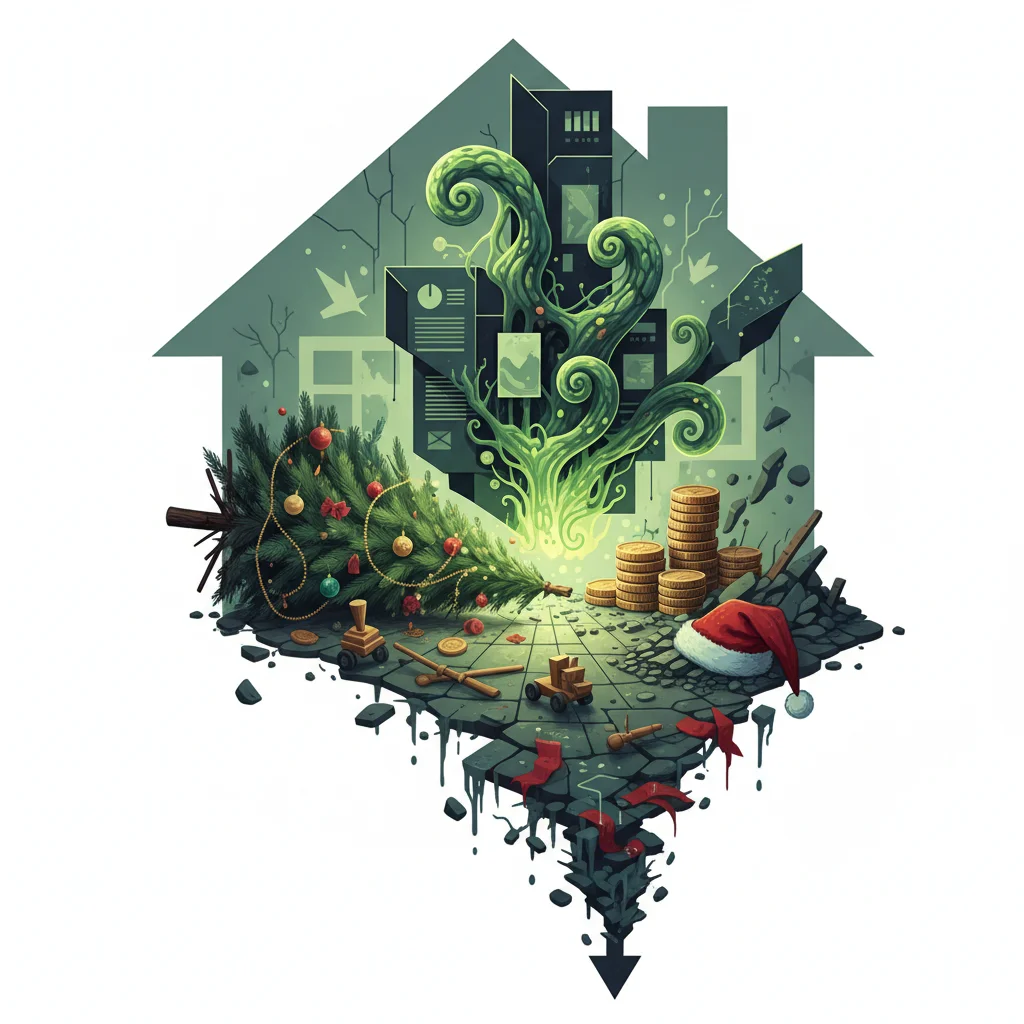
For most, the Christmas season is a time of warmth, family, and homecoming. For the Wadley family, it has become a stark reminder of a crisis festering within their walls. Their 19-year-old son, who suffers from asthma, cannot return home for the holidays. The reason? A pervasive, toxic mould outbreak that has rendered their house uninhabitable for him. The cause, as reported by the BBC, was improperly installed cavity wall insulation, part of a government-backed green energy initiative designed to improve homes and save the planet.
This heartbreaking story is more than just a personal tragedy. It’s a potent metaphor for a type of risk that investors, finance professionals, and business leaders often overlook: the “hidden mould” of poor execution. It represents the dangerous gap between a well-intentioned policy or investment thesis—like ESG (Environmental, Social, and Governance) investing—and the on-the-ground reality. While the stock market may reward the announcement of a green initiative, the real value, and the real risk, lies in its implementation. This single family’s plight serves as a microcosm of a much larger systemic issue, revealing deep-seated vulnerabilities in our economy, investment strategies, and the very infrastructure of modern banking and finance.
The Economics of Good Intentions Gone Wrong
At first glance, government schemes subsidizing home insulation seem like a clear win-win. They aim to reduce carbon emissions, lower energy bills for households, and create jobs for installers. From a macroeconomic perspective, such initiatives are designed to stimulate specific sectors of the economy and contribute to national climate goals. The financial logic is straightforward: public investment is used to leverage private sector action, creating a positive economic ripple effect.
However, the Wadley case exposes the critical flaw in this model: a failure of oversight and quality control. When large sums of public or private capital are deployed rapidly, the primary incentive for contractors can shift from quality of work to quantity of installations. According to a report by the Building Research Establishment (BRE), an estimated 800,000 homes in the UK suffer from condensation, damp, and mould, costing the NHS over £1.4 billion annually in treatments (source). Many of these issues are exacerbated by botched “improvements” like the one the Wadleys experienced.
This isn’t just a construction problem; it’s a fundamental economic and financial one. The capital was allocated, the work was paid for, and on paper, a key performance indicator (KPI)—”homes insulated”—was met. Yet, the outcome was a net negative. The asset (the house) was devalued, significant future costs were created (remediation, health), and the initial investment was effectively destroyed. This pattern of value destruction, masked by surface-level metrics, is a recurring theme in both public policy and private investing.
Navigating the Void: Rishi Sunak, the COVID Economy, and the Playbook That Never Was
ESG Investing and the Peril of “Green-Washing”
For the modern investor, the Wadley story should be a cautionary tale about the nuances of ESG investing. The insulation company involved could have easily ticked an “E” box for contributing to environmental goals. An investment fund holding a portfolio of such companies or financing these projects might boast a high ESG score, attracting capital from investors keen to make a positive impact. Yet, the reality is far more complex.
True ESG analysis must go beyond the mission statement and delve into the operational realities. The “G” for Governance is not merely about board composition; it’s about the systems of control and quality assurance that ensure the “E” and “S” are delivered effectively and not just on paper. A company cutting corners on insulation installation to boost profits is a governance failure that creates negative environmental and social outcomes, despite its “green” business model.
Investors are increasingly exposed to this “implementation risk.” A real estate investment trust (REIT) might see its portfolio value erode as thousands of properties require expensive mould remediation. A bank’s mortgage portfolio could face higher default rates as homeowners face financial ruin from similar botched jobs. The stock market may eventually punish the companies responsible, but only after the damage is done. Proactive due diligence is the only effective defense.
To illustrate the difference between superficial and deep-dive analysis, consider the following approach:
| Superficial ESG Metric | Deep-Dive Due Diligence Question |
|---|---|
| Company installs green home solutions. | What are the company’s technician certification and training standards? What is their project failure/remediation rate? |
| Portfolio finances renewable energy projects. | What are the supply chain auditing processes for materials? Are there mechanisms to ensure quality control during construction? |
| Government initiative funds “X” number of retrofits. | What independent third-party verification is required before final payment is released to contractors? |
| Bank provides “green loans” for home improvements. | How does the bank vet and monitor the quality of the contractors its loans are paying for? |
Financial Technology: The Antidote to Decay
How do we prevent these failures of oversight at scale? The answer lies in leveraging financial technology (fintech) and adjacent technologies like blockchain to build systems of trust and transparency. The manual, trust-based models of the past are no longer sufficient for managing the complexities of the modern economy.
Imagine a different scenario for the Wadley family, enabled by technology:
- Blockchain for Supply Chain & Verification: The insulation materials could be tracked on a blockchain from the manufacturer to the home, ensuring they meet quality standards. The installer, a certified professional with credentials logged on the same blockchain, scans the materials upon arrival. Upon completing the job, they upload time-stamped photos, sensor data (e.g., thermal readings), and a digital certificate of completion to the immutable ledger.
- Fintech and Smart Contracts: The government subsidy or bank loan is held in a smart contract. Payment is not released to the installation company in a lump sum. Instead, it’s released in tranches, automatically triggered by verifiable milestones on the blockchain. The final, largest payment is only released after the digital certificate of completion is co-signed by the homeowner and perhaps verified by a remote, AI-driven analysis of the uploaded data. This aligns financial incentives directly with quality execution.
This technology-driven approach transforms the entire ecosystem. For banking and finance, it de-risks lending for green projects. For the stock market, it provides companies with a verifiable, auditable trail of their high-quality work, justifying a premium valuation. For the economy, it ensures that investments produce their intended value, preventing the costly negative externalities of failure. This is the future of financial technology: not just faster trading, but the creation of transparent, accountable systems that underpin the real economy.
The Thrown Parcel: Deconstructing the Financial Risks in Evri's Last-Mile Delivery Model
The Macroeconomic Cost of a Microscopic Spore
The economic impact of mould in homes extends far beyond a single family’s tragedy. It is a significant, if often uncounted, drag on the national economy. The costs are multifaceted and substantial.
- Healthcare Costs: As noted, respiratory illnesses and other health problems stemming from poor housing conditions are a massive burden on public health systems. A study published in the journal Atmosphere highlighted the direct link between indoor mould exposure and the exacerbation of asthma, creating billions in direct and indirect economic costs (source).
- Property Devaluation: A home with a serious mould problem is a depreciated asset. This erodes household wealth and weakens the collateral base that underpins trillions of dollars in mortgage debt held by the banking sector.
- Remediation and Lost Productivity: The cost to fix these problems is enormous, and while it creates some economic activity, it’s an inefficient use of capital—money spent fixing a problem that shouldn’t have existed. Furthermore, sick days and reduced productivity from illness also take their toll on economic output.
When we fail to ensure quality in foundational areas like housing, we are not just failing individuals; we are injecting instability and inefficiency into the entire economic machine. The trading floors and boardrooms may seem a world away from a damp wall in a family home, but the systems are inextricably linked. The value of a mortgage-backed security on a trading screen is ultimately dependent on the structural integrity of the thousands of homes it represents.
Beyond the Balance Sheet: How Your Email Language is Devaluing Your Professional Worth
Conclusion: From a Ruined Christmas to a Resilient Economy
The story of the Wadley family is a powerful reminder that in economics and investing, the devil is always in the details. A well-intentioned policy or a promising ESG investment thesis can crumble into a value-destroying liability without a ruthless focus on execution, quality, and governance.
For business leaders and finance professionals, the key takeaway is to look past the headlines and scrutinize the underlying operations. For investors, it is a call to demand a higher standard of transparency and accountability, moving beyond simplistic ESG scores to a more robust analysis of implementation risk. The future of intelligent investing and sustainable economics will be defined not by the grandeur of our goals, but by the integrity of our execution. By embracing financial technology like blockchain and smart contracts, we can build the transparent, accountable systems needed to ensure that our investments build real, lasting value—turning stories of heartbreak and decay into foundations for a more resilient and prosperous future.

Related Posts

Beyond the Western Lens: Decoding China’s Characteristically Different Economic Blueprint for 2025
Mind the Gap: What London Underground Etiquette Reveals About Today’s Economy