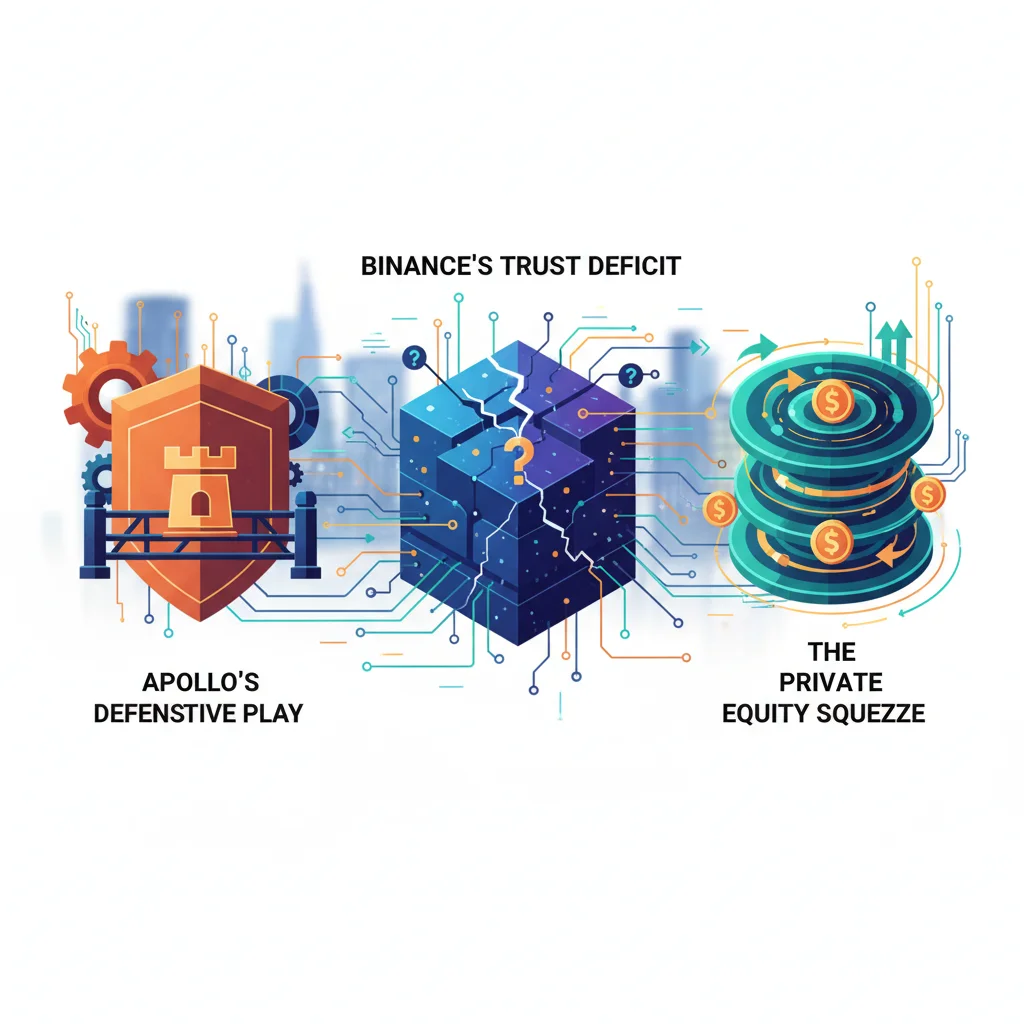
Beyond the Headlines: Binance’s Trust Deficit, Apollo’s Defensive Play, and the Private Equity Squeeze
The New Financial Playbook: Navigating a World of Scrutiny and Strategy
In the fast-paced world of global finance, the headlines often serve as mere signposts to deeper, more complex realities. Today, three such signposts point towards a seismic shift in the financial landscape, affecting everything from the futuristic realm of blockchain to the established corridors of private equity. News that Binance, the world’s largest cryptocurrency exchange, allegedly continued to service suspicious accounts even after a landmark U.S. settlement sends shockwaves through the fintech community. Simultaneously, investment giant Apollo Global Management is reportedly shifting into a “defensive mode,” a strategic pivot that speaks volumes about the current economy. And beneath it all, the once-frenzied world of private equity deals is facing a challenging new reality. These are not isolated events; they are interconnected chapters in a larger story about a new era of accountability, risk management, and strategic discipline in modern investing.
For investors, business leaders, and financial professionals, understanding these undercurrents is no longer optional—it’s essential for survival and success. We will dissect each of these developments, providing the context, analysis, and expert perspective needed to understand not just what is happening, but why it matters for the future of finance, trading, and capital allocation worldwide.
Binance’s Lingering Shadow: Can Crypto Ever Truly Win Trust?
The saga of Binance and its regulatory battles has been a defining narrative for the cryptocurrency industry. After agreeing to a historic $4.3 billion settlement with the U.S. Department of Justice for violating anti-money laundering (AML) and sanctions laws, the exchange was supposed to turn a new leaf. The settlement, which also saw the departure of its founder Changpeng “CZ” Zhao, was meant to be a painful but necessary step towards legitimacy—a signal to the world of traditional banking and finance that crypto was ready to play by the rules.
However, recent reports suggest that the path to redemption is fraught with peril. The allegation that Binance continued to allow transactions for sanctioned or suspicious entities even after this settlement is more than just a minor compliance hiccup; it strikes at the very heart of the industry’s trust deficit. For regulators, it raises questions about the effectiveness of even multi-billion-dollar penalties in reforming an industry built on a decentralized, often anonymous, ethos. For investors, it’s a stark reminder of the persistent operational risks that exist within the digital asset ecosystem. The core of the issue lies in the immense challenge of implementing robust Know Your Customer (KYC) and AML protocols across a platform that processes billions of dollars in trading volume daily, across countless jurisdictions.
This development underscores a fundamental tension within the world of financial technology: the clash between the disruptive, borderless nature of blockchain and the rigid, compliance-driven framework of the global financial system. While the settlement mandated the appointment of an independent compliance monitor, the latest news suggests that turning the ship around is a monumental task. According to the Financial Times, insiders have raised concerns that the exchange’s internal systems are still struggling to effectively police the vast flow of funds on its platform (source). The success or failure of Binance’s cleanup effort will be a bellwether for the entire crypto market’s ability to integrate with mainstream finance.
Beyond the Verdict: What Jimmy Lai's Conviction Means for Hong Kong's Future as a Global Finance Hub
Apollo’s Defensive Stance: A Harbinger for the Broader Stock Market
When a multi-hundred-billion-dollar asset manager like Apollo Global Management signals a shift to “defensive mode,” the entire market should pay attention. This isn’t a sign of panic, but rather a calculated, strategic response to the prevailing macroeconomic environment. The era of near-zero interest rates and boundless liquidity that fueled a decade-long bull run in the stock market is definitively over. In its place is a landscape defined by higher borrowing costs, persistent inflation, and geopolitical uncertainty. In this new paradigm of economics, the definition of a “smart” investment has changed dramatically.
A “defensive” posture for a firm like Apollo means prioritizing capital preservation and predictable cash flows over speculative, high-growth bets. The focus shifts away from venture-style moonshots and towards more resilient asset classes. This includes:
- Private Credit: With traditional banks tightening their lending standards, private credit funds are stepping in to provide financing to companies, often at attractive, floating rates that benefit from a higher-rate environment.
- Infrastructure: Assets like toll roads, airports, and data centers that provide essential services and generate steady, long-term revenue streams regardless of the economic cycle.
- Structured Debt and Asset-Backed Securities: Investing in debt instruments that offer downside protection and a clear position in the capital stack.
This pivot is a macro call on the state of the global economy. Apollo’s strategists are essentially signaling that they anticipate lower growth and higher volatility ahead. For the average investor, this is a powerful lesson in portfolio construction. While a defensive shift doesn’t mean abandoning equities, it does suggest a greater emphasis on quality, profitability, and durable business models. The days of chasing high-flying tech stocks with no profits may be numbered, replaced by a renewed appreciation for companies that can weather an economic storm. A recent analysis suggests that major asset managers are increasing their allocation to private credit by as much as 15-20% (source), a clear indicator of this trend.
To better understand this strategic shift, consider the differences between an offensive and defensive investment approach in today’s market:
| Investment Characteristic | Offensive Strategy (Low-Rate Environment) | Defensive Strategy (High-Rate Environment) |
|---|---|---|
| Primary Goal | Capital Appreciation / High Growth | Capital Preservation / Stable Income |
| Key Asset Classes | Venture Capital, Growth Equity, Speculative Tech Stocks | Private Credit, Infrastructure, High-Quality Bonds, Dividend Stocks |
| Risk Tolerance | High | Low to Moderate |
| Reliance On | Market Multiple Expansion / Cheap Leverage | Predictable Cash Flow / Contractual Returns |
| Economic Outlook | Optimistic / Expansionary | Cautious / Potentially Contractionary |
Private Equity’s New Reality: The End of the Easy Money Era
For over a decade, the private equity (PE) model was a well-oiled machine. Firms would acquire companies using a significant amount of cheap debt—a strategy known as a leveraged buyout (LBO)—hold them for a few years, and then sell them for a handsome profit, often aided by a rising stock market and hungry corporate buyers. That machine is now sputtering, and the primary culprit is the sharp rise in interest rates.
The entire LBO model is predicated on the cost of debt. When borrowing was cheap, PE firms could amplify their returns through leverage. Today, with financing costs having doubled or tripled, the math simply doesn’t work as well. This has created a cascade of challenges across the deal-making landscape:
- The Valuation Gap: Sellers still remember the lofty valuations of 2021, while buyers are pricing assets based on today’s higher borrowing costs and uncertain future. This bid-ask spread has led to a significant slowdown in M&A activity.
- The Financing Hurdle: Securing debt for large buyouts has become more difficult and expensive, forcing firms to either put up more equity (which dilutes returns) or walk away from deals altogether. Reports indicate that global private equity deal volume has fallen by over 40% from its peak (source).
- The Exit Problem: The IPO market remains sluggish, and strategic corporate buyers are more cautious. This makes it harder for PE firms to sell their portfolio companies and return capital to their investors (Limited Partners), creating a liquidity crunch across the ecosystem.
This environment is forcing a fundamental shift in the private equity value proposition. The era of “financial engineering”—where returns were driven largely by leverage and multiple expansion—is giving way to an era of “operational engineering.” To generate strong returns today, PE firms must be true partners to their portfolio companies, actively helping them to improve margins, grow revenue, and become more efficient. The focus is shifting from spreadsheets to operations, a back-to-basics approach that separates the top-tier managers from the rest of the pack. This is a healthier, albeit more challenging, state of affairs for the industry and the broader economy.
China's Economic Engine Is Sputtering: A Red Flag for Global Investors?
Conclusion: A Unified Theme of Discipline and Adaptation
At first glance, the compliance struggles of a crypto exchange, the strategic pivot of an asset manager, and the slowdown in private equity might seem like disparate events. Yet, they are all threads in the same tapestry. They tell the story of a global financial system grappling with the end of an era of easy money and lax oversight. The new landscape demands a higher standard of discipline—be it the regulatory discipline required of Binance, the portfolio discipline being exercised by Apollo, or the operational discipline now essential for private equity success. For every participant in the market, from the individual investor to the largest institution, the message is clear: the playbook has changed, and the ability to adapt will determine the winners and losers of the decade to come.

Related Posts

Beyond the Podium: Decoding the Economic Tremors of a Presidential Address

Beyond the Balance Sheet: Why a Local Florist’s Success is a Major Signal for the Stock Market