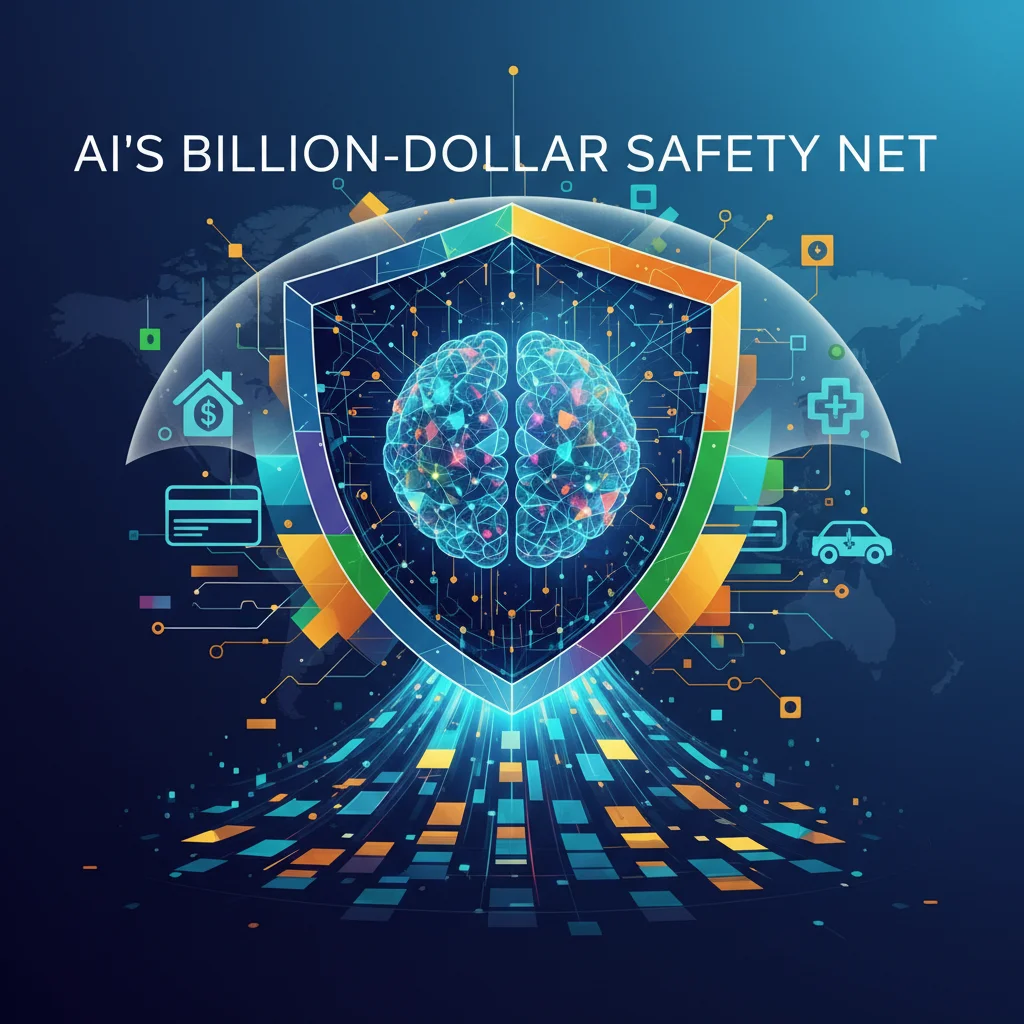
AI’s Billion-Dollar Safety Net: How Insurance is Taming the Risk of Automated Decisions
Picture this: You’re applying for a mortgage, arguably one of the biggest financial decisions of your life. You submit your documents, hold your breath, and wait. But behind the scenes, it’s not a person in a stuffy office poring over your paperwork. It’s an algorithm—a complex piece of artificial intelligence—making the initial call. This is no longer science fiction; it’s the reality of modern finance. And it begs a terrifyingly simple question: What happens if the AI gets it wrong?
For years, this question has been a major roadblock for the adoption of AI in high-stakes industries. A single flaw in a machine learning model could lead to discriminatory lending practices, triggering massive regulatory fines and class-action lawsuits. But a groundbreaking shift is underway. A new financial product is emerging that acts as a safety net for algorithmic errors, and it’s poised to unlock the next wave of automation and innovation. Welcome to the world of AI insurance.
In a move that signals a major maturation of the AI industry, top-tier insurers like Munich Re are now underwriting policies that protect mortgage lenders against the financial fallout of their AI’s mistakes. According to a recent report from the Financial Times, this isn’t just about peace of mind; it’s a strategic financial tool that could fundamentally change how companies manage technological risk.
The AI Revolution in Your Mortgage Application
For decades, the mortgage underwriting process has been notoriously slow, paper-heavy, and prone to human bias. Lenders have been turning to AI and machine learning to overhaul this archaic system. Companies are developing sophisticated software, often delivered as a SaaS (Software as a Service) solution, that can analyze thousands of data points in seconds to assess a borrower’s risk.
The benefits are undeniable:
- Speed: Decisions that once took weeks can now be made in minutes.
- Efficiency: Automation reduces the manual labor and operational costs for lenders.
- Accuracy: AI can identify patterns and correlations that human underwriters might miss.
- Inclusion: Proponents argue that well-designed AI can look beyond traditional credit scores to identify creditworthy individuals in underserved communities, potentially making lending fairer.
But with this immense power comes immense responsibility—and risk. Regulators like the Consumer Financial Protection Bureau (CFPB) are watching like hawks. The primary concern? Algorithmic bias. If an AI model is trained on historical data that reflects past societal biases, it can inadvertently learn to discriminate against applicants based on race, gender, or geography, a direct violation of fair lending laws.
This isn’t a theoretical problem. The fear of a biased algorithm has forced lenders to hold vast sums of “operational risk capital” on their balance sheets. This is money set aside purely to cover potential losses from fines or legal settlements if their tech goes rogue. It’s idle capital that could otherwise be used to issue more loans, stifling growth and innovation.
The Delivery Hero Dilemma: When Hyper-Growth Hits a Reality Wall
The Game-Changer: Insuring the Algorithm
This is where the new insurance products come in. Instead of just insuring against a data breach or a server outage, these policies insure the *outcome* of the AI model itself. One of the pioneers in this space is Zest AI, a software company that provides AI-powered underwriting tools. They worked with insurers to create a policy that specifically covers “fair lending risk.”
Here’s how it works: If a lender using Zest AI’s platform faces a regulatory penalty or a legal settlement because the model was found to be discriminatory, the insurance policy kicks in to cover the financial loss. This is a monumental development. For the first time, the abstract risk of an algorithm’s decision-making process has been quantified and made transferable, just like any other business risk.
The impact is profound. By shifting the risk to an insurer, lenders may no longer need to hold as much operational risk capital. As the Financial Times reports, this insurance has the potential to “cut capital requirements” for lenders, freeing up billions of dollars to flow back into the economy. It’s a classic example of financial engineering enabling technological adoption.
To better understand this shift, let’s compare the old and new methods of managing AI risk:
| Aspect of Risk Management | The Old Way: Capital Reserves | The New Way: AI Insurance |
|---|---|---|
| Risk Mitigation | Passive. Money is set aside to pay for failures after they happen. | Proactive. Insurers require rigorous third-party validation and ongoing monitoring of the AI model to even issue a policy. |
| Capital Efficiency | Very low. Capital is tied up on the balance sheet, unproductive. | Very high. A smaller premium payment unlocks a much larger amount of capital for lending and investment. |
| Regulatory Confidence | Uncertain. Regulators see capital reserves as a last resort, not a sign of a good process. | Higher. An insured model has been vetted by a financially-motivated third party (the insurer), signaling a higher standard of care. |
| Incentive for Startups | Low. High capital requirements create a barrier to entry for smaller, innovative lenders. | High. Startups can adopt powerful AI and de-risk their operations, allowing them to compete with larger institutions. |
I predict this will expand far beyond mortgages. Imagine insurance for AI-driven hiring tools to cover wrongful termination or discrimination lawsuits. Or policies for autonomous vehicle software to cover accidents caused by algorithmic misjudgment. This creates a powerful new incentive for developers to build transparent, fair, and robust AI. If your model is a “black box,” no one will insure it. This will push the entire industry towards more explainable AI (XAI). Furthermore, this opens up a massive opportunity for startups in the “AI validation” space—companies whose entire business is to audit and certify AI models for insurability. This is the moment AI risk management gets professionalized.
What This Means for the Future of Tech and Innovation
The ripple effects of this development will be felt across the tech landscape, from individual developers to the largest cloud providers.
For Developers and Programmers
The code you write has direct financial consequences like never before. The demand for robust model validation, bias detection toolkits, and meticulous documentation will skyrocket. Skills in explainable AI and ethical programming are no longer just “nice-to-haves”; they are becoming core requirements for building insurable, commercially viable AI products. The era of “move fast and break things” is over for high-stakes AI; the new mantra is “move carefully and get insured.”
The AI Gold Rush or a Ticking Debt Bomb? Why Wall Street is Hedging its Bets on Tech
For Startups and Entrepreneurs
This is a massive unlock. Previously, a fintech startup with a brilliant underwriting model would struggle to compete with a large bank, partly because the bank had the massive balance sheet to absorb the regulatory risk. Now, that startup can approach a bank or credit union and say, “Our SaaS platform is not only more accurate, but its performance is backed by an insurance policy from a global leader like Munich Re.” It’s a powerful way to level the playing field and accelerate innovation. Adam Ely, chief information security officer at Fidelity National Financial, noted that this type of insurance helps “get a new product to market faster” (source).
For the Cybersecurity and Cloud Industry
The integrity of the AI model is now an insurable asset. This elevates the importance of cybersecurity. A malicious actor who could subtly tamper with a model’s training data or inference logic could trigger catastrophic financial losses, which would now fall under an insurance claim. We can expect insurers to mandate stringent cybersecurity controls, continuous monitoring, and secure cloud environments as a prerequisite for coverage. This intertwines the fields of AI safety and cybersecurity in a very tangible, financial way.
The Road Ahead: Uncharted Territory
Of course, this new frontier is not without its challenges. Pricing risk for a complex, constantly evolving AI model is incredibly difficult. How does an insurer account for model drift, where performance degrades over time? What happens in the event of a systemic failure that affects thousands of lenders using the same underlying software? The “actuarial science” for artificial intelligence is still in its infancy.
Furthermore, this raises complex questions of liability. If an insured AI makes a bad decision, who is ultimately at fault? The lender who deployed it? The developer who built it? The company that supplied the training data? The insurer who underwrote it? The legal and regulatory frameworks will need to evolve rapidly to keep pace with the technology.
Despite these hurdles, the direction of travel is clear. The introduction of insurance is a critical step in transforming AI from a promising but risky technology into a trusted, foundational component of our economic infrastructure. It’s a financial wrapper that provides the confidence needed for widespread adoption, much like deposit insurance did for the banking system a century ago.
By creating a financial backstop for when algorithms fail, we are not just protecting businesses; we are building the scaffolding necessary for a future where automated decisions can be made safely, responsibly, and at scale. This isn’t just a story about mortgages—it’s about how we learn to live with, and trust, our intelligent machines.