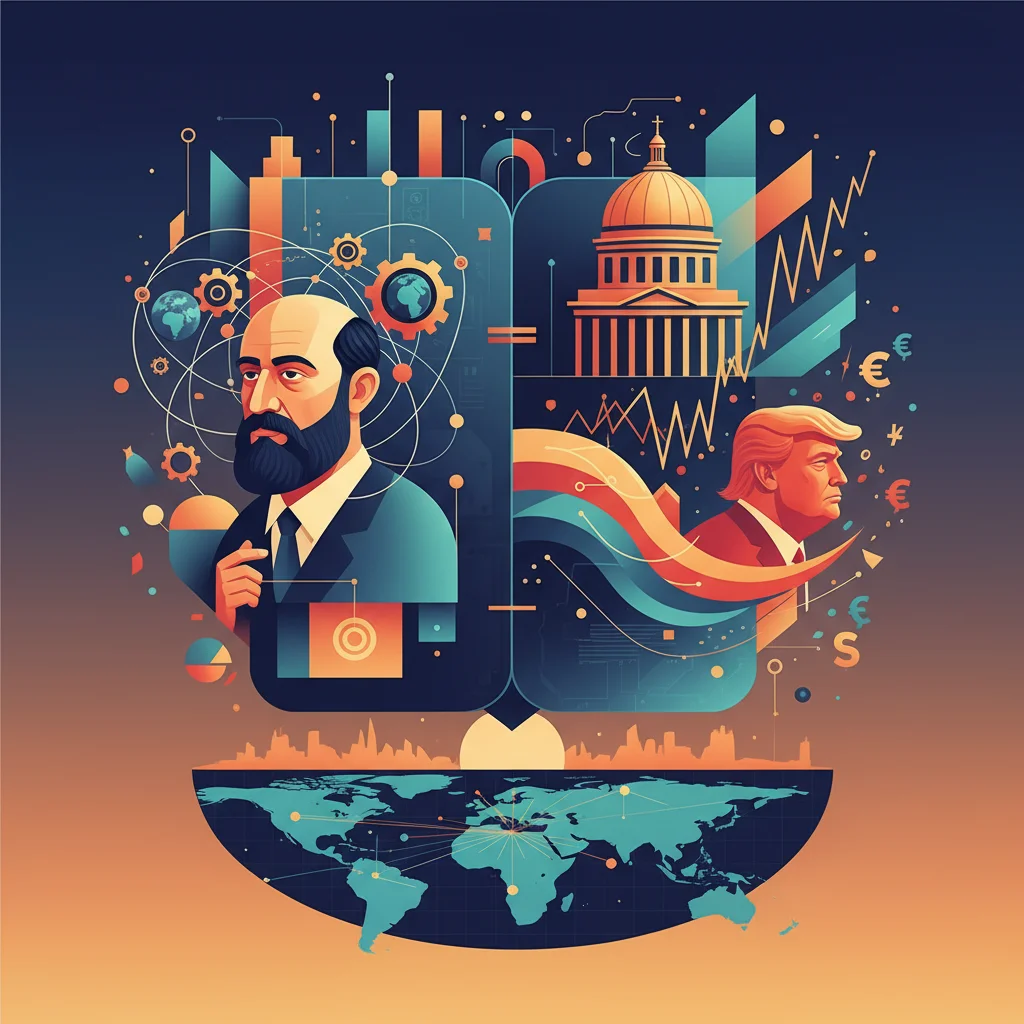
The Gramscian Playbook: How a Marxist Thinker Explains Trump’s Impact on the Global Economy
In the world of finance and high-stakes investing, we often look to economic indicators, quarterly earnings, and central bank policies to predict market movements. But what if one of the most potent analytical tools for understanding today’s volatile landscape comes not from an economist, but from a 20th-century Italian Marxist philosopher? A recent letter to the Financial Times by Andrea Goldstein draws a fascinating, and for many, an unsettling parallel between the political strategies of Donald Trump and the theories of Antonio Gramsci. This connection, while seemingly academic, offers a powerful framework for investors, business leaders, and anyone trying to navigate the seismic shifts in the global economy.
At first glance, the pairing is paradoxical. Gramsci, a founder of the Italian Communist Party who wrote his most influential works from a fascist prison cell, and Trump, a real estate mogul and embodiment of capitalism, could not appear more different. Yet, the parallel lies in a shared, albeit likely unintentional, understanding of how power is won and maintained. It’s a strategy that goes beyond elections and legislation, targeting the very “common sense” that underpins a society’s economic and political systems. Understanding this playbook is no longer optional; it’s essential for comprehending modern political risk and its profound impact on the stock market, banking, and international trade.
Who Was Antonio Gramsci and What Is ‘Cultural Hegemony’?
To grasp the significance of this comparison, we must first understand Gramsci’s central concept: cultural hegemony. Writing in the 1920s and 30s, Gramsci wrestled with a critical question: why had the predicted Marxist revolutions in Western Europe failed to materialize? He concluded that the ruling class, the bourgeoisie, maintained control not primarily through force (the police, the military) but through a more subtle, pervasive form of power. They achieved this by shaping society’s culture, values, and beliefs until their worldview became the accepted, natural “common sense.”
This cultural hegemony, as he termed it, is disseminated through society’s institutions: schools, media, the church, and the family. These institutions create a consensus where the dominance of one group feels not like oppression, but like the normal, inevitable order of things. For decades, the post-World War II era was defined by a specific cultural hegemony: a belief in liberal democracy, free trade, global cooperation, and market-based economics. This “common sense” was the bedrock upon which the modern global financial system was built. According to the Stanford Encyclopedia of Philosophy, Gramsci saw this “spontaneous’ consent given by the great masses” as the primary pillar of the ruling class’s power.
A “war of position,” in Gramsci’s view, was a long-term struggle to dismantle this consensus and replace it with a new one—a battle for the hearts and minds of the populace to establish a new “common sense.” This is precisely the lens through which we can analyze the political phenomenon of Trumpism.
Cracking the Code: How to Solve the Global Economy's Most Complex Crossword Puzzle
Trump’s ‘War of Position’ on the Global Economic Order
As Andrea Goldstein’s letter in the Financial Times suggests, Donald Trump’s political strategy can be seen as a sustained “war of position” against the established liberal hegemony. His approach isn’t just about winning elections; it’s about fundamentally challenging and delegitimizing the institutions and norms that uphold the existing order.
Consider the targets of his most consistent attacks:
- The Media (“Fake News”): By attacking established news organizations, he seeks to erode the credibility of the primary vehicles that transmit the established “common sense.”
- The Judiciary and Intelligence Agencies: Questioning the impartiality of courts and federal agencies undermines the state’s role as a neutral arbiter, a cornerstone of liberal democracy.
- International Alliances (NATO) and Trade Agreements (NAFTA, TPP): These attacks challenge the post-war consensus that global cooperation and free trade are inherently beneficial for the United States.
- Scientific Consensus (Climate Change): By questioning established science, he challenges the very idea of objective expertise, a key pillar of the technocratic governance model.
Through rallies, social media, and a relentless communications strategy, he has worked to construct a counter-hegemony—a new “common sense” for his supporters built on nationalism, protectionism, and a deep skepticism of global institutions. This isn’t just political rhetoric; it’s a direct assault on the foundational assumptions that have guided Western economics and foreign policy for over 70 years. The result is a level of political and policy uncertainty that has become a defining feature of the modern investment landscape. A 2021 study published in the Journal of Economics Letters found that Trump’s tweets alone were a significant driver of stock market volatility, demonstrating the direct link between this political strategy and financial market behavior.
From Theory to Portfolio: The Tangible Impact on Finance and Investing
Understanding this “war of position” is critical for financial professionals because it directly translates into market risk and opportunity. When the fundamental “rules of the game” are up for debate, the entire economic playing field becomes unstable.
1. Heightened Policy and Regulatory Uncertainty
The most immediate consequence is a dramatic increase in policy uncertainty. When a political movement is dedicated to dismantling the old order, investors can no longer rely on the continuity of regulations, trade agreements, or tax policies. This uncertainty makes long-term capital allocation decisions incredibly difficult. Will a trade war with China escalate or de-escalate? Will environmental regulations be rolled back or strengthened? This unpredictability forces companies to delay investments and investors to demand higher returns to compensate for the added risk, impacting everything from corporate bond yields to stock market valuations.
2. The Future of Financial Technology (Fintech) and Banking
The battle of hegemonic ideas extends deep into the world of financial technology. The established order favors a globalized, interconnected banking system, often with complex international regulations. A nationalist, populist counter-hegemony might favor a more fragmented, domestically-focused financial system. This could lead to a regulatory environment that favors incumbent national banks over disruptive, global fintech platforms. Conversely, a deep distrust of established institutions could fuel interest in decentralized technologies like blockchain, which offer an alternative to the traditional financial system. The regulatory winds for crypto and other fintech innovations could shift dramatically depending on which “common sense” prevails.
The Chip War's New Frontline: Is Nvidia's H200 a Loophole for China's AI Ambitions?
3. Sectoral Winners and Losers
A shift in the dominant economic narrative creates clear winners and losers across different sectors. The table below illustrates the potential shift in focus and its implications.
This table outlines the contrast between the established post-war economic consensus and the emerging populist-nationalist alternative, highlighting the potential impacts on key economic and financial sectors.
| Domain | Established Hegemony (Post-WWII Consensus) | Emerging Counter-Hegemony (Populist Nationalism) |
|---|---|---|
| Trade Policy | Multilateral agreements, globalization, and open markets (e.g., WTO, EU). Favors multinational corporations and complex supply chains. | Bilateral deals, protectionism, and tariffs (e.g., “America First”). Favors domestic manufacturing and onshore production. |
| Financial Regulation | Global coordination (e.g., Basel III), focus on systemic risk. Generally favors large, international banks. | Nationalist approach, potential for deregulation to favor domestic players. Can create uncertainty for global banking. |
| Energy & Environment | Emphasis on renewable energy, international climate agreements (e.g., Paris Accord), and ESG investing principles. | Emphasis on fossil fuels, energy independence, and skepticism of climate science. Potential rollback of environmental regulations. |
| Technology & Innovation | Open internet, global tech giants, and international data flows. Supports global fintech and tech platforms. | “Splinternet” concerns, data localization, and national security focus on tech. Potential challenges for Big Tech. |
Navigating the New Reality: A Guide for Leaders and Investors
So, how can one operate in an environment where the very foundations are shifting? The old playbooks may not be sufficient. A new approach to strategy and risk management is required.
First, political risk analysis must be elevated from a peripheral concern to a core competency. This means moving beyond tracking election polls and understanding the deeper cultural currents and narrative battles that shape policy outcomes. It requires a qualitative, Gramscian-style analysis of whose “common sense” is gaining ground.
Second, scenario planning becomes paramount. Businesses and investment funds must model radically different futures. What does your portfolio or business look like in a world of escalating trade wars and deglobalization versus one where the old order reasserts itself? Stress-testing strategies against these divergent outcomes is no longer a theoretical exercise but a practical necessity for survival and growth.
Finally, strategic agility is key. In a stable hegemonic order, long-term, rigid plans can succeed. In a “war of position,” the ability to pivot quickly in response to sudden shifts in policy or public sentiment is a significant competitive advantage. This applies to supply chains, trading strategies, and corporate public affairs.
The Anarchist in the Boardroom: Why Radical Thinkers Are Finance's Unsung Heroes
Conclusion: The Unseen Force Driving the Markets
The parallel between Antonio Gramsci and Donald Trump, as highlighted in the FT, is more than a historical curiosity. It is a powerful analytical key that unlocks a deeper understanding of the forces reshaping our world. The battle we see playing out is not just about policies; it’s a fundamental struggle over the ideas and values that will define the 21st-century global economy.
For those in finance, investing, and business, ignoring this cultural and political dimension is a luxury we can no longer afford. The stability of the stock market, the future of financial technology, and the very nature of global trade depend on the outcome of this “war of position.” By understanding the Gramscian playbook, we can better anticipate the shifts, manage the risks, and identify the opportunities in an era of profound and unpredictable change.

Related Posts
A Canary in the Coal Mine? Why Australia’s $200 Billion Pension Fund is Selling AI Stocks
The New Geopolitical Playbook: Decoding Trump’s Foreign Policy and Its Impact on Your Portfolio